Learning About Waldorf Education: Complete Guide for Parents

Waldorf schools have become a paradox for our time. In an age when Silicon Valley entrepreneurs build ever more immersive screens, many of those same tech executives choose the screen-free, nature-rich world of Waldorf education for their children.

These parents are drawn by the promise of a learning environment that values imagination, artistic expression, and emotional intelligence just as highly as academics. If you’re a parent in Boca Raton or the surrounding South Florida communities, you might be curious about this holistic approach. 

Waldorf School of Palm Beach serves children from Pre‑K through Grade 10 across two campuses: the Early Childhood–Grade 4 campus at 2450 NW 5th Avenue, Boca Raton, FL 33431, and the Grade 5–Grade 11 campus at 414 NW 35th Street, Boca Raton, FL 33431. As you explore whether a Waldorf education is the right fit for your family, this guide demystifies the philosophy, curriculum, benefits, and local offerings.

What Is Waldorf Education?

Waldorf education began in 1919 when philosopher Rudolf Steiner founded the first Waldorf school in Stuttgart, Germany. Today, the movement has a global reach with 1,092 Waldorf schools in 64 countries and 1,857 kindergartens in more than 70 countries. Europe alone counts 802 schools serving 190,000 pupils. 

A key reason for this growth is Waldorf’s whole‑child philosophy. Rather than focusing solely on early academics or standardized test scores, Waldorf schools nurture intellectual, artistic, and practical capacities through the principle of head, heart, and hands.

waldorf curriculum​

Core Principles Of Waldorf Education

Waldorf education is guided by several foundational principles:

  • Developmentally appropriate timing: Formal reading and math wait until first grade, while early childhood prioritizes play, storytelling, song, and rhythm. Steiner believed that imitative learning and imaginative play are the best ways for children under seven to learn.

  • Learning through the arts: Visual arts, music, movement (eurythmy), and handwork (knitting, woodworking) are integrated into every subject. Research shows that artistic experiences engage multiple areas of the brain and strengthen cognitive development.

  • Teacher continuity: Class teachers often stay with the same group of students for several years, fostering deep relationships and a sense of security.

  • Outdoor and nature‑based learning: Time outdoors in gardens and woods builds physical coordination, fosters respect for the environment, and grounds science lessons in lived experience.

  • Rhythms and rituals: Daily, weekly, and seasonal rhythms (such as morning verses, festival celebrations, and regular nature walks) provide children with predictability and connection to the natural world.

These elements combine to cultivate curiosity, creativity, and a love of learning that lasts well beyond childhood.

Three Developmental Stages

Waldorf educators view childhood as progressing through three seven‑year phases, each with its own educational needs.

Early childhood (Birth–Age 7)

During the first seven years, children learn primarily through imitation and play. 

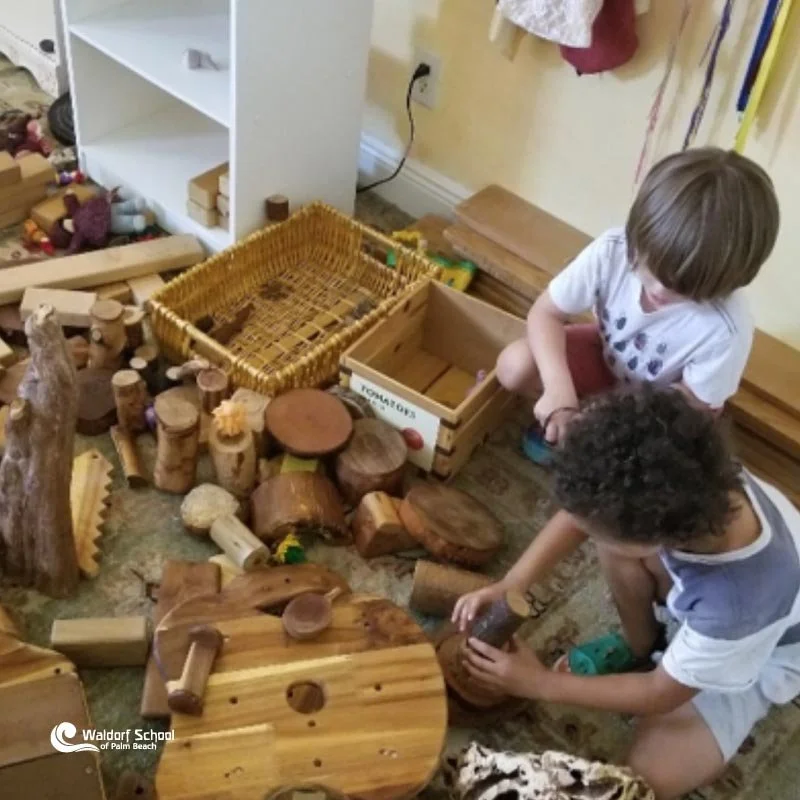
Waldorf kindergartens provide warm, homelike rooms filled with natural materials where children bake bread, build forts, care for animals, and explore the seasons through songs and stories. Playful activities like building with blocks, watercolor painting, and imaginative role‑play strengthen fine motor skills, language development, and social cooperation. 

Such arts‑based and sensory‑rich activities light up multiple regions of the brain and “wire the brain’s neural circuits” for future learning. 

Guided play also supports self‑regulation, creativity, and problem‑solving skills essential for later academic success. Teachers introduce oral storytelling, circle games, and rhythmic verses to nurture listening and memory.

Middle childhood (Ages 7–14)

From age seven to adolescence, children crave meaningful narratives and hands-on exploration. Waldorf grades 1–8 introduce reading, writing, and mathematics through imaginative stories and characters. 

For example, letters may be introduced through fairy‑tale creatures, and multiplication tables through clapping games or drawing patterns. Main lesson blocks (three‑ to four‑week units that immerse students in a single subject) allow deep study of mythology, geography, botany, geometry, physics, and history. Each block culminates in an illustrated “main lesson book” created by the student.

Arts integration continues: every child learns to play a string instrument and participates in a chorus; handwork progresses from knitting to sewing and woodworking; foreign languages (often Spanish and German) begin in first grade. 

Such multisensory learning improves memory and understanding because arts integration increases overall academic achievement by around 10 percent, according to the Arts Integration Institute. Studies also show that creating and viewing art engages the prefrontal cortex and boosts cognitive abilities.

Adolescence (Ages 14–18)

In high school, the focus shifts toward critical thinking and self‑expression. Waldorf Upper School students delve into literature, calculus, world religions, modern history, biology, and chemistry through independent projects and scientific experimentation. 

They stage plays, build violins, farm biodynamically, and study social issues through community service. Adolescents need to test ideas against their own experiences; thus Waldorf curricula encourage debate, research papers, and artistic portfolio work.

Because the curriculum aligns with developmental milestones, students often show strong intellectual curiosity and self‑motivation by graduation.

Integration of Arts Across All Subjects

Waldorf’s commitment to the arts is more than aesthetic; it is grounded in neuroscience. Visual art, music, movement, and drama activate different networks in the brain, strengthening neural pathways and improving memory. 

Studies in neuroarts show that creating and viewing art engages the prefrontal cortex responsible for executive functions; this boosts cognitive flexibility and emotional regulation. When children learn to play instruments or draw, they coordinate motor skills, pattern recognition, and emotional expression simultaneously. Arts training also improves impulse control and social skills; for instance, musically trained children display thicker auditory processing regions and better self‑regulation.

The benefits of arts integration extend beyond brain structure. 

A study cited by the Association of Waldorf Schools of North America (AWSNA) notes that arts-integrated instruction leads to higher grades, fewer disciplinary infractions, and improved empathy. These findings underscore why Waldorf classrooms weave painting, music, poetry, and movement into every academic subject. When children engage their head, heart, and hands together, they build lasting understanding.
Waldorf vs. Montessori vs. Traditional Education

Parents often compare Waldorf vs. Montessori vs. conventional schooling. Each approach has unique strengths; the table below summarizes core differences drawn from educational experts.

Waldorf vs Montessori vs Traditional School

What To Expect: Waldorf Curriculum By Grade Level

The most common question parents ask is simple and practical: What will my child learn? Waldorf education answers this through a clear developmental sequence that unfolds from early childhood through high school. While each school adapts the curriculum to its local culture and environment, the overall progression is consistent worldwide and carefully aligned with how children grow intellectually, emotionally, and physically at each age.

What follows is a chronological overview, showing how learning deepens over time and how academic content is introduced in ways that are developmentally appropriate, meaningful, and lasting.

Early Childhood (Ages 3–6): Foundation Through Play

In the early childhood years, learning is rooted in rhythm, imitation, and purposeful play. A typical day follows a predictable flow that helps children feel secure and grounded: a morning circle with songs, verses, and movement; extended periods of free play indoors and outdoors; preparing and sharing snack together; story time; nature exploration; artistic activities such as watercolor painting, drawing, or working with beeswax; and a closing circle to bring the day to completion.

There is no direct instruction and no formal academics. Children are not taught to read, write, or calculate during these years. Instead, teachers model meaningful, real-life activities such as breadmaking, cleaning, gardening, and simple crafts. Children learn by observing and naturally joining in, developing concentration, coordination, and social awareness through imitation rather than instruction.

This approach builds essential foundations: listening skills, memory, imagination, emotional resilience, physical balance, and self-regulation. By protecting early childhood as a time for play and sensory-rich experience, Waldorf education supports healthy development that later academic learning can rest upon with strength and confidence.

Grades 1–5: The Imaginative Years

As children enter the grades, formal academics are introduced through imagination, story, and artistic expression. Learning is presented pictorially at first, allowing concepts to be absorbed deeply before moving into abstraction.

  • Grade 1 begins with fairy tales and stories that introduce letters as living images and characters. Reading and writing grow organically from storytelling, while counting and arithmetic are taught through movement, rhythm, and practical activity. The focus is on wonder, curiosity, and joy in learning.

  • Grade 2 builds reading fluency and introduces fables and legends that explore contrasting human qualities through animal stories and saintly figures. Children begin to recognize moral nuance while strengthening literacy and numeracy skills.

  • Grade 3 corresponds with a major developmental shift often called the “nine-year change,” when children begin to experience themselves as more separate from the world. The curriculum responds with grounding, practical subjects such as house building, farming, measurement, and Old Testament stories that emphasize work, responsibility, and structure.

  • Grade 4 introduces Norse mythology, reflecting themes of courage and individuality. Academically, students work with fractions, local geography and history, and zoology, developing clearer thinking and a stronger sense of place in the world.

  • Grade 5 is often experienced as a golden year of balance and harmony. Students study ancient civilizations, especially Greece, alongside botany and freehand geometry. The year frequently culminates in a Greek Olympics celebration, integrating physical education, history, and community in a joyful rite of passage.

Across Grades 1–5, academics are always integrated with the arts. Handwork progresses from knitting to embroidery to early woodworking, building dexterity and perseverance. Music evolves from pentatonic flute to recorder and ensemble playing. Letters, numbers, science, and history are introduced through rhythm, movement, drawing, and storytelling, allowing understanding to grow from lived experience rather than memorization.

This imaginative foundation prepares students for the increasing intellectual demands of the upper grades, while preserving creativity, confidence, and a love of learning.

Grades 6–8: The Awakening Mind

The middle school years mark a clear shift in Waldorf education toward abstract thinking, critical reasoning, and intellectual rigor. Students are developmentally ready to question, analyze, and connect ideas across disciplines, and the curriculum responds with deeper academic challenges while continuing to integrate the arts.

  • Grade 6 focuses on the transition from mythic thinking to logical structure. Students study Roman history and the medieval world as expressions of law, order, and civic responsibility. In the sciences, physics is introduced through direct observation and experiment, including acoustics, optics, heat, magnetism, and early astronomy. Earth science expands into mineralogy, and mathematics emphasizes business math, ratios, and practical applications tied to the real world.

  • Grade 7 aligns with the theme of transformation and exploration. History moves into the Renaissance, Reformation, and Age of Exploration, reflecting humanity’s growing curiosity and individuality. Mathematics introduces algebra and geometry theorems, while chemistry explores combustion, acids, and bases through hands-on experimentation. Perspective drawing develops spatial reasoning and artistic discipline, and health studies emphasize nutrition and human development.

  • Grade 8 serves as an academic and personal culmination. Students engage with modern history, including major revolutions and the forces shaping contemporary society. Science deepens into anatomy and physiology alongside introductory organic chemistry. Mathematics becomes more advanced and abstract, preparing students for high school–level work. The year is anchored by major milestones, including an independent research project, a class play (often Shakespeare), and a formal graduation ceremony that celebrates intellectual growth, collaboration, and maturity.

Across all three years, subject specialists begin to take a more prominent role, academic expectations rise significantly, and arts integration remains central, reinforcing comprehension, creativity, and confidence. Eighth grade stands as a capstone experience, bringing together years of learning through substantial projects, public presentations, and shared achievement.

High School (Grades 9–12): Preparing for Life

Waldorf high school education is designed to prepare students not only for college, but for thoughtful, capable participation in adult life. The Waldorf School of Palm Beach currently offers classes through 10th grade and is expanding to a full high school program by the 2026–2027 academic year. In a complete Waldorf high school experience, academic rigor increases while purpose, independence, and real-world relevance come into sharper focus.

Rigorous academics across core disciplines

Students engage in challenging coursework across disciplines, including advanced mathematics through calculus, laboratory-based sciences, world and American literature, and continued study of foreign languages. History expands into government, economics, and social studies, encouraging students to analyze systems, ethics, and global responsibility with nuance and depth.

Upper grades also emphasize experiential learning and applied skills. Advanced practical arts such as woodworking, metalwork, automotive studies, and technology foster problem-solving, craftsmanship, and mechanical understanding. Fine arts continue at a high level, with students developing portfolios in visual art, music, theater, or movement.

Technology is introduced intentionally and purposefully, including computer science, coding, digital media, and research skills, ensuring students are technologically fluent without being dependent.

Senior year milestones and college counseling

The senior year at full Waldorf high schools is marked by signature experiences. The senior project challenges students to pursue an independent research, creative, or service-based endeavor, culminating in a written thesis and formal presentation. College counseling supports students through the admissions process, including SAT or ACT preparation, application strategy, and self-reflection around future goals.

By graduation, Waldorf students leave with strong academic foundations, creative confidence, and a clear sense of purpose; prepared not just to succeed in higher education, but to think critically, act ethically, and contribute meaningfully to the world beyond school.

holistic education waldorf school

Proven Benefits Of Waldorf Education For Future Success

Parents often choose Waldorf because of its far‑reaching benefits. Here are some key advantages supported by research and statistics.

Academic Outcomes and College Preparation

Research dispels the myth that Waldorf students fall behind academically. A 2024 study of Waldorf charter schools found that students initially scored lower than peers on standardized tests in early grades but met and even surpassed state standards in 7th and 8th grades. 

Researchers concluded that Waldorf’s developmental approach leads to significantly higher percentages of eighth‑grade students meeting or exceeding state standards in English and math. 

A separate Stanford University‑linked analysis of 23,000 students found that Waldorf students outperformed peers on standardized state assessments by 8th grade, were more engaged, and had fewer disciplinary actions. 

These results suggest that although Waldorf delays formal academics, the integrated arts curriculum supports deep learning that emerges in later grades.

Creativity and Innovation

The World Economic Forum’s Future of Jobs Report identifies analytical and creative thinking as the most in‑demand skills for 2023 and beyond. Waldorf’s emphasis on storytelling, music, painting, and problem‑solving gives students daily practice in creative thinking. 

Because they engage multiple senses and create original work, Waldorf graduates often develop resilience and adaptability, qualities prized in rapidly changing industries.

High college attendance

Multiple alumni studies point to strong higher-education outcomes. A survey of Waldorf high school graduates found 94% attend college, and 88% complete or are completing degrees. 

Another large survey (1,066 graduates) reported 98% attend college and 90% gain admission to one of their top three choices. 

Separately, research summarized through California State University, Monterey Bay capstone work reports over 60% of surveyed Waldorf alumni earn a bachelor’s degree, described as nearly 30% above the national average. 

Many alumni also describe benefits that translate well to university life, including creative thinking, time management, and confidence engaging with professors.

Strong Academic Performance Over Time

Beyond college outcomes, some analyses report that Waldorf students outperform district averages on standardized state assessments across Grades 3–8. This aligns with the “slow and deep” arc many Waldorf schools describe: early foundations in attention, comprehension, and creativity that show up later as stronger academic performance.

Social-Emotional Wellbeing and Resilience

Arts integration and hands-on projects nurture empathy and collaboration. Research shows that musically trained children develop better impulse control and improved social interaction. Students who participate in arts‑rich environments display greater empathy and lower discipline problems. 

Smaller class sizes (such as the 6:1 ratio at Waldorf School of Palm Beach) create a family‑like atmosphere where children feel seen and valued. Seasonal festivals, class plays, and outdoor adventures strengthen community bonds.

Waldorf School of Palm Beach: Unique Offerings

Families in South Florida do not need to travel far to experience authentic Waldorf education. Right here in Boca Raton, the Waldorf School of Palm Beach (WSPB) offers a deeply rooted, developmentally aligned Waldorf education for children from early childhood through the upper grades, with a clear vision for continued growth.

Founded in 2006 by a group of committed parents through the Sea Star Initiative, WSPB was built intentionally as a community-centered school. Today, it serves more than 70 students and remains guided by the same founding values: protecting childhood, fostering curiosity, and educating the whole human being. With a low 6:1 student-to-teacher ratio, children receive individualized attention within a warm, relational learning environment. Tuition assistance is available, helping ensure accessibility for families who share the school’s values.

WSPB operates across two campuses designed to meet children where they are developmentally. The early childhood campus emphasizes rhythm, play, and nature-based learning, while the grades campus supports a rich academic curriculum infused with the arts, movement, and hands-on experience. The school is also actively working toward a full high school program, guided by a strategic plan that expands offerings thoughtfully and sustainably in response to community growth.

To support working families, WSPB also offers aftercare, providing a calm, supervised extension of the school day where children can unwind, play, and transition smoothly from classroom life to home life. Families can also expect a clear, predictable school calendar that reflects Waldorf’s seasonal rhythm, including festivals, holiday breaks, and community events that help mark the year in a way children can feel and anticipate.

Visiting and Applying to Waldorf School of Palm Beach

Choosing a school is a meaningful decision, and WSPB encourages families to experience Waldorf education directly. Observing classrooms, meeting teachers, and feeling the rhythm of the school day offer insights no brochure can fully capture.

The admissions process is designed to be clear and personal:

  • Schedule a tour to observe classes in action

  • Submit an application

  • Participate in a child visit and parent interview

  • Receive an admissions decision

Tours are strongly encouraged, as they provide the most authentic understanding of how Waldorf education looks and feels in practice.

Take the Next Step

If you are exploring Waldorf education in Boca Raton and want to see how this approach supports academic growth, creativity, and emotional well-being, the best next step is to visit the school in person.

Schedule a tour and learn more about admissions

Seeing Waldorf education firsthand often answers questions you didn’t even know you had, and helps clarify whether this thoughtful, human-centered approach is the right fit for your child and family.

Frequently Asked Questions

What is the Waldorf method of teaching?

The Waldorf method educates the whole child through a developmental approach that aligns learning with age and maturity. Subjects are taught in immersive “main lesson” blocks and woven with art, music, movement, and storytelling. Academics build gradually, emphasizing imagination first, then critical and abstract thinking.

How is Waldorf different from Montessori?

Montessori emphasizes self-directed learning with specialized materials and early independence. Waldorf places greater emphasis on teacher-led instruction in the early years, shared rhythm, storytelling, and arts integration. Waldorf typically delays formal academics and screen use, while Montessori introduces structured academic work earlier through individual choice.

How many Waldorf schools are there in Germany?

Germany has approximately 240–250 Waldorf schools, making it the largest Waldorf network in the world. These schools educate tens of thousands of students and are supported by long-established teacher training institutes. Exact numbers fluctuate slightly each year as schools open, expand, or consolidate.

What are the criticisms of Waldorf schools?

Some individuals question Waldorf’s philosophical roots, the later start to formal reading/testing, and a more limited early use of screens. The fairest critique is that quality depends on implementation. Strong Waldorf schools address this with transparent practices, clear academic benchmarks by upper grades, and thoughtful, age-appropriate technology.

What is a Waldorf elementary school like?

A Waldorf elementary school blends strong academics with art, music, movement, and hands-on learning. Subjects are taught in integrated blocks that build understanding over time, helping children develop focus, creativity, and confidence. Learning emphasizes meaning and connection rather than memorization or constant testing.

What makes the Waldorf curriculum unique?

The Waldorf curriculum follows a clear developmental sequence, introducing concepts when children are most ready to grasp them. Lessons are taught through story, art, experimentation, and discussion, allowing knowledge to deepen gradually and supporting long-term comprehension and critical thinking.

What happens in a Waldorf preschool?

A Waldorf preschool centers on play, rhythm, and imitation rather than early academics. Children learn through storytelling, creative play, outdoor exploration, and practical activities like cooking and gardening, building social skills, imagination, and self-regulation.

Is Waldorf a good Montessori alternative for preschool?

For families choosing between Montessori or preschool options, Waldorf is a leading option among Montessori alternatives. While Montessori emphasizes early independence and materials-based work, Waldorf learning focuses on imagination, shared rhythm, and teacher-guided experiences in the early years.

Feature Waldorf Education Montessori Education Traditional School
Philosophy Waldorf education prioritizes holistic development of head, heart and hands; curriculum aligned to developmental stages. Child-led exploration; children choose their activities and pace. Focus on academic achievement and standardized benchmarks.
Curriculum structure Delayed academics; literacy and numeracy introduced through storytelling and play; main lesson blocks with integrated arts. Early introduction of reading and math; learners guide their own curriculum and work independently. Structured curriculum with discrete subjects and homework from early grades.
Role of teacher The teacher remains with the same class for multiple years, nurturing relationships and guiding developmental transitions. The teacher acts as observer, preparing the environment and intervening minimally while children work independently. Teachers specialize by subject and grade; relationships change yearly.