Waldorf education is an approach to school founded by Austrian philosopher Rudolf Steiner in 1919, built on the idea that what a child is taught should match the stage of development they are actually in. It is also called Steiner education. The two words mean the same thing. The name comes from the first school, which opened in Stuttgart, Germany for the children of workers at the Waldorf-Astoria cigarette factory. Today there are more than 1,200 independent Waldorf schools in 75 countries.
If you have toured the private schools in Palm Beach County and something still feels off, this guide is for you. Maybe your child comes home drained instead of excited. Maybe you sense there is a better way to learn than worksheets and test prep. This is what Waldorf education actually looks like day to day, what the method rests on, and how to tell whether it fits your child.
Waldorf School of Palm Beach is an independent Waldorf school in Boca Raton serving families from early childhood through Grade 11.
Waldorf education at a glance:
Founded by Rudolf Steiner in 1919. Also called Steiner education.
Formal academics begin around age six or seven, not earlier.
The arts are the teaching method, not an elective.
One class teacher stays with a group from Grade 1 through Grade 8.
No standardized testing in the early and middle years.
Screens are kept out of the early years and introduced gradually.
Non-religious, and open to families of all backgrounds.
What Does "Waldorf" Actually Mean?
The word itself is not a philosophy. It is a factory name.
In 1919, Emil Molt ran the Waldorf-Astoria cigarette factory in Stuttgart and asked Rudolf Steiner to start a school for his workers' children. The school took the factory's name and the name stuck. Every Waldorf school since traces back to that one.
So when people ask what Waldorf means, there are really two answers. Literally, it is the name of the first school. In practice, it refers to the whole approach Steiner built: a curriculum organized around three stages of childhood, the arts used as a teaching method rather than an elective, and one class teacher who stays with a group of children for years rather than months.
"Steiner education" and "Waldorf education" are the same thing. British and European schools tend to say Steiner. American schools tend to say Waldorf. There is no difference in the method.
The philosophy underneath it is called anthroposophy, which translates roughly as the study of human wisdom. It is a philosophical framework, not a religion, and it is not taught to students. Waldorf schools are non-denominational and welcome families of every background.
What Is Waldorf Education? Understanding the Steiner Philosophy
Waldorf education is a developmentally appropriate curriculum approach founded by Austrian philosopher Rudolf Steiner in 1919. The first school was created for children of Waldorf-Astoria factory workers in Stuttgart, Germany. Today, there are over 1,200 independent Steiner schools across 75 countries, making it the largest independent school movement in the world.
The terms "Waldorf" and "Steiner" are interchangeable. Both refer to the same educational philosophy grounded in anthroposophy, which translates to "the study of human wisdom." This is a philosophical framework, not a religious doctrine. Steiner and Waldorf education is non-denominational and welcomes families of all backgrounds and beliefs.
At its core, the Waldorf education philosophy holds that learning should nurture the whole child across physical, emotional, social, cognitive, and spiritual dimensions at each developmental stage. At Waldorf School of Palm Beach, this philosophy translates into imaginative play, hands-on exploration, and creative curriculum that builds critical thinking and ethical decision-making in students across Palm Beach County.
Rudolf Steiner's Vision for Child-Centered Learning
Rudolf Steiner was an Austrian philosopher and educator who developed a holistic education framework based on deep observation of how children actually develop. He believed education should honor each child's unique potential and prepare them to contribute meaningfully to society.
Modern Waldorf schools, including Waldorf School of Palm Beach, have adapted Steiner's insights to contemporary life while keeping the core principles intact. The result is a child-centered learning pedagogy that feels both timeless and deeply relevant to how children learn today.
The Core Principles of the Waldorf Method and Steiner Learning Approach
Several key tenets set the Waldorf method apart from conventional schooling. The curriculum is developmentally appropriate, meaning content arrives when children are genuinely ready for it, not when an arbitrary academic calendar says so. Arts integration, experiential learning, and the cultivation of imagination run through every subject.
Learning happens through doing. Storytelling, music, movement, and artistic expression are central to every lesson. Students might learn fractions through rhythm, explore geometry through form drawing, or study ancient civilizations through drama. Research published in The Curriculum Journal (Wiley) found that experiential learning approaches significantly benefit academic achievement, particularly in science and math.
The Waldorf learning model also embraces a low-tech education philosophy in early years. Young children engage with natural materials, imaginative play, and real-world experiences before digital devices enter the picture, typically around age 14. This low-tech education approach lets children build strong sensory and social foundations before screens compete for their attention.
Then there's the class teacher model. One class teacher stays with the same group from Grade 1 through Grade 8. Eight years. The teacher who introduces fractions in Grade 3 is the same person guiding the Grade 8 project, and they have watched every step in between. At Waldorf School of Palm Beach, small class sizes make that continuity even more concrete, since the teacher is holding twenty relationships rather than a hundred. This creates deep relationships, continuity, and a truly individualized understanding of each student. At Waldorf School of Palm Beach, small class sizes amplify this benefit, giving teachers the space to know each child and tailor instruction to their developmental readiness.
Arts Integration: More Than Just Creative Expression
In a Waldorf program, arts aren't an afterthought or an elective squeezed into the schedule. They're woven directly into academic subjects to deepen understanding and activate different learning styles. A student studying the Renaissance doesn't just read about it. They paint, sculpt, perform, and write their way into the material.
Waldorf School of Palm Beach's robust arts-integrated education curriculum includes visual arts, music, eurythmy, and handwork. These disciplines develop fine motor skills, emotional intelligence, and creative curriculum outcomes alongside strong academics.
A comprehensive review by the Association of Waldorf Schools of North America (AWSNA) highlights how this holistic education approach builds integrated, interdisciplinary thinkers.
The Values Behind the Approach
Most schools can tell you their curriculum. Fewer can tell you what they believe about childhood itself. The Waldorf education philosophy rests on three commitments that show up in almost every decision a Waldorf school makes.
Childhood is not a runway. The pressure to read earlier, test earlier, and specialize earlier assumes that the sooner a child starts, the further they go. Waldorf education takes the opposite position. Formal reading instruction begins around age six or seven, after oral language, storytelling, and fine motor skills have had time to develop. Children are not behind. They are being built differently.
Rhythm does what rules cannot. A Waldorf day, week, and year follow a predictable rhythm: morning circle, main lesson, practice lessons, outdoor time. A Waldorf year moves through seasonal festivals. Children who know what comes next spend less energy bracing for it, and that steadiness is a large part of why Waldorf classrooms feel calm.
What you make, you understand. Students produce their own main lesson books rather than filling in worksheets. They knit, model, draw, and build. The work is slower than a photocopied packet, and that is the point. A child who has drawn the cell has a different relationship to it than a child who has labeled one.
What Is a Waldorf School Like? Daily Life and Teaching Style
So what is a Waldorf school like from day to day? The rhythm matters. Mornings typically begin with a circle, followed by main lesson blocks where students immerse themselves in one subject for three to four weeks straight. After that, practice lessons in math, language arts, and specialty subjects fill out the day.
Walk into a Waldorf classroom, and you'll notice the difference immediately. Warm, homelike spaces filled with natural materials. Student artwork covering the walls. No mass-produced posters or fluorescent lighting. The environment itself supports concentration and calm.
The teaching style of a Waldorf school leans heavily on narrative and experience. Teachers tell stories, guide discoveries, and facilitate hands-on exploration. Students create their own main lesson books rather than filling in worksheets. Assessment takes the form of holistic observation, written narrative reports, and student portfolios rather than constant standardized testing. This teaching style of a Waldorf school is what sets it apart from the lecture-and-test cycle most families are used to.
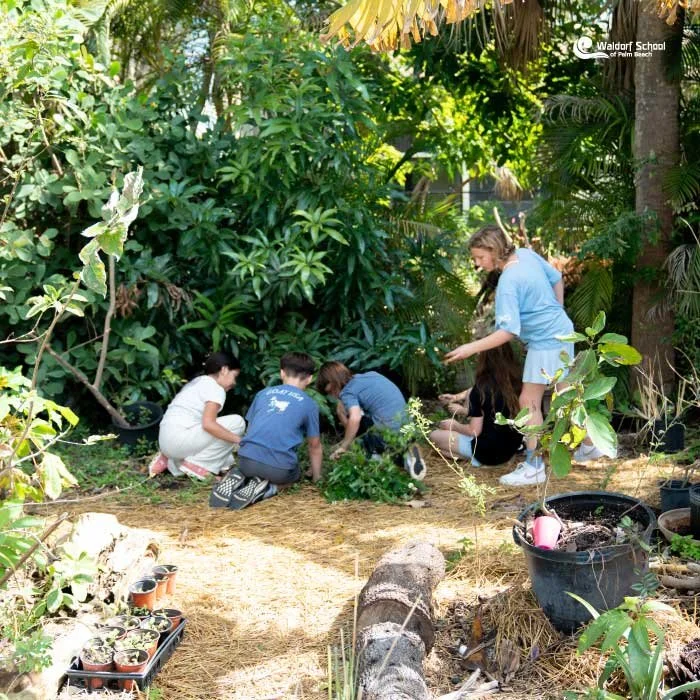
At Waldorf School of Palm Beach, the school's nature-based learning environment in South Florida enhances outdoor education, gardening, and connection to Florida's natural landscape, key components of the Waldorf education philosophy.
Understanding Different Types of Waldorf Programs: Charter, Independent, and Waldorf-Inspired Schools
Not all Waldorf schools operate the same way. There are three main types.
Waldorf charter school: It's publicly funded and must meet state standards, which sometimes means adapting the Waldorf curriculum.
Waldorf-inspired school: It incorporates some Steiner learning methods but isn't fully certified.
Independent Waldorf schools: And then there are independent Waldorf schools with full autonomy to deliver the complete pedagogy.
Waldorf School of Palm Beach is an independent Waldorf school and an associate member of AWSNA. This means the school has the freedom to fully implement authentic Waldorf learning from early childhood onward without compromise. The benefits include a comprehensive arts program, extended childhood without early academic pressure, and flexibility to meet each child's individual needs.
While all models have value, independent Steiner schools offer the most complete expression of Steiner's educational vision. Waldorf School of Palm Beach also offers summer programs that extend the Waldorf program experience year-round for local families.
Waldorf Education Philosophy in Action: From Early Childhood to High School
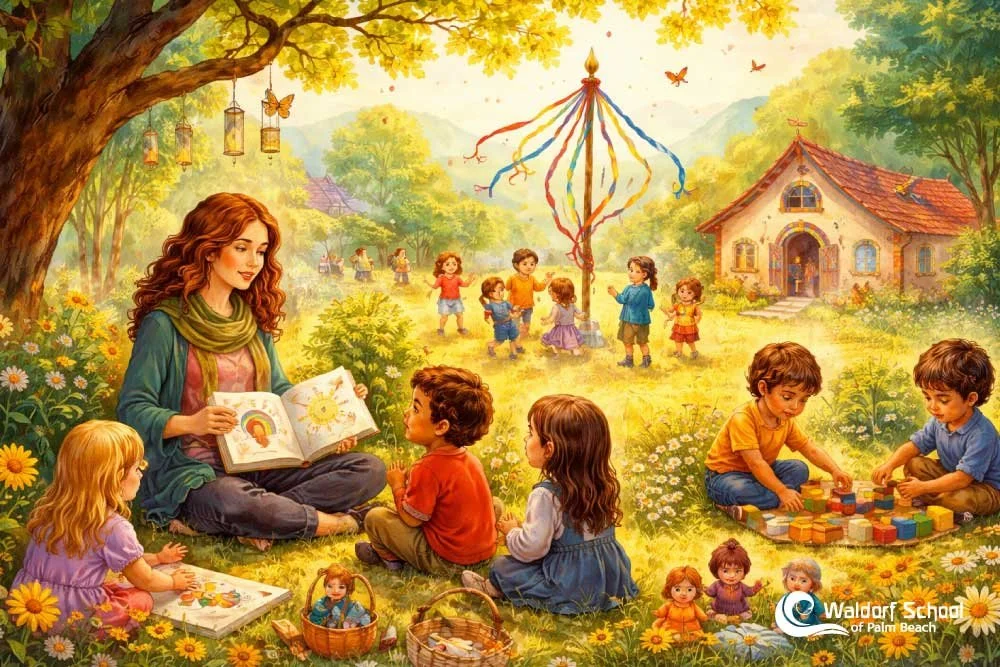
The Waldorf education philosophy shifts deliberately at each developmental stage. In early childhood (ages 3 to 6), the focus is on imaginative play, imitation, sensory-rich experiences, and building social-emotional foundations. There's no rush to read or write at this age.
During the elementary years (grades 1 to 8), academic content arrives through artistic and experiential methods. Literacy, numeracy, sciences, humanities, world languages, and practical skills all grow in complexity as students mature. A study by the Research Institute for Waldorf Education found that Waldorf students develop strong comprehension skills and a love of learning through this graduated approach.
What is a Waldorf high school experience? Students in grades 9 through 12 engage in independent thinking, abstract reasoning, specialized study, community service, and college preparatory work, all while maintaining arts and hands-on learning.
Steiner and Waldorf education introduces formal reading instruction around age 6 to 7, allowing time for oral language, storytelling, and fine motor development first. Waldorf School of Palm Beach offers a continuum from early childhood through high school, providing consistency and seamless transitions as children grow.
The Waldorf High School Experience: Preparing Students for Life Beyond Graduation
A Waldorf high school is academically rigorous and college preparatory, yet it maintains the arts, practical skills, and experiential learning that define the approach. Graduates leave as well-rounded, ethical, independent thinking individuals.
The numbers back this up. According to the Survey of Waldorf Graduates conducted by the Research Institute for Waldorf Education, 94% of Waldorf graduates go on to attend college, and many earn advanced degrees. Colleges and universities actively seek these students for their ability to integrate ideas, demonstrate leadership, and maintain high ethical standards. Waldorf School of Palm Beach's high school program prepares local students for success at universities nationwide.
Is Waldorf Education Right for Your Child? Identifying Students Who Thrive in Steiner Schools
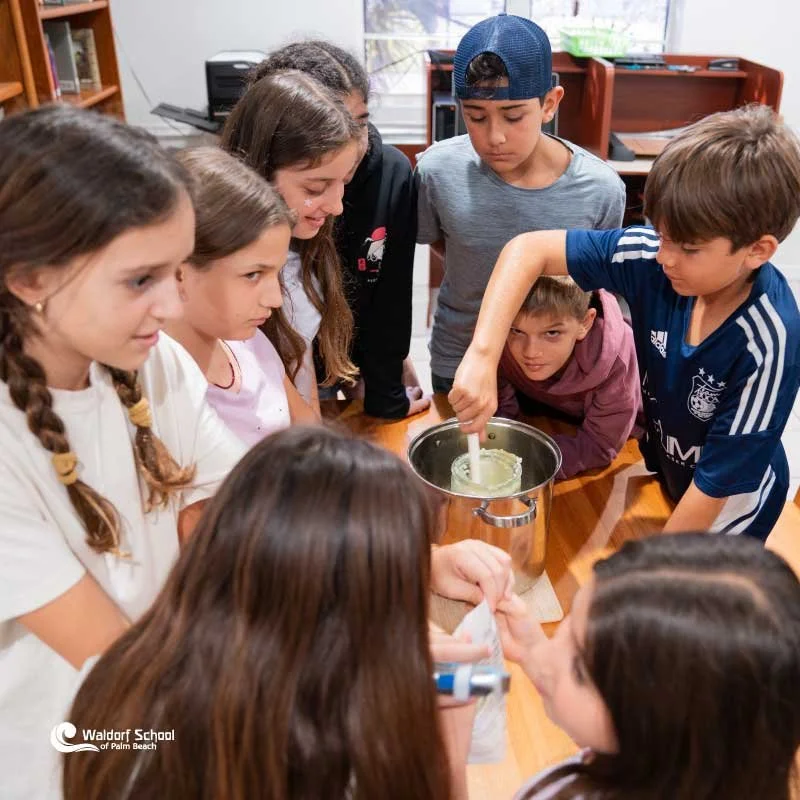
What student is a good fit for a Waldorf school? Children who flourish here tend to benefit from hands-on, creative curriculum approaches. They need movement woven into their academics. They thrive with consistent relationships and a strong sense of community.
Waldorf education works especially well for late bloomers who need time to develop at their own pace, highly creative or artistic children, kids overwhelmed by test pressure, and families who value childhood, imagination, and nature-based learning. Research from Frontiers in Education confirms that experiential learning environments significantly boost student motivation and classroom engagement.
That said, Waldorf education may present a challenge for families expecting formal reading by age 4, those prioritizing technology from the start, or parents who want frequent standardized scores in elementary school. But here's the thing: students who transfer from Waldorf to traditional settings catch up quickly and often surpass peers in comprehension, creativity, and critical thinking.
The best way to know? Visit Waldorf School of Palm Beach, observe classes in action, speak with teachers and current families, and trust your instincts about what fits your child's temperament.
Choosing the Right Path for Your Child's Education
Steiner and Waldorf education offer a time-tested alternative to conventional schooling. It honors childhood, nurtures whole child development, and prepares students to be creative, ethical, engaged citizens who think critically, feel deeply, and act with purpose.
For Palm Beach County families, Waldorf School of Palm Beach brings this internationally recognized progressive education to your local community. Small class sizes, dedicated teachers, a rich arts curriculum, and nature-based learning come together in a private school that Palm Beach County families can trust.
Ready to see the difference for yourself? Schedule a campus tour, attend an open house, or contact the admissions team to learn how Waldorf education can shape your child's future. Because the right education doesn't just open doors. It helps children discover who they are and who they want to become.
Frequently Asked Questions
What is the main difference between Waldorf and traditional education?
Waldorf education uses a whole-child, developmentally appropriate approach that integrates arts into all academics and emphasizes experiential learning over memorization. Traditional schools typically prioritize earlier academics, technology integration, and standardized testing for assessment. Waldorf's class teacher model keeps one dedicated teacher with the same students for multiple years, building deeper relationships and truly individualized instruction.
Are Waldorf schools religious?
No. Waldorf schools are non-denominational and welcome families of all faiths. While founded on anthroposophy, a philosophical framework recognizing the spiritual dimension of humans, it is not taught to students. Waldorf School of Palm Beach celebrates diversity and focuses on universal human values like kindness, respect, wonder, and ethical development.
Will my child be prepared for college if they attend a Waldorf high school?
Absolutely. Research shows 94% of Waldorf graduates attend college, with many earning advanced degrees in diverse fields. They excel in critical thinking, creative problem-solving, leadership, and ethical decision-making. Waldorf School of Palm Beach's college preparatory program develops independent thinkers with strong communication skills, intellectual flexibility, and the curiosity that top colleges actively seek.
At what age do children learn to read in Waldorf schools?
Waldorf education introduces reading in first grade, around age 6 to 7, through an artistic approach beginning with oral language, storytelling, drawing, and letter formation. This allows fine motor skills and love of stories to develop first. By year's end, children read and write sentences confidently, with research showing this approach creates passionate lifelong readers.
What does Waldorf mean in education?
Waldorf refers to the educational approach founded by Rudolf Steiner in 1919, named after the Waldorf-Astoria factory in Stuttgart where the first school opened. In practice it describes a method built on developmental stages, arts integration across every subject, and long-term class teacher relationships. Waldorf and Steiner education are the same thing.
What is a Waldorf school like day to day?
Mornings open with a circle, then a main lesson block where students study one subject intensively for three to four weeks. Practice lessons in math and language arts follow, along with specialty subjects like music, handwork, and world languages. Classrooms use natural materials and student artwork rather than mass-produced posters. Assessment comes through written narrative reports and portfolios rather than constant testing.
What is the Waldorf education philosophy?
That education should develop the whole child across thinking, feeling, and doing, and that what children are taught should match where they are developmentally rather than where a standardized calendar says they should be. The curriculum responds to three phases of childhood: imitation and play in the early years, imagination and story in the middle years, and independent reasoning in adolescence.
How is Waldorf different from Montessori?
Montessori emphasizes child-led, self-directed work with specialized materials. Waldorf uses a structured, teacher-led curriculum organized around developmental phases, with the arts integrated into every subject and a strong emphasis on story, imagination, and seasonal rhythm. Read the full comparison.
Is there a Waldorf school in Palm Beach County?
Yes. Waldorf School of Palm Beach is an independent Waldorf school in Boca Raton serving families from across Palm Beach County and South Florida, including Delray Beach, West Palm Beach, Boynton Beach, and Coral Springs. The school offers Early Childhood through Grade 11 across two campuses.