
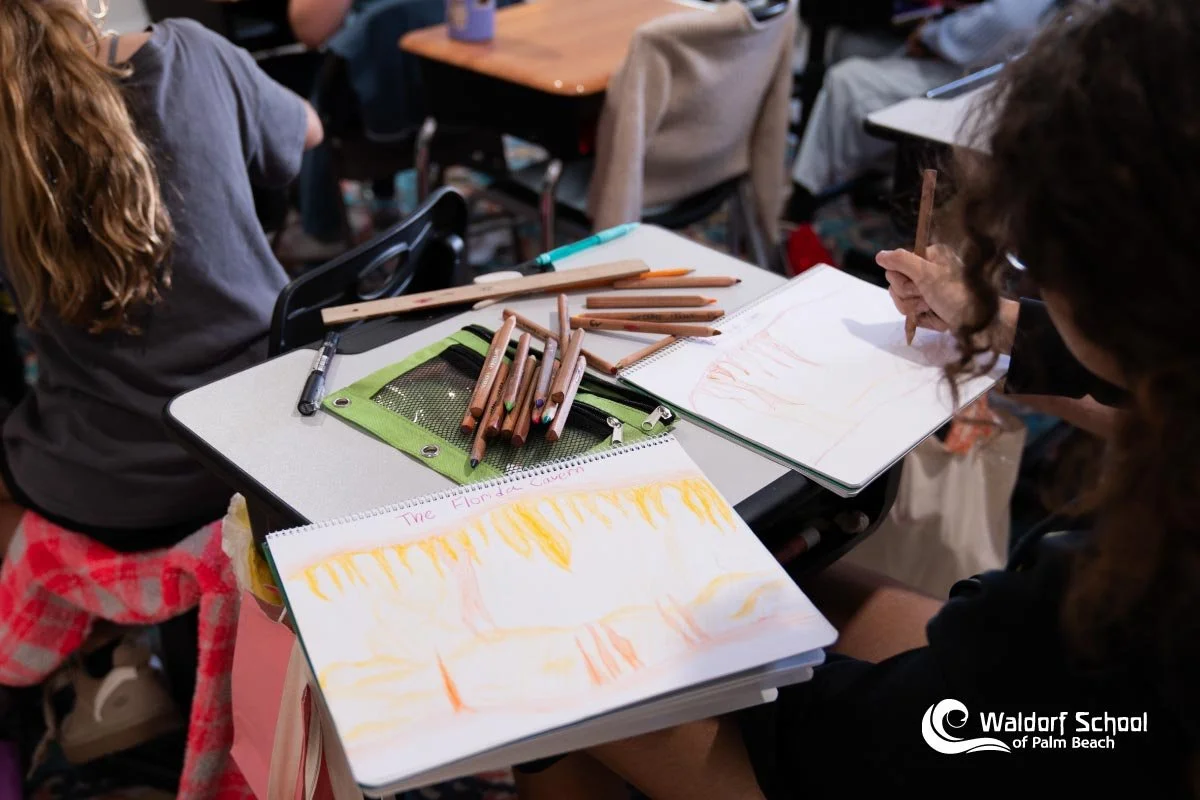
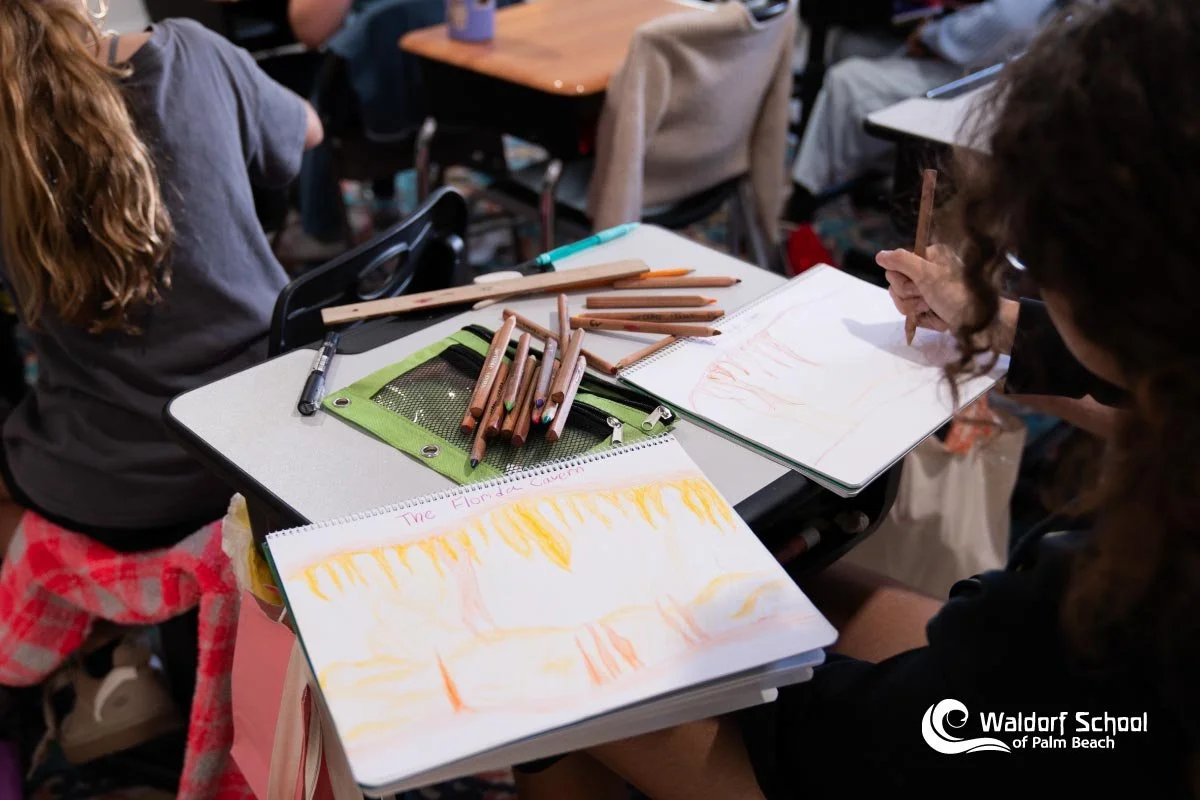
Picture a morning at Waldorf School of Palm Beach. A five-year-old kneels in the garden, fingers deep in soil, planting seedlings she will water every day until they bloom. No worksheet in sight. No screen. No pressure to perform. Just a child, her hands, and the slow miracle of growth.
Many families ask us the same question. Why choose an education that looks so different from everything else? It is a fair question, and one that deserves a real answer.
If you have read our parents’ guide to Waldorf education, the landscape feels familiar. This article goes deeper. It explores the why behind the Waldorf education philosophy, the values and beliefs that shape every lesson, every rhythm, every choice inside our classrooms.
Childhood is sacred. Development is holistic. Education should nurture the whole human being, body, soul, and spirit. The rest of this piece unpacks what that means in practice, and why it matters for families seeking alternative education in Palm Beach County.
The Foundational Belief: Education Should Serve the Human Being, Not the System
At the heart of the Waldorf education philosophy sits a radical idea from Rudolf Steiner. Education exists to support the unfolding of each unique child. It does not exist to mold children into standardized outputs for an industrial system.
Think about how most schools are structured today. Bells ring. Desks in rows. Standardized tests. College prep starts in kindergarten. The pressure is relentless, and the assumption is that children are containers to be filled with content, measured against benchmarks, then shipped to the next grade.
Steiner saw things differently. The child is a developing human being, not a product. Rudolf Steiner philosophy views each student as an individual with a unique pace, unique gifts, and a unique timing. This is the ground from which the entire Waldorf approach grows. It is also why Rudolf Steiner philosophy remains so relevant more than a century after the first Waldorf school opened in 1919.
At Waldorf School of Palm Beach, you see this belief in action. Small class sizes. Teachers who know each child deeply. A curriculum that honors when a child is ready for a concept, rather than pushing them to master it on a schedule designed by committee. This is child-centered learning in practice, and it shapes the texture of every day.
Some parents assume a Waldorf school philosophy must be anti-academic. The opposite is true. The Waldorf methodology builds strong academic foundations by first building strong humans. Children who feel seen, grounded, and secure become adaptable learners who can think, create, and lead.
Why This Matters for Palm Beach Families Today
Parents are noticing what is happening. Anxiety diagnoses in children are rising. Screens dominate play. Childhood itself feels like it is shrinking, caught between academic pressure and digital overstimulation. Families across Palm Beach County are searching for a progressive education philosophy that offers something different.
The Waldorf philosophy of education answers that concern directly. By protecting childhood, fostering imagination, and building intrinsic motivation, the Waldorf approach gives children room to grow into themselves. Children who develop their own intrinsic motivation become lifelong learners, not performers chasing external rewards. This kind of alternative education, which Palm Beach County has embraced for years, produces students who are curious, resilient, and creatively alive.
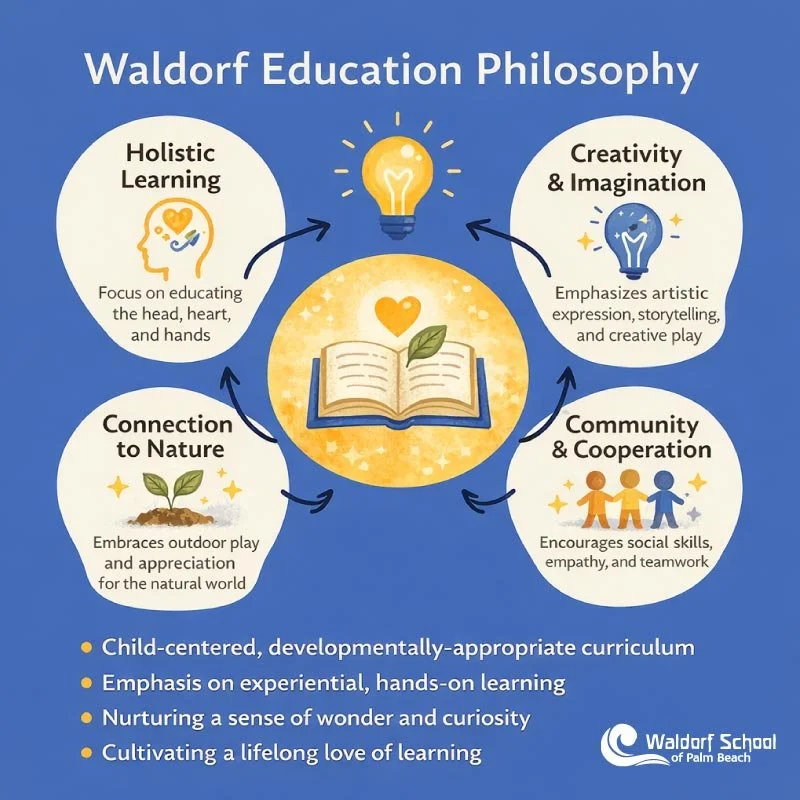
Honoring Childhood as Sacred: Why Waldorf Protects the Early Years
One of the most distinctive features of the Waldorf education philosophy is how it treats the early childhood years, birth through roughly age seven. This phase is a time for sensory exploration, imitation, warmth, and play. Not formal academics. Not flashcards.
Why? Because a child’s brain, body, and nervous system are developing in ways that need space, not pressure. When young children engage in imaginative play and sensory exploration with natural materials, they build the neural architecture that supports reading, math, and abstract thinking later. Push academics too early, and you can actually undermine the very capacities you are trying to develop.
This is why Waldorf early childhood classrooms look the way they do. Soft lighting. Wooden toys. Generous outdoor time. Stories told, not streamed. Our nursery program is built on these principles, and families often tell us the change in their child’s calm and creativity is noticeable within weeks. The Waldorf education preschool experience offers a rare refuge from hurry, which is exactly what young children need.
A common concern parents raise is simple. Will my child fall behind? Research from organizations like the Alliance for Childhood consistently finds the opposite. Early academic pressure does not produce long-term advantage. Children who experience play-based learning and nature-based education in their early years often outperform peers on measures of reading, problem-solving, and social-emotional development by later elementary grades.
The Waldorf education preschool model is grounded in this evidence. Play-based learning is the work of childhood, and protecting it is one of the most academically sound choices a school can make.
The Role of Rhythm and Repetition in Early Development
Walk into any Waldorf early childhood classroom, and you feel something steady. A rhythm. The same songs at circle time. Bread baking on Tuesdays. Painting on Fridays. Seasons are celebrated with festivals that return year after year.
This is intentional. Young children thrive on predictability. Rhythm and repetition regulate the nervous system, reduce anxiety, and create a sense of security that allows children to explore freely. Rhythm and repetition are not scheduling tools. They are developmental ones. This is one of the quieter gifts of the Waldorf learning style, and one of the reasons the Waldorf learning style produces such grounded children. Our classrooms breathe with the seasons, and the children breathe with them.
The Philosophy of Developmental Stages: Meeting the Child Where They Are
Steiner observed that children move through three distinct seven-year phases, each with its own inner character. Understanding these developmental stages is central to the Waldorf teaching method, and it separates Waldorf from almost every mainstream approach.
The first seven years are about the body and the will. Children learn through imitation and sensory exploration of the physical world. The second phase, roughly seven to fourteen, is the heart of childhood. Children learn through feeling, imagery, and story, which is why the Waldorf teaching method weaves academics into imaginative learning that speaks to the child’s emotional life. The third phase, fourteen to twenty-one, is the age of independent thinking and judgment. Abstract reasoning, rigorous academics, and the pursuit of personal truth come fully into focus.
The Waldorf methodology does not rush children through these stages. Each one has work to do. Forcing abstract thinking on a seven-year-old disconnects them from their body and feelings. Skipping the imaginative stage creates thinkers who struggle with empathy and meaning. Honoring the natural unfolding builds whole, integrated human beings. The Waldorf program is built on depth, meaning, and integrity, not speed.

Why Arts and Imagination Are Central, Not Optional
In most American schools, the arts are the first thing cut when budgets tighten. The Waldorf school philosophy takes the opposite position.
Artistic engagement develops flexible thinking, empathy, and the capacity to see multiple perspectives. When a child learns fractions by dividing a watercolor painting into proportional sections, or learns history by performing a scene from ancient Egypt, they are not just absorbing content. They are integrating it. Arts integration is one of the most powerful forms of experiential learning we know, and experiential learning sticks in ways that memorized facts never do.
At Waldorf School of Palm Beach, we weave visual arts, music, movement, handwork, and drama into every academic subject through our curriculum. Math through form drawing. Science through observation and watercolor. Language arts through storytelling and performance. This is holistic education in practice. Subjects do not live in silos because the human being does not live in silos.
Research tracked by the Association of Waldorf Schools of North America points to Waldorf alumni reporting high levels of creativity, critical thinking, and leadership capacity. Many describe learning to think by learning to do and create. In this way, the Waldorf program treats the arts not as enrichment, but as how real thinking actually happens.
The Connection Between Handwork and Brain Development
Knitting. Woodworking. Gardening. Sewing. These are not quaint traditions inside the Waldorf approach. They are a strategic pedagogy.
Activities that require the hands to work with intention integrate the brain in powerful ways. Fine motor coordination. Patience. Sequencing. Spatial reasoning. Hands-on learning builds the same neural pathways used for complex thinking and problem-solving later. When a fourth grader knits her own recorder case, she is building focus, resilience, and pride in her work. She is also building cognitive scaffolding that will serve her in geometry three years from now. Hands-on learning makes this connection concrete, and the Waldorf methodology treats it as central, not supplemental.
Anthroposophy and Spirituality: What It Means and Doesn’t Mean
Let us address the question parents often whisper before they ask it out loud. Is Waldorf religious? The answer is no. It helps to understand where the philosophy comes from.
The Waldorf education philosophy is rooted in anthroposophy, Rudolf Steiner’s name for his spiritual science. Anthroposophy views the human being as body, soul, and spirit. It is a worldview that honors the full dimension of what it means to be human, including the parts of us that reach for meaning, beauty, and connection.
In the classroom, anthroposophy education looks less like religious instruction and more like reverence. Reverence for nature. For story. For each child. Anthroposophy education supports human development, not doctrine. Families of every faith and no faith attend Waldorf schools. Palm Beach families of all backgrounds find this a breath of fresh air, a school that takes childhood seriously without asking anyone to believe anything in particular.
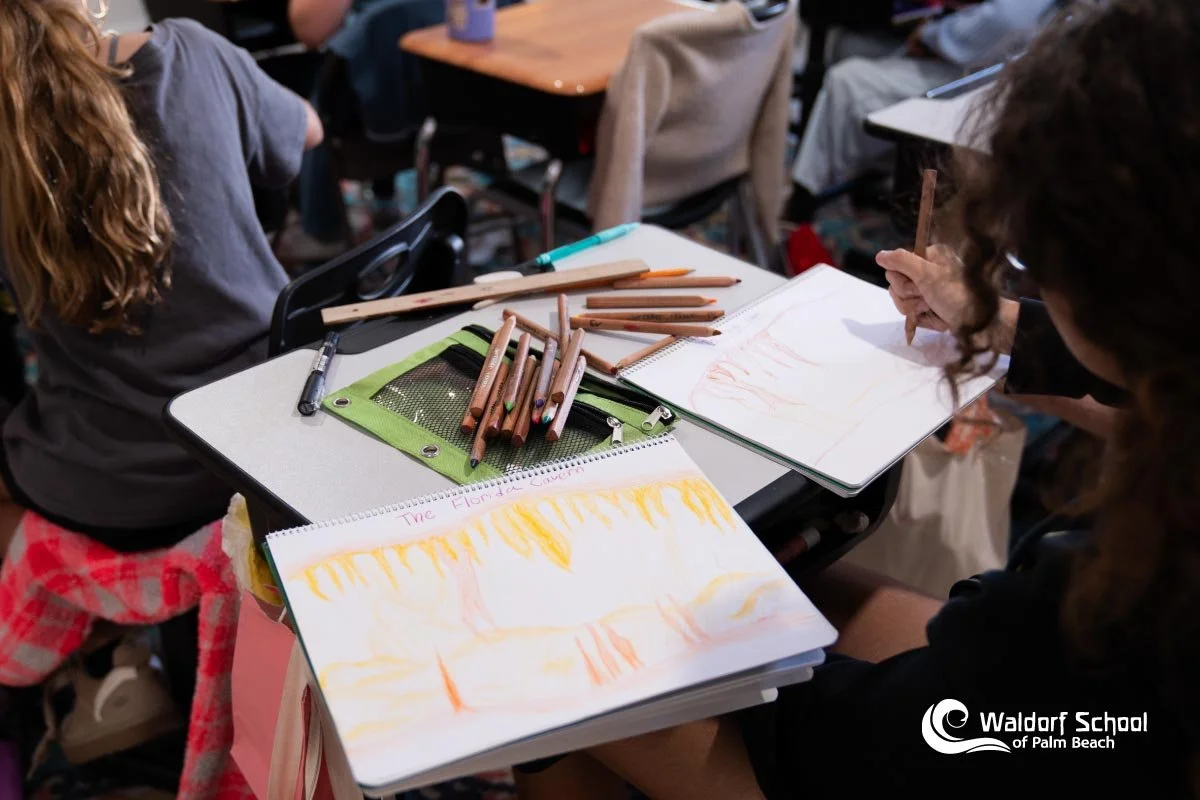
Why Community and Teacher Relationships Are Foundational
Learning happens in relationship. This belief shapes one of the most distinctive features of the Waldorf teaching method. Class teachers loop with their students for multiple years. In the elementary grades, a single teacher often stays with the same class for several years at a stretch.
This is philosophy, not logistics. When a teacher knows your child deeply over many years, they can guide with precision. They know when to push and when to wait. They know the shape of each child’s becoming. This kind of deep teacher-student relationship creates the soil in which emotional safety grows, and emotional safety is the condition for real learning. Strong teacher-student relationships are not a perk. They are an educational infrastructure.
At Waldorf School of Palm Beach, our small class sizes and tight-knit community are direct expressions of this Waldorf philosophy of education. Children do not get lost here. They get known.
Graduates of Steiner education programs often speak about their teachers decades later with the kind of warmth most people reserve for family. That is not sentimental. That is the measurable outcome of a philosophy that treats relationships as the foundation. Steiner education consistently produces adults who value deep connection, and that begins here in the classroom.
The Role of Parent Partnership in Waldorf Philosophy
The Waldorf educational philosophy sees parents as co-educators. The home and the school work as a team to support the child’s healthy development. Rhythms at home echo rhythms at school. Screen practices, mealtimes, bedtimes, and festivals all create a coherent world for the child. This is part of what makes the Waldorf educational philosophy so effective. Children receive one consistent, nourishing culture that supports who they are becoming.
Conclusion
The Waldorf education philosophy is not simply a teaching method. It is a worldview. It says childhood matters. Imagination matters. Human beings are far more than test scores or college applications.
We live in a noisy, accelerated moment. Families across Palm Beach County are searching for something that slows the pace and puts the child, not the system, at the center. Whole-child development is not a marketing phrase here. It is the daily practice.
If any of this resonates, the best way to understand Waldorf is to feel it. Come visit. Watch children absorbed in painting, digging in the garden, reciting poetry they have memorized together.
You can schedule a campus tour any time, or explore our 2026 summer program to give your child a taste of the experience. Children who are free to unfold at their own pace, rooted in nature and nourished by beauty, grow into adults who meet whatever the future brings with creativity, courage, and compassion. That is the philosophy. That is the promise. And that is what we practice every day here in Palm Beach.
Frequently Asked Questions
Is Waldorf education philosophy religious?
No, the Waldorf education philosophy is not religious. While it is rooted in Rudolf Steiner’s anthroposophy, a spiritual worldview, classrooms do not teach religious doctrine. Teachers nurture reverence for nature, story, and each child. Families of every faith and no faith attend Waldorf schools and feel genuinely welcomed.
Why does Waldorf philosophy delay technology and formal academics?
Waldorf philosophy delays technology and formal academics to protect early childhood development. Young children need sensory exploration, play, and imagination to build the neural foundation for later learning. Research shows early pressure does not create long-term advantage, while play-based learning builds stronger cognitive and emotional capacities that last a lifetime.
How does Waldorf philosophy prepare children for the real world?
Waldorf philosophy prepares children by building resilient, creative thinkers who adapt to change. Students develop strong communication, critical thinking, and problem-solving skills through experiential learning and arts integration. Graduates often report feeling exceptionally prepared for college, careers, and life because they learned to think deeply, not just memorize content.
What is the role of imagination in Waldorf philosophy?
Imagination sits at the center of Waldorf philosophy because it powers flexible thinking, empathy, and creativity. Through storytelling, artistic work, and open-ended play, children develop the ability to visualize, innovate, and see multiple perspectives. Imagination is not a break from learning inside a Waldorf classroom. Imagination is learning itself.