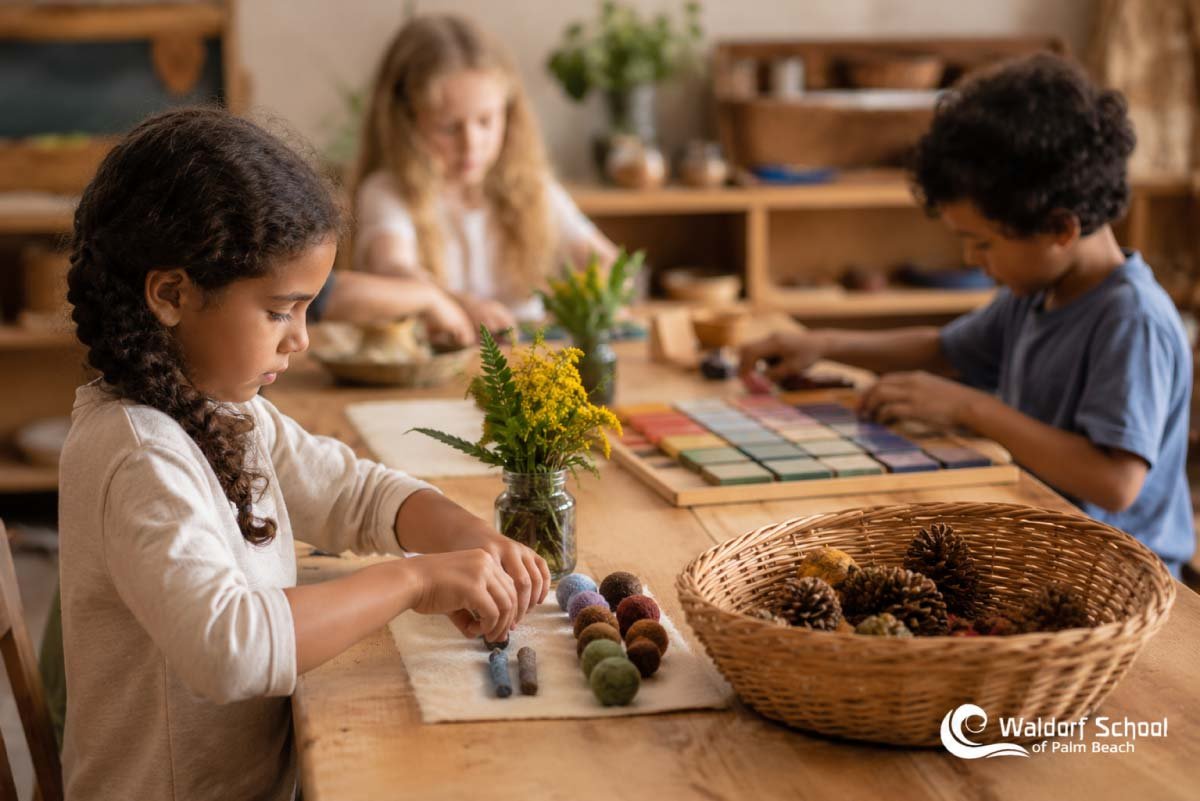
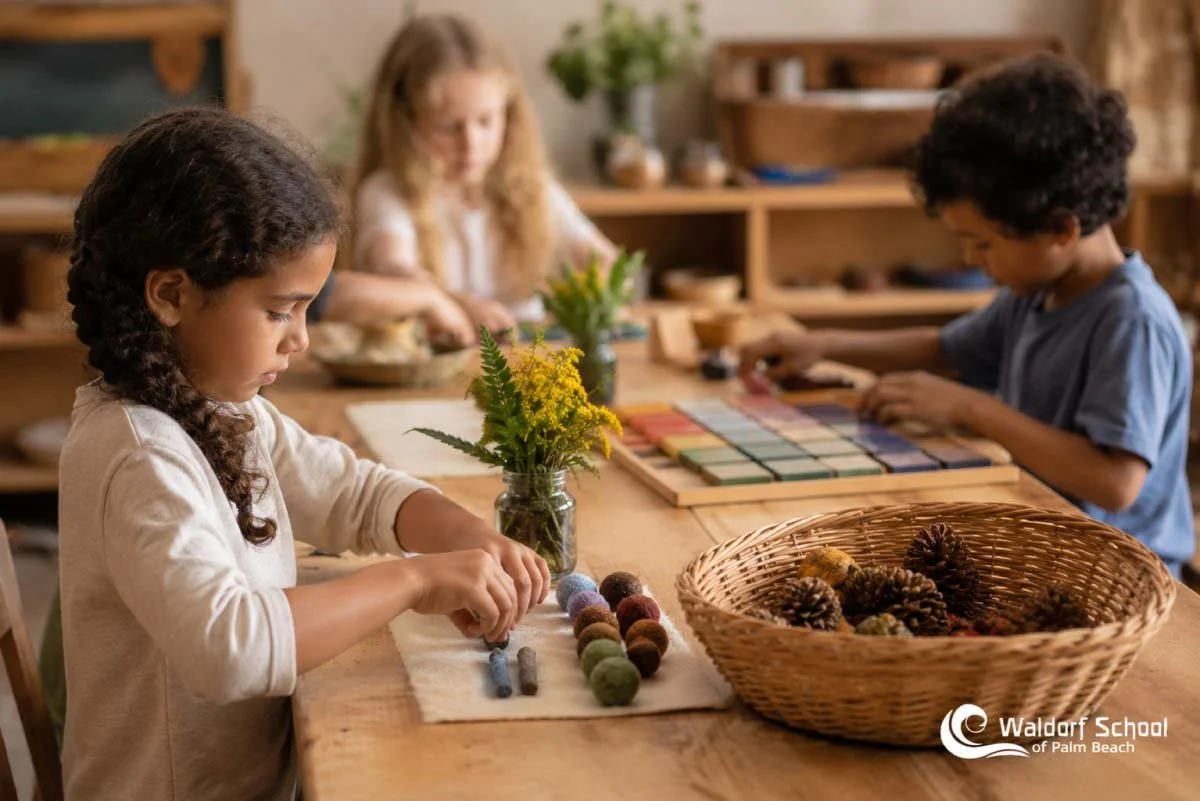
Most parents who end up at the Waldorf School of Palm Beach for the first time describe the same moment. They are standing in a hallway in Boca Raton, watching a class teacher draw a careful chalkboard illustration in colored pastels, and a child nearby is reciting a poem from memory while another stitches something out of wool. And the question that surfaces, every time, is some version of: what is my child actually being taught here, and does it add up to a real education?
The Waldorf curriculum is a developmental, arts-integrated program of study delivered in concentrated subject blocks and designed to match what a child is ready for at each stage from early childhood through high school. It is not a slower version of conventional schooling. It is a different organizing principle entirely, one built around how children grow rather than around grade-level benchmarks.
People often ask: what is the Waldorf curriculum, and is it actually rigorous? Yes, and that's what brings families across Palm Beach County to our campus week after week. By the time a Waldorf student finishes grade 8, they are working in algebra, plane geometry, chemistry, and original research writing. By grade 11, they are reading literature, completing lab sciences, and defending capstone projects. The slower start in the early grades is not a slower finish.
What follows is a parent-perspective walkthrough of the three developmental phases that organize the entire curriculum, what's taught when (and why), how the Waldorf School of Palm Beach delivers it from preschool through grade 11, and what parents tend to notice in their own children year over year. This is not a subject-by-grade catalog, that already lives on our detailed Waldorf curriculum from early childhood through grade 8 hub page. This is the explanation that makes the catalog make sense.
What Makes Waldorf Curriculum Different From Other Private School Curricula
Waldorf curriculum is built around child development, not grade-level standards. Subjects are introduced when the child is developmentally ready for them, not when a state benchmark says they should be.
That difference shows up everywhere. In a conventional classroom, academic content is the central measure of growth, and everything else (art, movement, music) is treated as enrichment around the edges. In a Waldorf classroom, academic learning is one of several ways a child grows, and it lives alongside artistic, physical, and social development as equal partners. None of those are extras. All of them are how the curriculum works.
Three structural differences are usually what parents notice first on a tour day. The schedule runs on main lesson blocks instead of forty-five-minute periods. The same class teacher stays with the children for multiple years rather than rotating annually. And the arts and movement (eurythmy, handwork, music, painting) are woven directly into every academic subject, not bolted on as electives.
It is worth saying plainly: Waldorf is not a fringe approach. It is the largest independent school movement in the world, with more than a thousand schools across Europe, the Americas, Asia, and Africa, all working from the same developmental framework. To understand the Waldorf curriculum, you have to understand the three phases of childhood Rudolf Steiner identified, and why each one calls for a completely different kind of teaching.
The Main Lesson Block: Why Waldorf Schools Teach One Subject Each Morning
In simple terms, a main lesson is a three-to-five-week period during which students study one subject in depth each morning, typically for two hours, instead of cycling through six subjects a day. A class might do a math main lesson for three weeks, then a history main lesson, then a botany main lesson, each one a sustained immersion before the next subject takes its place.
The reason behind it is straightforward: depth beats breadth for retention. A child who spends three weeks immersed in fractions remembers fractions a year later better than a child who got thirty minutes of fractions every day for a month. Sustained attention builds memory in a way that fragmented attention cannot.
The block also has its own internal rhythm, what teachers call review, do, new. Yesterday's content is reviewed at the start of the morning, today's work is completed in the middle, and tomorrow's content is introduced at the end. That structure mirrors how memory consolidates overnight, which is why Waldorf students often leave a block with material that genuinely stays.
Students at the Waldorf School of Palm Beach create their own main lesson book during each block. It is illustrated, handwritten, and built page by page over the weeks of study. Part textbook, part personal artifact, the main lesson book is also a quiet executive-function workout: children are responsible for organizing their own record of what they have learned, in their own hand.
The Class Teacher: Why One Teacher Stays With a Class for Years
In most Waldorf schools the class teacher stays with the same group of students for multiple years, often grades 1 through 5, sometimes longer. The same adult who taught your child to read also teaches them long division, ancient history, and how to write their first research paper.
The reason is relational. Over years of daily contact, the teacher comes to know each child's learning style, social patterns, and family context with a depth that simply cannot be built in nine months. Waldorf accepts a real trade-off here, less subject specialization in the early years, because the relationship itself does so much of the developmental work.
This aligns with what research consistently shows about teacher continuity. The strength of a student-teacher relationship is one of the most reliable predictors of both academic and social outcomes, and Waldorf builds that strength in by design rather than hoping for it as an accident.
At WSPB, our class teachers work in close partnership with subject specialists in eurythmy, handwork, music, and foreign language, so children get both the depth of relationship that comes from years with one adult and the breadth of expertise that comes from working with specialists who know their craft.
The Three Developmental Phases That Shape the Entire Curriculum
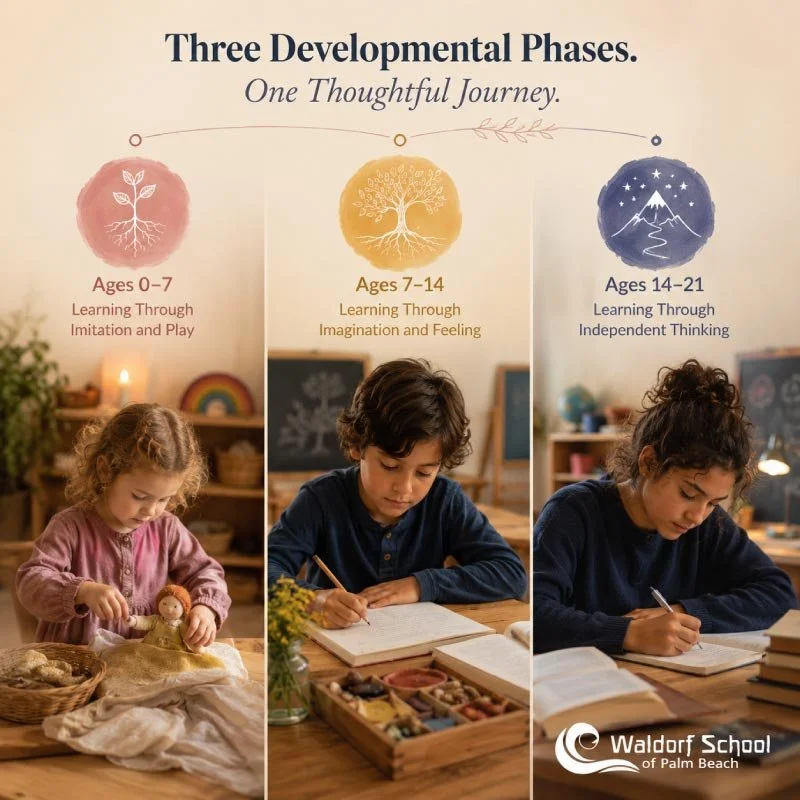
What most parents notice first, when they sit down with a Waldorf curriculum guide, is that it isn't really organized by subject. It's organized by phase. The Waldorf curriculum is built around three developmental phases (birth to age 7, ages 7 to 14, and ages 14 to 21) each with its own teaching approach, its own classroom feel, and its own answer to the question of what a child of that age can actually do.
The premise underneath this is that children pass through clear developmental shifts roughly every seven years, and that effective teaching meets the child at the stage they're actually in, not the stage a standardized curriculum says they should be in. This is the principle Rudolf Steiner emphasized to teachers when the first Waldorf school opened in Stuttgart, Germany, in 1919: comprehend these phases fully and bring age-appropriate content that nourishes healthy growth. Every Waldorf school in the world, including ours, is built on this foundation. (For readers who want to go deeper into the philosophy itself, our page on Waldorf educational philosophy covers it in more detail.)
Each phase looks completely different in the classroom, and each one solves for what a child of that age is actually capable of.
Phase One: Early Childhood (Ages 0–7) — Learning Through Imitation and Play
In the first phase children learn primarily through imitation, what they see modeled by the adults around them, and through unstructured, imaginative play. Formal academics are intentionally postponed. Build the soil before planting the crop.
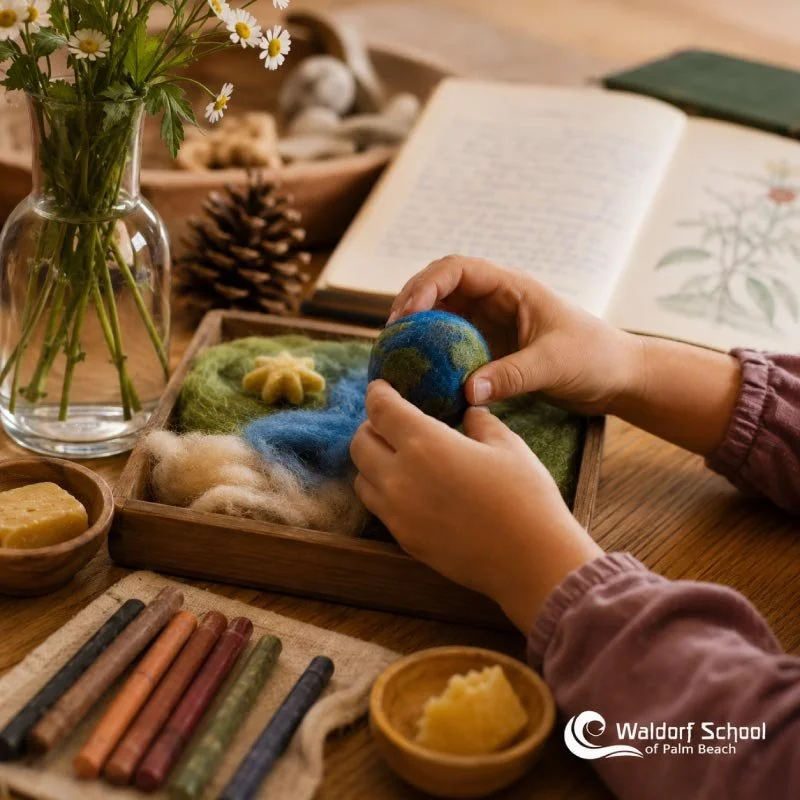
A typical morning includes a circle with verses and songs, free play indoors and outdoors, baking or cooking, watercolor painting, beeswax modeling, story time, nature walks, and the seasonal festivals that mark the year: Michaelmas in the fall, the Lantern Walk, the Advent Spiral, May Day.
The question every researching parent has is: why doesn't Waldorf teach reading until age 6 or 7? The same energy a young child uses for physical and imaginative development is the energy they will later draw on for literacy. Pulling that energy into reading too early borrows from foundations that aren't fully built yet. Emerging research suggests that play-based early childhood approaches, when compared with academic kindergartens, show meaningful long-term advantages in reading, writing, and self-regulation by the later elementary years. The science is still developing, but it increasingly aligns with what Waldorf has practiced for over a century.
At WSPB, our Parent and Child program, Nursery, and Kindergarten classes follow this phase faithfully: protected, screen-free, rhythm-based, and designed to build the inner readiness that academics will draw on later.
Phase Two: The Grade School Years (Ages 7–14) — Learning Through Imagination and Feeling
Between the change of teeth (around age 7) and puberty (around age 14), children learn most deeply through imagination, story, and emotional engagement. The curriculum responds with rich narrative content (fairy tales, fables, myths, history through biography) and a steady ramp into rigorous academics.
The progression is unmistakable once you see it. Grade 1 starts with fairy tales and the introduction of letters as living forms. Grade 2 brings fables and stories of saints and heroes. Grade 3, what Waldorf teachers call the "nine-year change," introduces practical work like farming, building, and Old Testament stories, because nine-year-olds are experiencing themselves as separate from the world for the first time and need work that connects them back to it. Grade 4 brings Norse mythology and fractions. Grade 5 explores ancient civilizations. Grade 6 begins Roman history, business math, and physics through the study of light and sound. Grades 7 and 8 deepen into the Renaissance, algebra, chemistry, and historical biography.
The literary content is not decorative. A child reading Norse mythology in grade 4 isn't just learning stories, they are processing themes of courage, individuality, and consequence at exactly the moment that maps to their inner development. The match between content and child is the whole point.
Academic rigor deserves a direct answer. By grade 8, Waldorf students are doing algebra, plane geometry, chemistry, and writing original research. The slower start in early grades is not a slower finish. At WSPB, our class teachers carry students through this arc in partnership with subject specialists, and the developmental progression is designed to leave grade 8 graduates academically prepared for high school work, wherever they go next.
Phase Three: High School (Ages 14–21) — Learning Through Independent Thinking
In the high school phase the curriculum shifts toward critical thinking, abstract reasoning, and the student's emerging ability to form independent judgments about science, literature, history, and themselves. This is the moment a Waldorf education has been building toward.
The structure shifts too. Students still have main lesson blocks, now four weeks long, but content is taught by subject specialists rather than by a single class teacher. The day is denser, the discussion is more demanding, and the student is asked to do more of the intellectual work themselves.
Academically, the Waldorf high school curriculum runs honors-level humanities, mathematics through calculus, lab sciences, world languages, and a senior capstone project requiring independent research and original work. It is a college-preparatory program with arts and movement woven in.
On the question of college readiness: Waldorf high schools are college-preparatory by design, not by test prep, but by depth of thinking. Waldorf graduates are accepted at competitive colleges nationally, and the executive function skills Waldorf builds (the ability to research, write, present, and defend ideas) are exactly what colleges report wanting from incoming freshmen.
The Waldorf School of Palm Beach is Florida's first private Waldorf high school, serving grades 9 through 11 in Boca Raton. The high school program continues the developmental arc that students have been on since early childhood, meaning families don't have to leave Waldorf education when their child reaches high school.
How the Waldorf Curriculum Is Delivered at the Waldorf School of Palm Beach
At the Waldorf School of Palm Beach, the curriculum is delivered as a continuous developmental arc, early childhood through grade 11, on a single Boca Raton campus serving families across Palm Beach County.
A few things make WSPB's delivery distinctive. The continuous program from PreK through grade 11 is rare in the region. The school is AWSNA-affiliated (the Association of Waldorf Schools of North America), and class teachers carry students through the developmental phases described above with the support of dedicated subject specialists in eurythmy, handwork, music, Spanish, and the upper-grade sciences.
The geography matters too. WSPB serves families from Boca Raton, Delray Beach, West Palm Beach, Boynton Beach, and Coral Springs, drawing from the full Palm Beach County region and beyond. Some children make a real commute to be here, and most of those families say the same thing: the curriculum is the reason.
The special subjects are integrated into the school day, not held off as extras. Eurythmy (an expressive movement art that turns speech sounds and music into deliberate, visible gestures, developed by Rudolf Steiner and Marie Steiner-von Sivers in the early 1900s) is taught from kindergarten through grade 11. Handwork (knitting, sewing, weaving, woodwork) is taught from grade 1 onward. Music includes string instruments and choral singing. Spanish runs across the grades. Festivals (Michaelmas, the Lantern Walk, the Advent Spiral, May Day) anchor the school year in rhythm and shared community life.
The clearest way to see all of this is to be on campus when it's happening. Campus tours, seasonal festivals, end-of-year demonstrations, and parent education events are all moments when prospective families can watch the curriculum in motion rather than read about it on a website.
The Questions Most Parents Ask Before They Commit
In our experience, parents researching the Waldorf curriculum almost always have the same two questions, and the answers are simpler than the philosophy can sound. The first is whether their child will be academically prepared, especially for college. The second is what happens if a family transfers in from a traditional school, or transfers out at some point along the way. The FAQ section below answers these directly.
Conclusion: How to Know If the Waldorf Curriculum Is Right for Your Child
The Waldorf curriculum has been shaping children continuously for over a century. In an era of screen-saturated childhoods and standardized output, its fundamentals have aged better than most education systems built in the same century. A movement that began as one school now spans more than a thousand schools across the world, not because Waldorf is a niche alternative, but because the developmental picture it works from has held up.
The Waldorf curriculum is best understood not as a list of subjects but as a developmental arc, structured around three life phases, delivered in main lesson blocks, integrated across academics, arts, and movement at every grade. The question for parents isn't whether the curriculum is rigorous. It's whether the philosophy fits your child.
The most reliable way to find out is to see it in person. Schedule a campus tour at the Waldorf School of Palm Beach in Boca Raton. Observing a main lesson, walking past the eurythmy room, and meeting class teachers will answer questions that no website ever will. Families also visit during seasonal festivals and our parent-and-child program, both of which show the curriculum in motion.
The parents who end up most certain Waldorf is right for their child are usually the ones who watched a class for ten minutes and felt something settle. (For more context before you tour, our complete parent's guide to Waldorf education covers the broader picture.)
Frequently Asked Questions
What is the Waldorf curriculum in simple terms?
The Waldorf curriculum is a developmental, arts-integrated education program that introduces academic content when children are developmentally ready for it, typically reading and writing around age 6 or 7, formal sciences around age 11. Subjects are taught in three-to-five-week main lesson blocks rather than 45-minute periods, and arts, music, and movement are woven into every academic subject.
Is the Waldorf curriculum academically rigorous?
Yes. Waldorf curriculum is academically rigorous, particularly in the upper grades. By grade 8, Waldorf students are doing algebra, plane geometry, chemistry, and original research writing. By high school, the curriculum includes honors humanities, mathematics through calculus, lab sciences, and a senior capstone project. The slower academic start in early grades is not a slower academic finish.
How is the Waldorf curriculum different from Montessori?
Waldorf and Montessori share a respect for the child but differ in approach. Montessori emphasizes self-directed work with specially designed materials and individualized pacing. Waldorf emphasizes class community, teacher-led storytelling, integrated arts, and a curriculum delivered in concentrated subject blocks. Both can be excellent. The question is which approach matches your child.
What does Waldorf kindergarten curriculum include?
A Waldorf kindergarten curriculum includes circle time with verses and songs, free imaginative play, baking and cooking, watercolor painting, beeswax modeling, story time, nature walks, and seasonal festivals. Formal reading and writing instruction is intentionally postponed until first grade. The focus is on sensory, motor, and language development through real-world activity rather than worksheets.
Does the Waldorf high school curriculum prepare students for college?
Yes. Waldorf high school is college-preparatory in structure, with honors-level humanities, mathematics through calculus, lab sciences, world language, and a senior capstone project. Waldorf graduates are accepted at competitive colleges nationally. The Waldorf School of Palm Beach in Boca Raton serves grades 9 through 11.
Where can I see the Waldorf curriculum taught in Palm Beach County?
The Waldorf School of Palm Beach in Boca Raton teaches the full Waldorf curriculum from early childhood through grade 11, and welcomes prospective families to observe classes during campus tours and seasonal festivals. WSPB serves families from across Palm Beach County, including Delray Beach, West Palm Beach, Boynton Beach, and Coral Springs. Scheduling a tour is the simplest way to see the curriculum in practice.
What if my child transfers into Waldorf from a traditional school — will they catch up?
Most students transferring into Waldorf adjust within a few months, particularly in the elementary years. The class teacher works closely with the student and family to identify gaps and integration points, and Waldorf's emphasis on whole-child development means strong students often discover capacities they didn't know they had. Transfers are most common in early elementary and most carefully evaluated in middle and high school.