
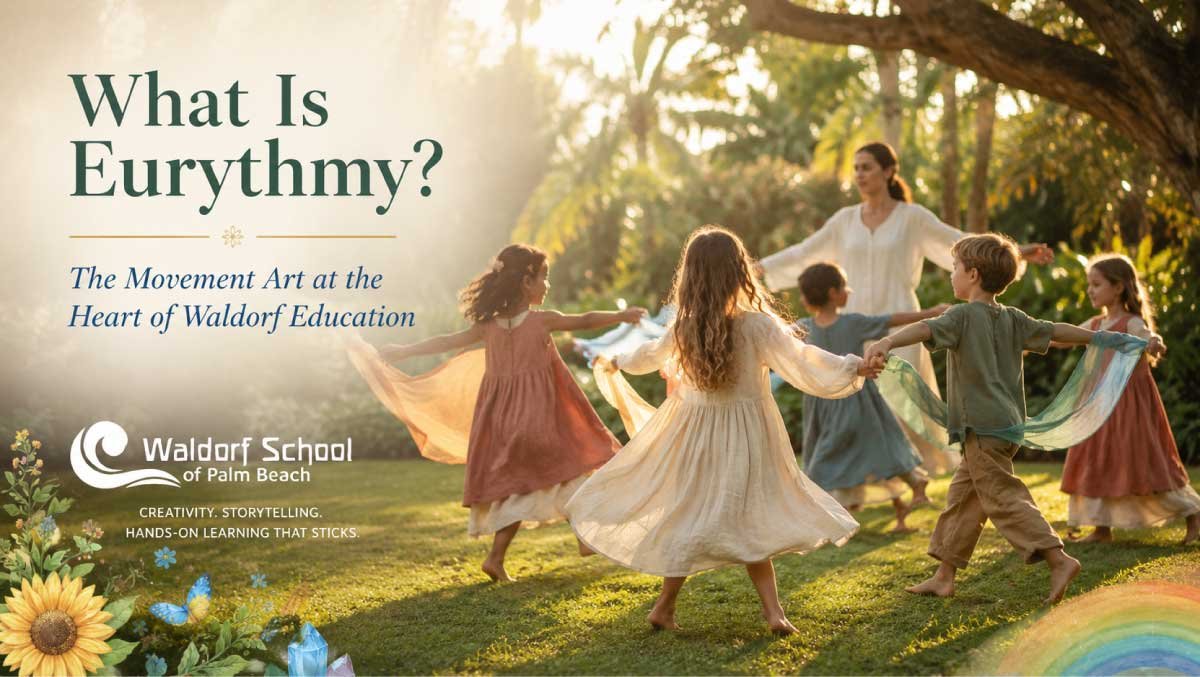
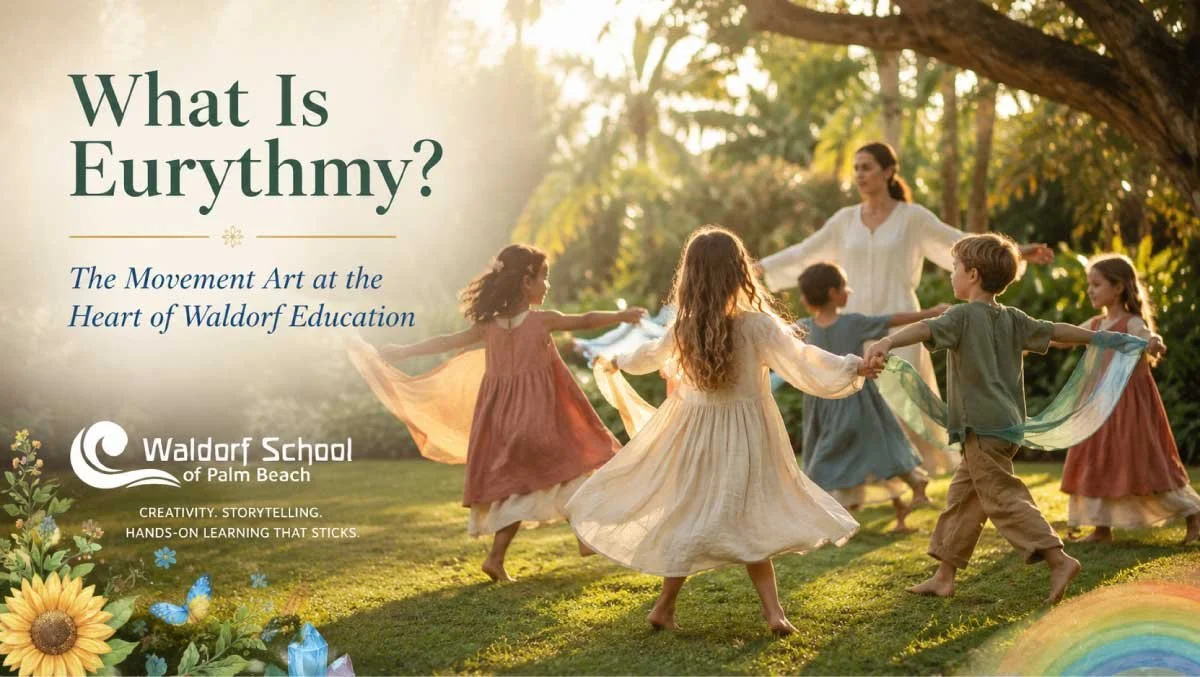
Imagine standing at the edge of a classroom at the Waldorf School of Palm Beach, watching a group of children move in a quiet circle on the Boca Raton campus. Their arms rise and fall with spoken poetry. Their gestures feel purposeful, almost like a language you have not yet learned to read.
You might wonder if you are watching a dance rehearsal, a theater warm-up, or something else entirely. What you are watching is eurythmy, and it is likely the most misunderstood subject in Waldorf education.
Eurythmy is a movement art that makes speech and music visible through deliberate gesture, developed by Rudolf Steiner in the early 1900s and taught in Waldorf schools ever since. Parents touring the Waldorf School of Palm Beach ask the same question every time. Is this a dance? The answer is no, and the longer answer is what this guide explains.
This walkthrough covers a clear eurythmy definition, the developmental benefits, and what your child actually gains at each grade level, drawn from what teachers at WSPB observe in classrooms every week. Our Waldorf educational philosophy places eurythmy at the center of how we teach.
Eurythmy Definition and What the Word Actually Means
Eurythmy is an expressive movement art that translates the sounds of speech and the tones of music into deliberate, visible gestures. That is the cleanest eurythmy definition parents can keep in their pocket.
The Greek roots help here. "Eu" means well or harmonious, and "rhythmos" means rhythm. The full eurythmy meaning lands close to harmonious rhythm, although most articles online lean too heavily on this etymology and never reach the practical part.
Eurythmy shares nothing with interpretive dance, yoga, or theater warm-ups. The word itself predates Steiner by centuries, used by ancient Greek and Roman architects to describe harmonious proportions in design. To understand why this art form ended up in every Waldorf classroom worldwide, we have to go back to 1919.
Where the Word Eurythmy Comes From
The term traveled a long road before it reached Waldorf classrooms. Greek architects used it to describe harmonious proportions. By the 17th and 19th centuries, English writers had adopted it to describe graceful bodily carriage.
Rudolf Steiner adopted and redefined the word in 1912 to describe the movement art he was developing alongside his wife, Marie Steiner-von Sivers. In short, eurythmy means harmonious rhythm, a name that captures both its origin and its purpose. This etymology is widely cited by sources including the Association of Waldorf Schools of North America, and it is documented in broader accounts of the history of eurythmy as well.
How Eurythmy Differs From Dance, Mime, and Movement Therapy
Eurythmy shares territory with dance and mime, although it follows a different rule. Every gesture corresponds to a specific sound, tone, or soul quality, never a choreographer's creative interpretation.
Where dance expresses emotion through the body, eurythmy expresses speech and music through the body. The distinction is structural, not stylistic. Where mime represents objects and actions, eurythmy represents the inner movement of language itself. There is also therapeutic eurythmy, a separate clinical application covered later in this guide.
Where Eurythmy Came From and the Story of Rudolf Steiner
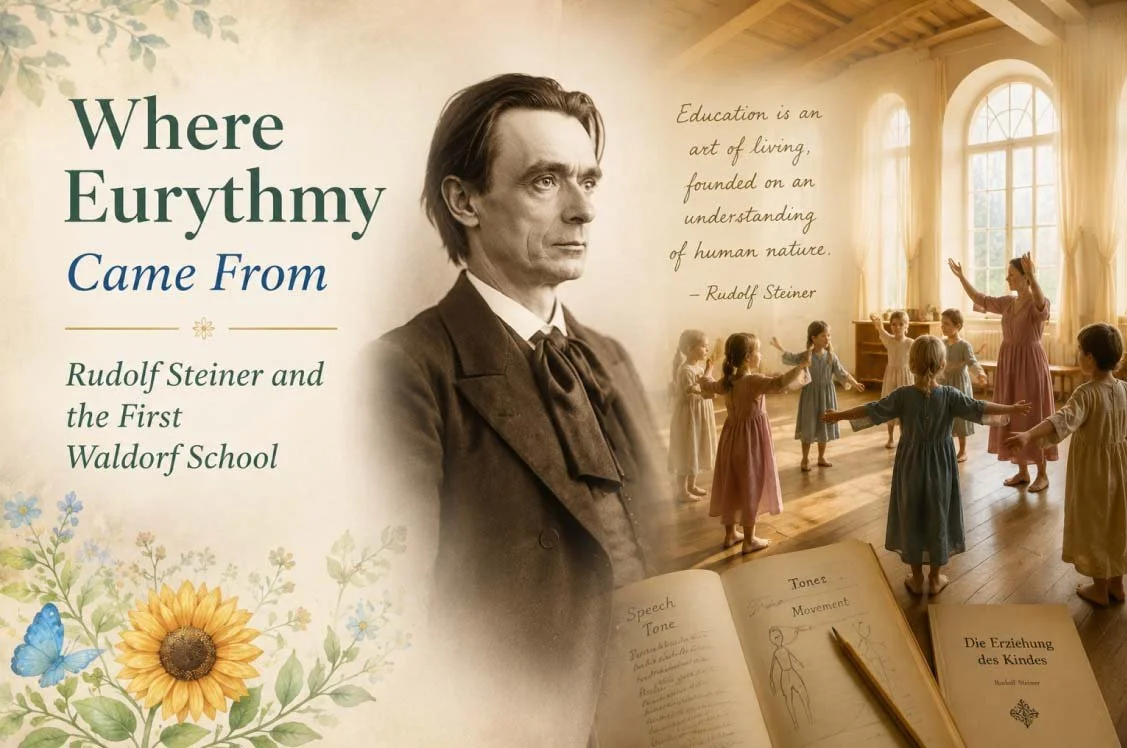
The lesser-known origin story starts in 1911, when a young woman named Lory Smits asked Rudolf Steiner for guidance on a movement-based career. That single conversation became the seed of an art form taught in Waldorf schools for more than a century.
Rudolf Steiner, an Austrian philosopher and scientist who founded anthroposophy, built eurythmy on the premise that every speech sound and musical tone has a corresponding archetypal gesture.
When Steiner founded the first Waldorf school in Stuttgart in 1919, eurythmy was part of the curriculum from day one. It has been taught continuously in Waldorf schools for over a century, and at the Waldorf School of Palm Beach since the school's founding. Why is eurythmy taught in Waldorf schools? Steiner believed that disciplined movement awakens the thinking life of the child, a principle that still guides our Waldorf curriculum at WSPB today.
Marie Steiner-von Sivers, often overlooked in shorter retellings, was the co-developer who shaped much of the early speech eurythmy practice. For a deeper look at the philosophical roots, our piece on Steiner's broader philosophy covers the anthroposophy background. The original cultural home of the practice is the Goetheanum in Switzerland.

The Three Forms of Eurythmy Parents Will See at WSPB
There are three main types of eurythmy, and each serves a distinct role in Waldorf education. The three forms are speech eurythmy, tone eurythmy, and therapeutic eurythmy. Each shows up at different points in a child's WSPB journey from early childhood through grade 11. Parents who walk past the eurythmy room across a single school year rarely see the same thing twice.
Speech Eurythmy and How It Makes Language Visible
Speech eurythmy assigns a specific gesture to every sound of human speech, including vowels, consonants, rhythms, and intonations. When a child performs the word "tree," the "T" gesture grounds, the long "E" extends upward, and the word's inner life becomes physically visible.
The benefit shows up quickly in literacy. This physical phonemic connection supports reading, writing, and language comprehension, especially in younger grades. Lessons in the lower grades draw heavily on poetry, fairy tales, and recited verse.
Tone Eurythmy and How It Makes Music Visible
Tone eurythmy translates musical elements such as pitch, interval, melody, and rhythm into gestures and group movement forms. A live pianist or musician typically accompanies tone eurythmy lessons, and recorded music is rare.
At WSPB, our eurythmy and music programs are intentionally interwoven, with the same instructor often supporting both. Tone eurythmy reinforces musical literacy, scale recognition, and listening skills, complementing rather than replacing music class. Older students often perform complex compositions by Beethoven and Bach at end of year demonstrations.
Therapeutic Eurythmy and Movement as Healing
Therapeutic eurythmy, also called curative eurythmy, is a clinical application that intensifies and modifies eurythmic gestures to support healing of specific physical, emotional, or developmental conditions. Think of it as the medical sibling of classroom eurythmy, carrying the same vocabulary toward a different goal.
Therapeutic eurythmy is prescribed by a physician working alongside a trained eurythmy therapist. Documented use cases include developmental delays, sensory integration challenges, and motor coordination support.
What Eurythmy Actually Does for a Child's Development
Eurythmy supports child development by integrating coordination, listening, language, and social awareness into a single embodied practice. Here is what your child is actually gaining, explained in plain terms.
Coordination, Midline Crossing, and Bilateral Brain Development
Many eurythmy exercises require children to cross the body's midline, the invisible vertical line down the center of the body. That crossing strengthens connections between the brain's hemispheres.
Midline crossing is foundational for reading, writing, and complex motor tasks and occupational therapists actively target the same skill. Walking in geometric forms such as figure eights, spirals, and lemniscates trains spatial awareness, sequencing, and balance. Proprioception and bilateral coordination improve alongside it.
Language, Listening, and Literacy Skills
Because every speech sound carries a corresponding gesture, children build a kinesthetic memory of language that supports phonics, vocabulary, and reading comprehension. Integrating speech, music, and movement engages multiple brain regions at once.
The Association of Waldorf Schools of North America confirms that experiential and kinesthetic learning are integral parts of Waldorf pedagogy, and that this approach allows students to retain material at a much higher level, a finding reflected in recent education research on Waldorf movement curriculum.
Social Cohesion and Self-Regulation
Moving in synchrony with classmates trains attention, patience, and group awareness, and children learn to feel where others are without ever looking up. Anyone who has watched a Waldorf basketball team play has heard the same observation from students, that years of eurythmy training built the awareness that holds the team together.
Eurythmy teaches children to listen with their whole body and move with awareness of everyone around them.
What Eurythmy Looks Like at Each Stage of School
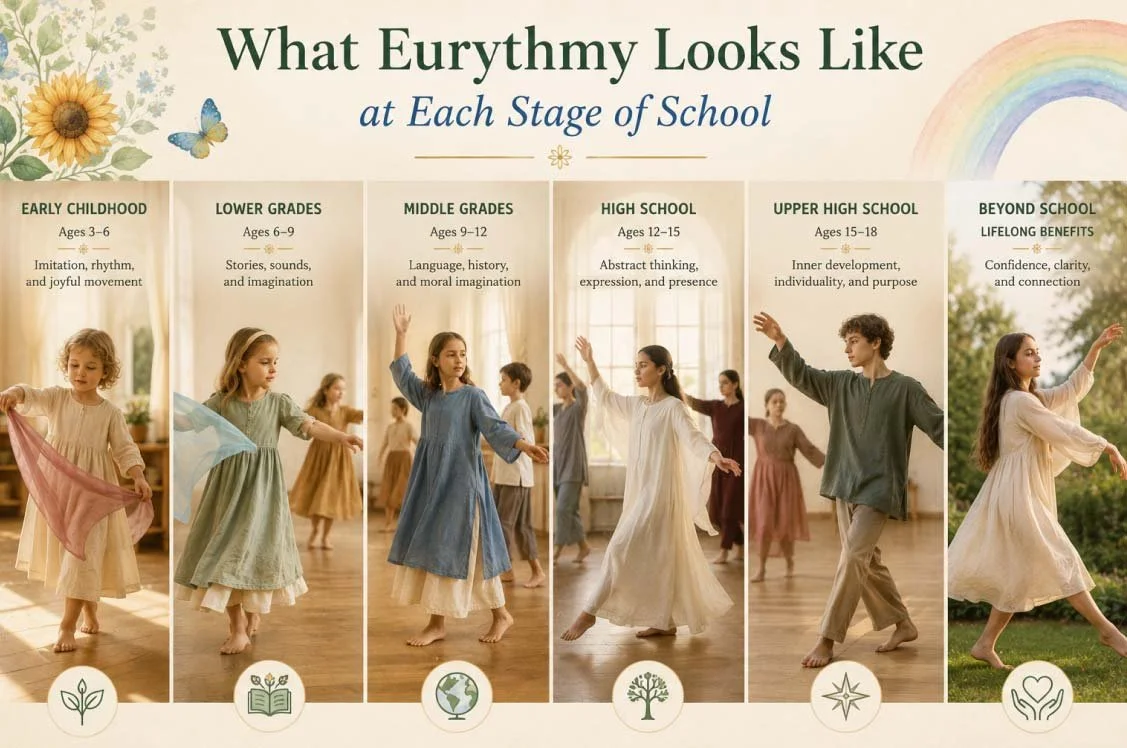
Eurythmy evolves with the child. In the early years, lessons feel like imaginative play. By middle grades, the work becomes more deliberate and structured. In high school, students perform full musical and poetic works for an audience. It is typically taught once per week through grade 3 and twice per week from grade 4 onward.
Early Childhood and Lower Grades, Ages 4 to 9
In the youngest grades, lessons feel like circle work, fairy tale narratives, and imaginative imitation. Children skip, hop, and tiptoe. The activity looks like play, and underneath it is quietly building spatial awareness. Concepts like left and right, big and small, fast and slow are introduced through repeated story-based exercises.
Grade 1 emphasizes the social circle over performance. Children learn to be part of a moving group before they are asked to stand out. Our early childhood program introduces these foundations gently.
Middle Grades, Ages 9 to 12
Form drawing arrives in earnest, and so do complex geometric eurythmy forms such as loops, eighths, triangles, and spirals. Speech eurythmy becomes more intentional at this stage, with children learning that each sound carries a specific gesture and beginning to recognize them deliberately rather than by imitation.
Tone eurythmy expands at this stage. Musical intervals are introduced, and group choreographies emerge as preparation for the more complex work of the upper grades.
Upper Grades and High School, Ages 13 to 18
Students perform full poetic and musical works in the upper grades, often choreographing their own pieces by senior year. Public performances become a regular part of school life. Eurythmy is shared with families at festivals and demonstrations rather than hidden away.
This is also when students often resist or reframe eurythmy, and that resistance, worked through honestly, becomes part of the developmental gift.
How Eurythmy Is Taught at the Waldorf School of Palm Beach
At the Waldorf School of Palm Beach, eurythmy is woven into every grade, from early childhood through grade 11, as part of the daily rhythm rather than as a special subject. The school serves families across Boca Raton, Delray Beach, West Palm Beach, Boynton Beach, and Coral Springs, and integrates eurythmy alongside handwork, music, and main lesson blocks as part of a unified arts integrated curriculum.
Families often see eurythmy firsthand at WSPB during campus tours, seasonal festivals, and end-of-year demonstrations. The school's broader philosophy of educating the whole child runs through every part of our Waldorf curriculum from early childhood through grade 8.
Common Questions Parents Ask Before Their First Eurythmy Lesson
Most parents have the same three questions about eurythmy, and the answers are simpler than the subject sounds. Will my child like it? Is it required? Does it actually work? The full FAQ block below covers a wider list, although those three keep coming up in admissions conversations across Palm Beach County.
Frequently Asked Questions
What is eurythmy in simple terms?
Eurythmy is an expressive movement art that translates the sounds of speech and the tones of music into deliberate gestures. Developed by Rudolf Steiner in the early 1900s, it is taught in Waldorf schools worldwide and described as visible speech and visible music. Every gesture corresponds to a specific sound or musical element.
Is eurythmy a religion or spiritual practice?
Eurythmy is a movement art rather than a religious practice, although it grew out of Rudolf Steiner's broader philosophy of anthroposophy. In Waldorf classrooms, children practice gestures, forms, and rhythms as part of an academic and developmental subject. Families of every background participate fully without any expectation of spiritual involvement.
Why do Waldorf schools teach eurythmy?
Waldorf schools teach eurythmy because it integrates language, music, and movement into a single embodied practice that supports brain development, coordination, and social awareness. It has been part of the Waldorf curriculum since the first school opened in 1919. Steiner believed learning takes a deeper root when the whole body is involved.
Is eurythmy the same as dance?
Eurythmy and dance are different art forms with different rules. Dance expresses emotion or narrative through choreography, while eurythmy assigns a specific gesture to each sound of speech and each musical tone. Both forms are beautiful in their own way, although only one is governed by the structure of language and music.
At what age do children start eurythmy?
Children typically begin eurythmy in Waldorf early childhood programs, often around age four, and continue through high school. At the Waldorf School of Palm Beach, students experience eurythmy from early childhood all the way through grade 11. In the youngest years, lessons feel like imaginative play with circle games and fairy tales.
Where can I see eurythmy taught in Palm Beach County?
The Waldorf School of Palm Beach in Boca Raton teaches eurythmy as part of its core curriculum and welcomes prospective families to observe lessons during campus tours and seasonal festivals. WSPB serves families from across Palm Beach County, including Delray Beach, West Palm Beach, Boynton Beach, and Coral Springs. Scheduling a tour helps tremendously.
Can adults learn eurythmy?
Adults can study eurythmy through workshops, performances, or full professional training programs that take four to five years to complete. Many parents at Waldorf schools attend introductory eurythmy sessions to better understand what their children are learning. Therapeutic eurythmy is also offered to adults in clinical settings under physician supervision.
Why Eurythmy Still Matters in 2026
In an era of screen-based learning and shrinking attention spans, eurythmy is one of the few subjects that demands full physical presence. Far from being a relic, eurythmy is one of the most quietly modern parts of Waldorf education, addressing exactly the developmental gaps contemporary research keeps highlighting.
In summary, eurythmy is the visible language of Waldorf education. Eurythmy is movement made meaningful, taught from age four through graduation, supporting cognitive, social, and physical development at the same time.
Palm Beach County families who want to understand eurythmy more deeply should observe a lesson firsthand. Schedule a campus tour at the Waldorf School of Palm Beach in Boca Raton. Seeing it answers questions that reading cannot. The children most resistant to eurythmy are often the ones who benefit most. That tension is the work, and it is the kind of work that defines a WSPB education.