
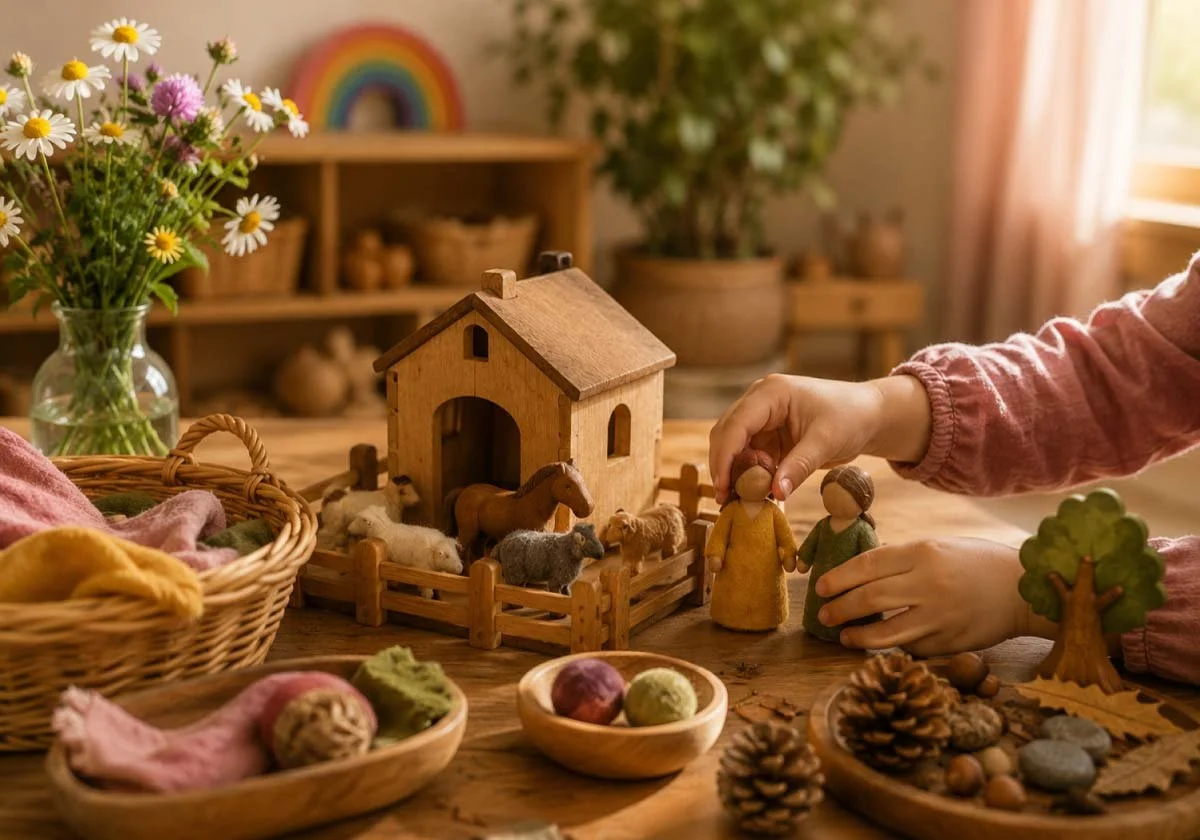
Almost every parent who walks through an early childhood program has the same quiet thought, even if they never say it out loud: this all looks lovely, but is my child actually learning anything, or just playing? It is one of the most honest questions in early education, and it deserves an honest answer rather than a brochure. If you have stood in a sunlit classroom watching four-year-olds stir a pretend soup pot and wondered whether play based learning is really learning — or whether your child is quietly falling behind — you are asking exactly the right question.
The short version: play based learning is purposeful, often child-led play that adults intentionally guide toward real developmental and academic goals. It is not unstructured free time, and it is not a break from the curriculum. In the early childhood classrooms at the Waldorf School of Palm Beach in Boca Raton, play is the curriculum — the deliberate, daily work of building the capacities that later reading, writing, and math depend on.
People often ask, is play based learning really learning? The short answer is yes — and the science behind why is what brings families across Palm Beach County to tour a campus and see it for themselves. This guide is written from the parent's chair: a clear definition you can trust, the developmental evidence behind it, how play-based education compares to academic and Montessori approaches, what it looks like at each age, and what families actually observe in a Waldorf early childhood classroom. It is shaped less by a dictionary and more by what teachers watch children gain through play every single week.
What Is Play Based Learning? A Definition Parents Can Trust
Play based learning is an educational approach where children learn through purposeful, often child-led play that teachers intentionally guide toward specific developmental and academic outcomes. The play looks spontaneous. The intention behind it is anything but.
The distinction most articles blur is intentionality. A child stacking blocks into a tower might appear to be doing nothing more than amusing herself. But the teacher chose those blocks, arranged the space, and set up the morning so that stacking would build spatial reasoning, fine motor control, and early math sense. The child keeps her agency and her delight. The adult holds the developmental goal. That partnership is the whole idea.
It helps to name what play based learning is not, because skeptical parents usually arrive carrying a few assumptions. It is not a lack of structure — the rhythm of the day is carefully planned. It is not anti-academic — it builds the foundations academics stand on. And it is certainly not babysitting. Play based learning is recognized as developmentally appropriate practice by major early-childhood organizations, which adds credibility to what good teachers have long observed in their own classrooms.
To understand why play teaches so effectively, it helps to see what is actually happening inside a child while they play.
Play Based Learning vs. Free Play — Where the Line Is
The difference between free play and play based learning is the teacher's intention. Free play is entirely child-directed, with no learning target; the children decide everything, and that open-ended freedom has real value of its own. Play based learning keeps the child's agency but adds a developmental purpose behind the setup.
Picture a play "market" in the corner of a classroom — a wooden stall, a basket of felt vegetables, a few coins. To a visitor it looks like pure imagination. But the teacher seeded that market on purpose, to draw out counting, turn-taking, and the back-and-forth conversation that builds oral language. The children think they are shopping. They are also, quietly, learning to negotiate, to wait, to add.
This is the distinction that reassures parents most. When the room looks playful, someone trained is still steering toward growth. The freedom is real, and so is the direction underneath it.
Where the Idea Comes From — Froebel, Steiner, and Modern Research
Play based learning has a long and serious lineage. Friedrich Froebel, the German educator who coined the word "kindergarten" in the 19th century, built his entire approach around guided play as the natural work of childhood. Rudolf Steiner, who founded the first Waldorf school in Stuttgart in 1919, carried that conviction further, treating early childhood play as essential developmental work rather than a warm-up for "real" school. Contemporary developmental science has since added a growing body of research on play and early learning to what these educators sensed.
What matters for a parent today is that this is not a passing trend. The Waldorf approach to early childhood education has treated play as serious developmental work for more than a century, and that conviction still anchors the early childhood philosophy at the Waldorf School of Palm Beach. The approach has roots, evidence, and a track record — three things worth knowing before you trust it with your child's first years.
Is Play Based Learning Effective? What the Development Science Actually Shows
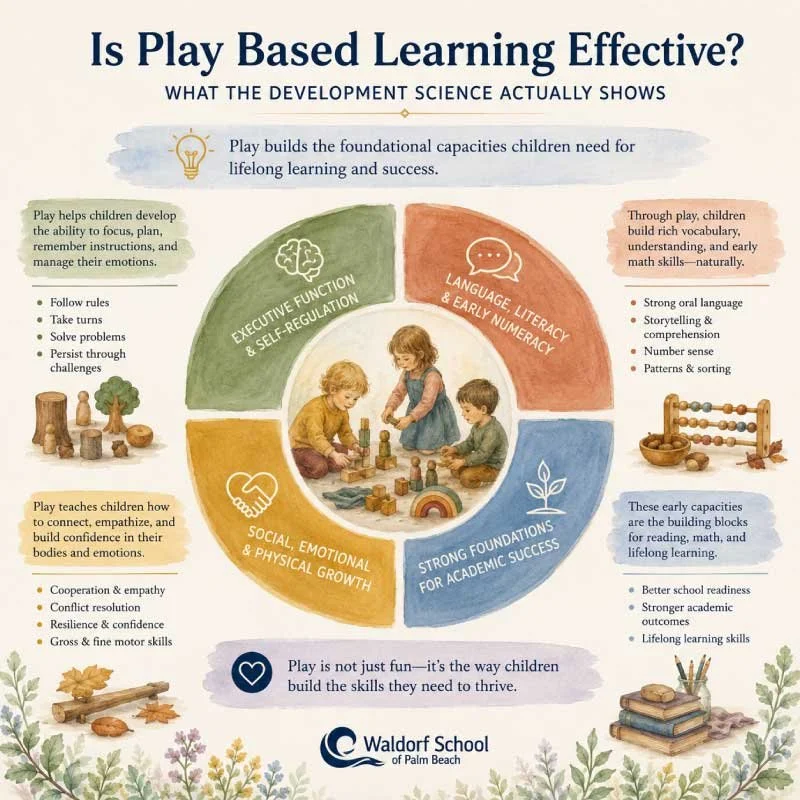
Here is what many parents do not realize: play is how young children's brains are built to learn, and the research consistently supports it. Effectiveness is not a matter of faith. It shows up in specific, nameable capacities that researchers can observe and measure.
Rather than a vague list of "benefits," the meaningful gains cluster around four mechanisms: executive function, self-regulation, oral language, and early numeracy. Each one is plain enough to picture in your own child. Together, they form the groundwork that formal academics are built on.
This is also where the real fear lives — will my child fall behind in reading or math? The reassuring truth runs the other way. Strong early oral language and self-regulation are among the foundations later reading and math depend on. Research suggests these early capacities are associated with stronger later academic performance. Play does not detour around reading and math. It lays the ground they stand on.
In short, play based learning is effective because it develops the underlying capacities — focus, language, and self-control — that all later academic learning is built upon.
Executive Function and Self-Regulation
Complex pretend play asks a great deal of a child. To run a shared game of "house" or "shipwreck," children have to hold rules in mind, take turns, adjust to other people's ideas, and manage their own impulses when the story does not go their way. Those are the building blocks of executive function — the brain's ability to plan, focus, and self-direct.
Parents should care about this because self-regulation in early childhood is associated with later school readiness — the capacity to sit with a task, follow directions, and recover from frustration. Children who can steer themselves are children who can learn.
This is also why uninterrupted time matters. Long, unbroken play blocks — a hallmark of the Waldorf early childhood day at WSPB — give these skills the room they need to develop, because real self-regulation grows in play that is allowed to unfold rather than play that is constantly cut short.
Language, Literacy, and Early Numeracy
Play is language-rich in a way worksheets rarely are. As children narrate their games, negotiate roles, and tell each other elaborate stories, they build vocabulary and sentence complexity — the very oral-language foundation that feeds directly into reading. A child who can tell a long, ordered story out loud is already practicing the architecture of a written one.
The same is true for numbers. Sorting acorns, building with blocks, making patterns, and playing shopkeeper all develop number sense well before any formal math lesson begins. Children learn that quantities can be compared, grouped, and counted because they are doing it with their hands.
It is worth being careful with the science here. Play does not magically wire a brain; it supports and reinforces these skills, giving them daily practice in a form children are wired to embrace.
Social, Emotional, and Physical Growth
Cooperative play is where children practice being people. Sharing a game means working out who goes first, what happens when feelings get hurt, and how to repair a friendship after a squabble — empathy, conflict resolution, and resilience, rehearsed in a low-stakes setting where the stakes are only a borrowed shovel.
The body grows alongside the heart and mind. Climbing, balancing, digging, and the fine handwork of a Waldorf classroom build gross- and fine-motor coordination naturally, without a child ever experiencing it as exercise. This is the whole-child educational philosophy in action: thinking, feeling, and moving developing together.
Play based learning develops the whole child — mind, heart, and body — in a single integrated experience.
Play Based Learning vs. Academic and Montessori Approaches
Most parents choosing an early childhood school are quietly running a comparison in their heads. It usually comes down to play-based versus an academic, worksheet-first preschool, with Montessori somewhere in the mix. The clearest way to think about it is sequence.
The difference between play based and academic preschool is sequence — play-based builds capacities first and formal skills second, while academic-first reverses the order. Neither approach ignores reading and math. They simply disagree about when, and about what has to be in place first.
Montessori comes up so often it deserves a direct answer. Both Montessori and play-based education honor child-led learning and trust children to follow their own interests. The difference is in the tools. Montessori uses structured, purpose-built materials moved through in a particular sequence; play-based education, especially in its Waldorf form, leans into open-ended, imaginative play with simple materials a child's mind can transform.
| Category | Play Based (Including Waldorf) |
Academic / Traditional | Montessori |
|---|---|---|---|
| Who Leads Learning? | Children explore interests while teachers guide and support. | Teachers direct lessons and classroom activities. | Children choose activities within a carefully prepared environment. |
| How Children Learn | Through imaginative play, exploration, storytelling, art, and social interaction. | Through structured lessons, teacher instruction, and academic exercises. | Through hands-on activities designed to teach specific concepts and skills. |
| Classroom Environment | Flexible, creative, and focused on discovery and collaboration. | Structured routines with group instruction and teacher-led activities. | Highly organized with dedicated learning stations and independent work areas. |
| Learning Materials | Open-ended toys, natural materials, art supplies, and dramatic play tools. | Workbooks, worksheets, flashcards, and teacher-selected resources. | Specialized Montessori materials designed for self-correction and mastery. |
| Academic Focus | Academic skills emerge naturally through play and real-world experiences. | Early emphasis on reading, writing, math, and measurable academic progress. | Academic concepts introduced through sequential hands-on learning. |
| Primary Development Goals | Creativity, social skills, self-regulation, problem-solving, and curiosity. | Academic readiness, knowledge acquisition, and classroom performance. | Independence, concentration, responsibility, and practical life skills. |
| Best For Families Seeking | A child-centered environment that nurtures creativity and whole-child development. | A structured academic approach with clear educational benchmarks. | Independent learning, self-motivation, and hands-on skill building. |
Each of these is a sincere answer to the question of how young children learn best. The right fit depends on your child and what you value in their earliest years — which is exactly why seeing an approach in person tells you more than any chart can.
What Play Based Learning Looks Like at Each Age
Play based learning evolves with the child — sensory exploration in toddlerhood, imaginative role-play in preschool, and purposeful project play in the early grades. It is not one fixed phase but a developing journey, which is useful whether you are a prospective parent picturing the years ahead or a current family wondering what comes next.
The clearest way to understand it is to picture what you would actually see walking through an early childhood and lower-grade classroom on a tour morning — not a syllabus, but real children at work. It also helps to see how play threads into the wider Waldorf curriculum from early childhood through the grades.
Toddlers and Early Childhood (Ages 2–4)
At this age, the room feels gentle and grounded. There is sensory play — water, sand, beeswax, soft cloth — and a lot of imitation of real-life tasks, like sweeping, washing, and baking. Simple circle games and songs come around at the same time each day, and that predictability is doing quiet work of its own.
What is developing here is foundational: early language, motor coordination, and the deep sense of security that fuels later independence. A two-year-old who feels safe and rhythmically held is a child building the confidence to explore.
Preschool and Kindergarten (Ages 4–6)
Now the play grows in scope. Imaginative role-play becomes rich and sustained — a single game of "ship" or "bakery" can stretch across a whole morning, with storylines, assigned roles, and elaborate problem-solving along the way. Building, storytelling, and longer cooperative scenarios take center stage.
The academic undercurrent is strong, even though there is not a worksheet in sight. Oral language, pre-literacy, and number sense all grow through this play. The children are absorbing the raw material of reading and math in the form their minds most readily take in.
The Early Grades and the Bridge to Formal Learning (Ages 6–8)
Around ages six to eight, the character of play shifts. It becomes more purposeful and project-based, and formal reading and math are gradually introduced as children show they are ready for them. The bridge is deliberate, not abrupt.
This is where the earlier years pay off. The foundation built through all that imaginative, language-rich play is exactly what makes the transition to formal learning smoother — children arrive at letters and numbers with attention, vocabulary, and self-regulation already in place.
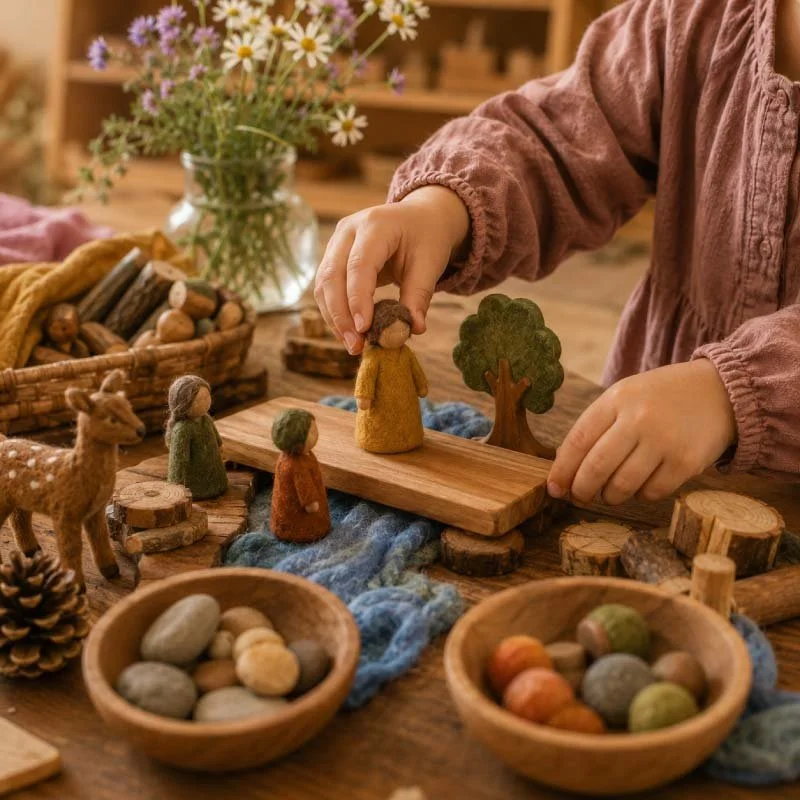
How Play Based Learning Works at the Waldorf School of Palm Beach
At the Waldorf School of Palm Beach, play based learning isn't a phase children grow out of — it's the foundation the whole curriculum is built on. Serving families across Boca Raton, Delray Beach, West Palm Beach, Boynton Beach, and Coral Springs, the school protects long, unhurried stretches of play in early childhood as deliberate developmental work rather than downtime between lessons.
What that looks like day to day is unhurried on purpose. The early childhood program in Boca Raton is arranged for deep, sustained play, with simple, natural materials and a predictable daily and seasonal rhythm. As of 2026, the early childhood program continues to anchor each morning in this protected play before it bridges into the lower grades.
Play here is never isolated from the rest of the education. It threads into the broader Waldorf rhythm — handwork, movement, music, and the main lesson, the focused morning block of study that anchors each day in the grades — so that play is understood as one part of an integrated Waldorf approach to education rather than a standalone method. The same intentionality that shapes a four-year-old's play continues, in new forms, all the way up through the grades.
Families across Palm Beach County are welcome to see this firsthand. The clearest way to understand purposeful play is to watch it: prospective families can observe during campus tours and parent-and-child programs, and seasonal festivals offer another window into the rhythm of the school year.
Conclusion: Why Play Is the Most Serious Work a Young Child Does
In an era of earlier academic pressure and more screens reaching younger children, protected play has quietly become the rarer and more valuable choice. What once seemed ordinary — a long morning of imaginative, unhurried play — is now something families have to seek out on purpose.
It is worth saying plainly: play based learning is not a soft alternative to "real" school. It is how young children are wired to learn, and the foundation later achievement stands on. Purposeful play builds language, focus, and self-regulation; it matures across the grades; and it prepares children for formal learning rather than delaying it.
In summary, play based learning is real learning — the most developmentally powerful kind a young child can do.
If you are a Palm Beach County family wondering whether play can really carry that weight, the most useful thing you can do is watch a morning of it unfold. Schedule a campus tour at the Waldorf School of Palm Beach in Boca Raton and observe purposeful play firsthand — a single morning answers what reading about it cannot. The children given room to play deeply now are often the ones most ready to learn formally later, and that quiet logic sits at the heart of a Waldorf early childhood education.
Frequently Asked Questions
Q1. What is play based learning in simple terms?
Play based learning is an approach where children learn through purposeful, often child-led play that teachers intentionally guide toward developmental and academic goals. It looks like play, but the environment and activities are designed to build skills like language, focus, and problem-solving. Unlike free play, there is always a learning intention behind the setup.
Q2. Is play based learning actually effective?
Yes — research consistently associates play based learning with stronger executive function, self-regulation, oral language, and early numeracy, which are the foundations later reading and math depend on. Rather than delaying academics, purposeful play builds the underlying capacities formal learning requires. The approach is widely recognized as developmentally appropriate for young children.
Q3. Will my child fall behind in reading or math?
No — when play is purposeful, children build the language, attention, and number sense that reading and math are built on. Early oral language and self-regulation are among the strongest predictors of later academic success. Play based learning develops these foundations first, then introduces formal skills as children are developmentally ready.
Q4. Is play based learning the same as Montessori?
Not exactly — both honor child-led learning, but they differ in tools. Montessori uses structured, purpose-built materials with a specific sequence, while play based learning, especially in Waldorf settings, leans into open-ended, imaginative play. Both are child-centered, but the materials and structure differ.
Q5. At what age does play based learning work best?
Play based learning is most central in early childhood, roughly ages two through six, when play is the primary way children make sense of the world. It continues into the early grades, gradually becoming more project-based as formal academics are introduced. At the Waldorf School of Palm Beach, purposeful play anchors the early childhood years and bridges naturally into the lower grades.
Q6. Where can I see play based learning in Palm Beach County?
The Waldorf School of Palm Beach in Boca Raton builds play based learning into its early childhood and lower-grade classrooms and welcomes prospective families to observe during campus tours and parent-and-child programs. WSPB serves families from across Palm Beach County, including Delray Beach, West Palm Beach, Boynton Beach, and Coral Springs. Scheduling a tour is the simplest way to see purposeful play firsthand.
Q7. How is play based learning different from just letting kids play?
The difference is intentionality. In free play, the child directs everything with no learning target; in play based learning, the teacher designs the environment and activities around specific developmental goals while preserving the child's agency. The room may look the same, but a trained teacher is quietly steering the play toward growth.