Families across Palm Beach County tend to start the search the same way, typing alternative schools Palm Beach County into a browser and hoping for a clean list. The harder, more useful question sits underneath it: which education model actually fits your child?
First, a quick clarification, because the term causes confusion. In this guide, an alternative school means a school built on an alternative philosophy of education, such as Montessori, Waldorf, or Reggio Emilia. It does not mean a remedial or disciplinary placement. That single distinction settles the biggest mix-up in the search results, and it shapes everything below.
Most parents can name one or two models, but would struggle to explain how they actually differ day to day. That gap is what this guide closes.
Parents often ask, what are the different types of alternative schools? The short answer is that there are several distinct models, each built on a different idea of how children learn best.
By the end, you will understand the major models, how to match one to your child, and where to see a Waldorf education firsthand in Boca Raton. The guide is written from the vantage point of the Waldorf School of Palm Beach, which gives it a close-up lens on one of those models.
What Counts as an "Alternative School"? Clearing Up Two Very Different Meanings
An alternative school is any school built on an education model different from the conventional public-school approach. The term covers two very different things, and telling them apart matters.
The first meaning is alternative pedagogy: philosophy-driven schools like Montessori and Waldorf. The second is alternative placement: programs for credit recovery, behavioral, or disciplinary needs. Parents quietly worry about the second when they read the phrase, so it is worth naming outright.
The difference between the two is intent. One is a chosen philosophy of learning. The other is a support placement. This guide is about the first.
Most families searching this term want a better educational fit, not a remedial program. If that is you, the rest of this piece is built around model choice.
Once you know you are looking for an education philosophy, the next question is which one.
Alternative Pedagogy vs. Conventional Schooling
Conventional schools standardize curriculum, pacing, and assessment. Alternative-pedagogy schools build around a specific theory of child development instead.
One concrete contrast makes it land. A conventional classroom usually moves the whole grade through the same material on the same calendar, measured by standardized testing. A developmental model waits for readiness, introducing reading or abstract math when a child is ready for it rather than when the calendar says so.
Alternative does not mean unaccredited or unstructured. Many of these models are highly structured, just structured around different priorities.
Why the "Alternative School = Struggling Kids" Myth Persists
The myth comes from the dual use of the term in US education policy, where alternative school often refers to placement programs for students who need credit recovery or behavioral support.
It is common enough that parents type is alternative school for bad kids into search engines. The reassuring answer is that philosophy-driven schools serve the full ability range, from children who need more challenge to children who simply learn better a different way, often with strong academic outcomes.
Here is what many people miss. The alternative schools parents choose for fit have nothing to do with the placement programs that happen to share the name.
The Main Types of Alternative Education Models, Explained
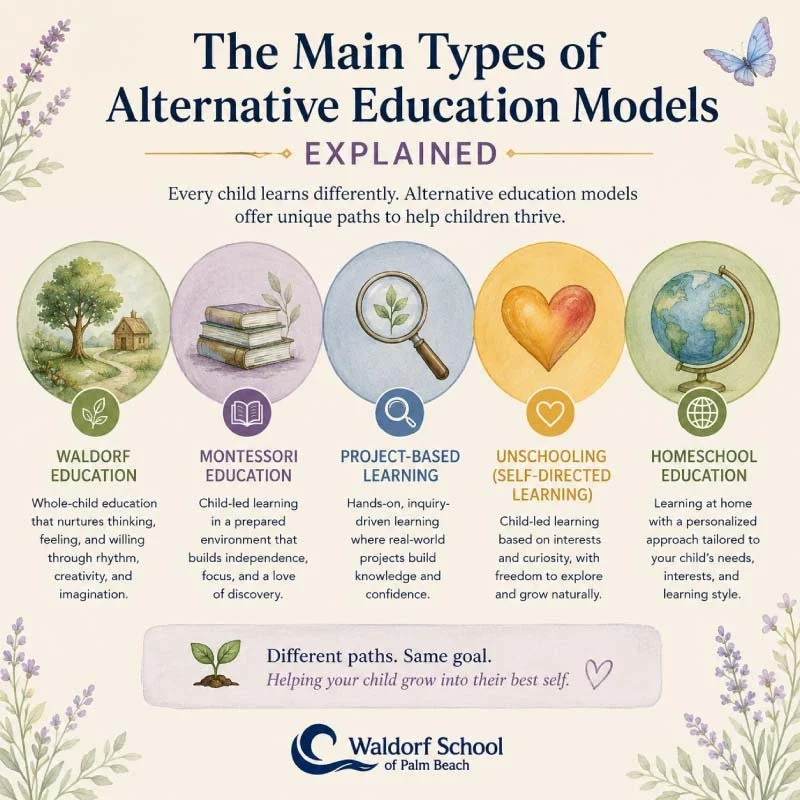
Below is a scannable menu of the major models, each in plain language. These are categories, not specific schools.
There are several main models of alternative education, and each is built on a different idea of how children learn. The table sums them up at a glance, then each model gets its own short breakdown.
| Model | Core Idea | Structure | Best Fit For |
|---|---|---|---|
| Montessori | Child-led work with specialized materials | Mixed-age classrooms, teacher as guide | Independent, hands-on learners |
| Waldorf | Arts-integrated, developmentally paced academics | Full developmental arc; main-lesson blocks | Whole-child, screen-conscious families |
| Reggio Emilia | Interest-led, project-based exploration | Mostly early childhood | Young, curious, project-driven kids |
| Charter | Independent public school under a charter | Tuition-free; varies by charter | Non-traditional focus, no tuition |
| Magnet | Themed public school within a district | Tuition-free; lottery or application | Specialized interest, such as STEM or arts |
| Micro-school / Pod | Very small, flexible cohorts | Newest, least standardized | Families wanting flexibility |
Charter and magnet schools are public-school categories, which is the quickest way to understand the cost and access differences between them and the private models above.
Montessori: Self-Directed Learning in Mixed-Age Classrooms
Montessori centers on child-led work with specialized hands-on materials, mixed-age classrooms, and teachers who act as guides rather than lecturers. Best fit: children who thrive with independence and tactile materials.
Picture a five-year-old choosing a set of wooden number rods from a low shelf, carrying it to a mat, and working through it alone while a teacher observes from a few feet away. According to the American Montessori Society, mixed-age grouping is a hallmark of the method, letting younger children learn from older ones and older children reinforce skills by teaching what they have already mastered.
The model spans preschool through secondary in many areas, though early childhood is where it is most common.
Waldorf / Steiner: Arts-Integrated, Developmentally Paced Education
Waldorf is an arts-integrated model that paces academics to a child's development, with subjects like eurythmy, handwork, and main-lesson blocks woven through the day. Best fit: families who want a screen-conscious, whole-child education that treats arts and movement as core rather than extra.
Waldorf education means academics delivered through art, movement, and storytelling, paced to a child's developmental stage rather than a standardized calendar. The Association of Waldorf Schools of North America describes the approach as developmentally appropriate, experiential, and academically rigorous, integrating the arts across every subject from preschool through twelfth grade.
It runs the full developmental arc, from early childhood through the upper grades, which is a structural feature of the model rather than an add-on. For a deeper look, see what Waldorf education really is and the Waldorf educational philosophy behind it.
Reggio Emilia: Project-Based, Child-Interest-Led Early Education
Reggio Emilia is an early-childhood approach centered on children's interests, careful documentation of their work, and the classroom environment itself as a teacher. Best fit: families of young children who value emergent, project-based exploration.
In the Reggio philosophy, the environment is treated as a third teacher, a phrase from founder Loris Malaguzzi that the North American Reggio Emilia Alliance still uses to describe how a well-designed room shapes learning. It is primarily an early-childhood philosophy, rarely a full K-12 model, which is useful to know when you picture the years ahead.
Charter and Magnet Schools: Public Options With a Twist
Both are tuition-free public schools. Charters operate independently under a charter agreement, while magnets offer specialized themes, such as STEM or the arts, within a school district. Best fit: families wanting a non-traditional focus without private-school tuition.
Admission usually runs through a lottery or a themed application, so a seat is not guaranteed. The National Center for Education Statistics, part of the US Department of Education, tracks both charter and magnet schools as part of the country's public school choice landscape. These are categories, not any specific Palm Beach County school.
Micro-Schools, Learning Pods, and Democratic Schools
These are the small, flexible settings. Micro-schools and learning pods emphasize tiny cohorts, while democratic or free schools emphasize student self-governance. Best fit: families seeking maximum flexibility or a highly individualized environment.
This is the newest and least standardized category, so accreditation and longevity vary widely. As of 2026, regulation is still catching up in many states, which is a fair thing for parents to weigh before committing.
How to Choose the Right Alternative School for Your Child
No model is universally best, so the honest question is which one fits this child and this family.
To choose an alternative school, start with three questions: how your child learns, what your family values, and what you can sustain logistically.
Walk through it in order. Look at your child's temperament. Weigh family values like screen use, the role of the arts, and the pace of academics. Then get practical about budget and tuition, commute, and the developmental arc you want a school to cover.
The single most useful thing you can do is visit during a normal school day. Models look very different in person than they do on paper.
In three steps: clarify your child's learning style, shortlist the models that match, and tour the ones you can realistically reach.
Match the Model to How Your Child Learns
Hands-on, independent learners often suit Montessori. Children who light up through art, story, and movement often suit Waldorf. Young, project-driven explorers often suit Reggio.
Resist over-labeling, though. Most children adapt, and fit is about emphasis rather than destiny.
The best data you already have is your child's current engagement. Watch what pulls them in and what drains them, then look for the model that leans the same way.
Weigh Cost, Commute, and the Developmental Arc
Public alternatives like charter and magnet schools remove tuition but may limit how much say you have over teaching philosophy. Private models like Montessori and Waldorf carry tuition but offer a defined educational arc.
Continuity matters more than families expect. A school that runs early childhood through the upper grades spares you a disruptive switch later.
Commute is real in Palm Beach County, where the geography is spread out. A model that exists only on the far side of the county may not survive the morning drive, so be honest about distance before you fall for a philosophy.
Tuition ranges shift year to year, so confirm current figures directly rather than leaning on old numbers.
Where to See Waldorf Education in Palm Beach County
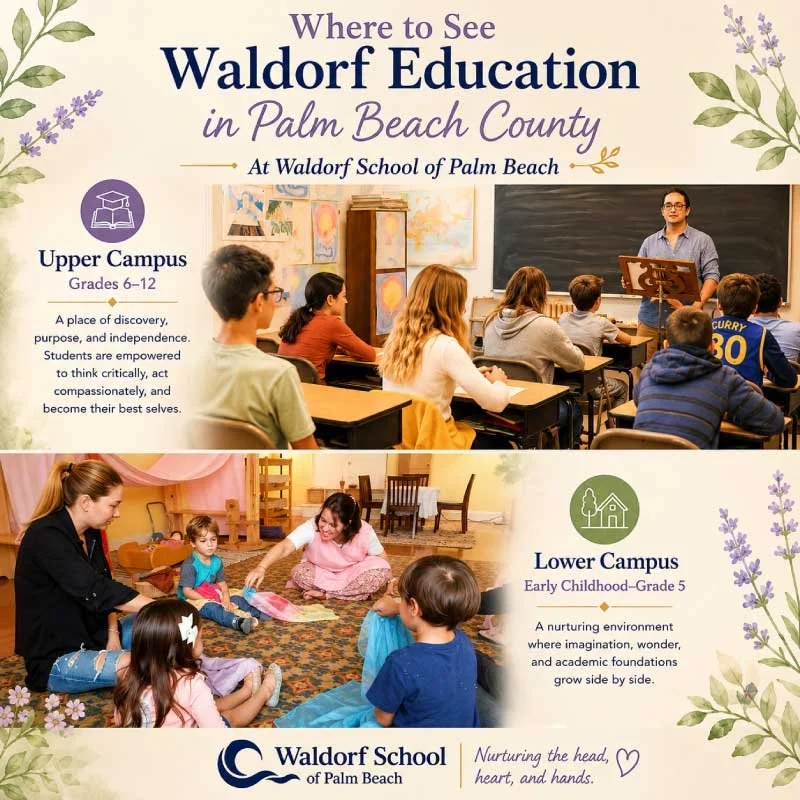
Families in Palm Beach County can see Waldorf education firsthand at the Waldorf School of Palm Beach in Boca Raton, which offers the full developmental arc from early childhood through the upper grades.
The school draws families from Boca Raton, Delray Beach, West Palm Beach, Boynton Beach, and Coral Springs, which is worth keeping in mind as a commute cue as much as a service area.
A visit usually means meeting the teachers who carry the model day to day, including the eurythmy and music faculty whose movement and arts work sits at the center of a Waldorf day.
What a visit shows that a guide cannot is the rhythm of a main-lesson block, the way arts woven through the school day shape every subject, and what a screen-free classroom actually feels like.
Campus tours are the standard way prospective families experience the model before they decide. You can arrange one through the Waldorf School of Palm Beach in Boca Raton.
Choosing With Confidence, Not Just Comparing Names
The goal is not to find the best school in the abstract. It is to find the right model for one specific child.
The alternative schools in Palm Beach County span several distinct models, and understanding how they differ is what turns an overwhelming search into a short, confident list.
Three things to remember. Alternative pedagogy is a chosen philosophy, not a placement. The major models differ mainly in how they teach. And fit beats reputation every time.
In short, the right alternative school is the one whose model matches how your child actually learns, and the only way to know for sure is to see it in person.
If the Waldorf model sounds like your child's lane, the clearest next step is to schedule a campus tour at the Waldorf School of Palm Beach in Boca Raton and watch a school day with your child's temperament in mind. The families who choose well are usually the ones who toured with a child's nature in view, not a ranking.
Frequently Asked Questions
What are the different types of alternative schools?
The main types are Montessori, Waldorf, Reggio Emilia, charter, magnet, and micro-schools or learning pods. Montessori, Waldorf, and Reggio are philosophy-driven private models. Charter and magnet are tuition-free public options. Micro-schools are small, flexible cohorts. Each is built on a different idea of how children learn best.
Are alternative schools only for struggling students?
No, and that is a common mix-up. Alternative school can mean a placement program for credit recovery or behavioral needs, but it more often refers to philosophy-driven schools like Montessori and Waldorf that serve the full range of learners. The schools parents choose for fit are about a different approach, not remediation.
What is the difference between Montessori and Waldorf?
Montessori centers on self-directed work with specialized materials in mixed-age classrooms. Waldorf integrates the arts, movement, and storytelling into academics paced to the child's development. Both reject one-size-fits-all instruction. Many families choose based on whether their child thrives with hands-on autonomy or with artistic, story-rich learning.
Do alternative schools in Florida have to be accredited?
Private alternative schools are not required to hold the same accreditation as public schools, and the Florida Department of Education does not accredit or require accreditation for private K-12 schools. Established models like Waldorf and Montessori often pursue recognition through their own associations. Always confirm a specific school's accreditation and affiliations directly.
How do I choose the right alternative school for my child?
Start with how your child learns, then match that to a model before you compare individual schools. Weigh family values like screen use and the arts, plus practical factors like tuition and commute. The most reliable step is touring during a normal school day, ideally with your child's temperament in mind.
Are there alternative schools in Palm Beach County?
Palm Beach County families have access to several alternative education models. For the Waldorf model specifically, the Waldorf School of Palm Beach in Boca Raton offers the full developmental arc from early childhood through the upper grades and welcomes families from Delray Beach, West Palm Beach, Boynton Beach, and Coral Springs. Scheduling a campus tour is the simplest way to see the model in action.
What's the difference between a charter school and a private alternative school?
A charter school is a tuition-free public school that operates independently under a charter, while a private alternative school such as a Montessori or Waldorf school charges tuition and follows a specific educational philosophy. Charters offer access without tuition but less control over teaching philosophy. Private models offer a defined approach for a cost. The right choice depends on your budget and how much a specific philosophy matters to your family.