
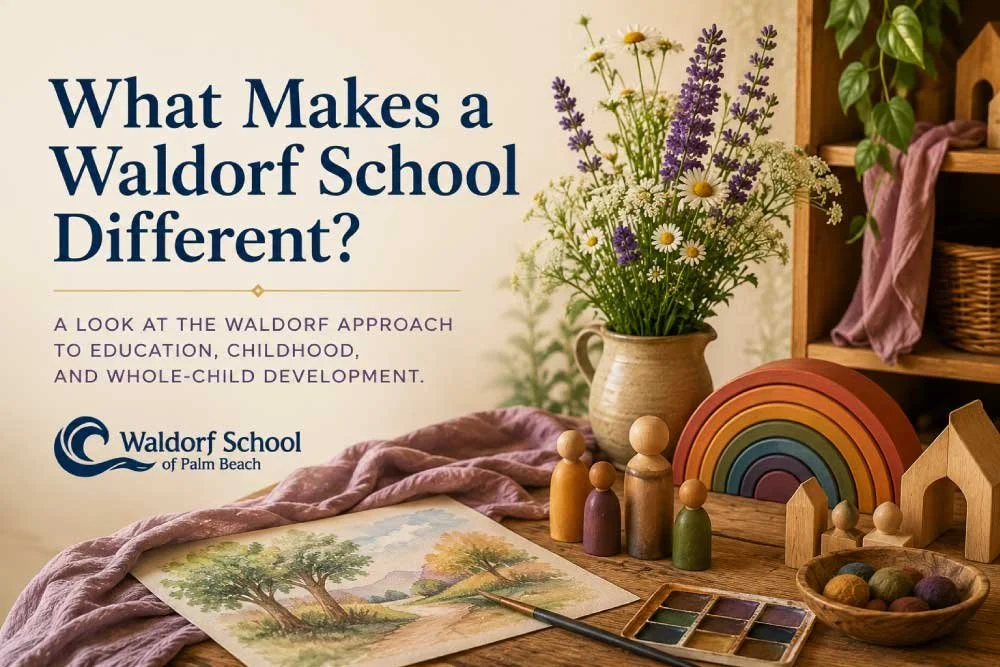
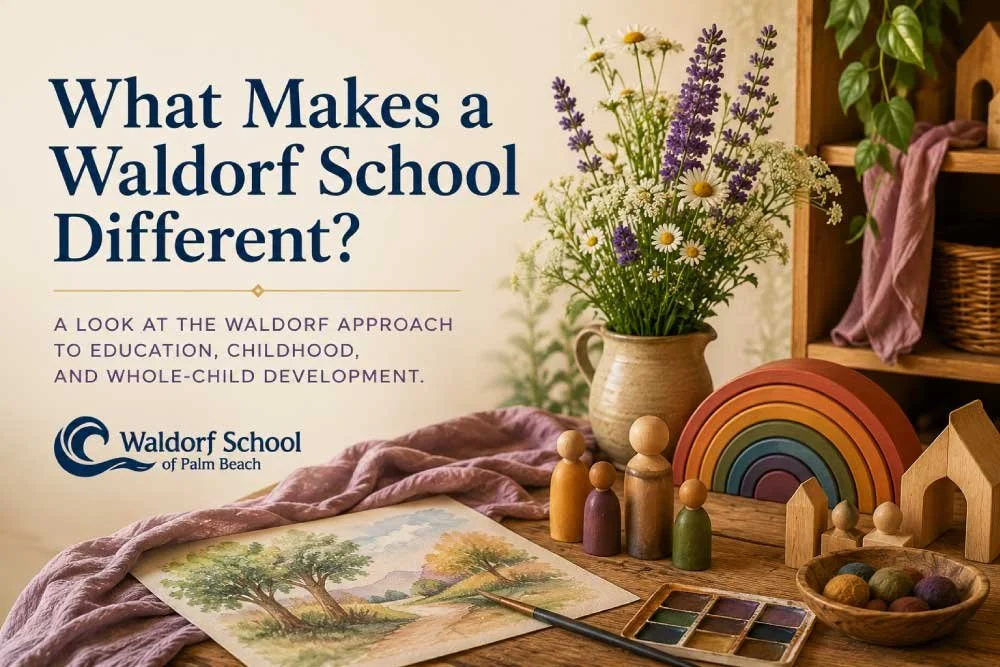
Walk into a Waldorf classroom and the first thing you'll notice is what isn't there. No screens glowing on desks. No wall of worksheets. Instead: shelves of natural-wood materials, a chalkboard drawing the teacher made by hand, a basket of wool, children knitting or moving in a circle. It's a room built for hands and imagination, not for tablets and test prep — and for most parents, it looks nothing like the fluorescent, worksheet-and-screen classroom they picture when they think of school.
That contrast is the whole point. A Waldorf school teaches the same core academics as any strong school — reading, math, science, history — but the how is different. Learning is arts-integrated, unhurried, screen-free in the early years, and anchored by one teacher who stays with a class for years rather than a new face every fall.
If you've toured the Waldorf School of Palm Beach in Boca Raton, you've seen this firsthand — and probably left with as many questions as answers. That's normal. Waldorf education is easy to feel and harder to explain in a sentence.
People often ask: what actually makes a Waldorf school special? The short answer is that Waldorf changes the how of learning, not just the what. This piece walks through the specific differences parents notice, answers the skeptical questions honestly (no, it's not a cult), compares Waldorf to Montessori and conventional schools, and shows what each difference looks like day to day.
Think of it as a parent-perspective walkthrough, grounded in what families actually see at WSPB — not a philosophy lecture.
The Seven Things That Actually Make a Waldorf School Different
Strip away the philosophy language and Waldorf comes down to a handful of concrete, observable differences — the kind a visiting parent notices before anyone explains the theory behind them. Here's what most people don't realize about Waldorf schools: the difference isn't one big thing — it's seven smaller ones working together.
Those seven: the same teacher for years, screen-free early years, arts woven into every subject, no early standardized testing, learning that follows developmental rhythms, hands-on experiential lessons, and strong seasonal community rituals.
No single feature defines Waldorf. A conventional school might do any one of these. It's the combination — all seven, reinforcing each other across the day and across the grades — that creates the distinctive feel families describe after a tour of WSPB.
1: One Teacher Who Loops With the Class for Years
In most Waldorf grade schools, a single class teacher stays with the same students for multiple years — often grades 1 through 8 in the traditional model — rather than handing them off to someone new each year. The class teacher is the adult who greets them in the morning, teaches the core academic blocks, and grows alongside them.
Why does that matter? Over years, the teacher comes to know each child's strengths and struggles deeply — the reader who needs a slower on-ramp, the child who thinks in pictures, the one who blooms in the spring. That teacher also becomes a trusted partner to parents, someone who has watched a child mature rather than met them in September. It's a kind of continuity conventional schools rarely offer.
Children aren't with only one adult, though — a question parents often raise. Specialist teachers for languages, music, movement, and handwork rotate in throughout the week, so students experience a range of adults and teaching styles.
2: Screen-Free Classrooms in the Early Years
Waldorf schools intentionally delay screens and classroom technology in early childhood and the lower grades, prioritizing hands-on materials, movement, and human interaction instead. In a Waldorf kindergarten or grade 1 room, you'll find beeswax, wooden blocks, and a teacher telling a story from memory — not a smartboard.
The reasoning, in the school's own terms: Waldorf educators hold that imagination and foundational skills develop best through direct, sensory, unmediated experience first. That's the rationale behind the approach, not a settled scientific verdict — and it's worth stating plainly as one rather than the other.
This doesn't mean students are left behind. Technology is introduced deliberately in the upper grades, once foundational thinking is in place, so students learn digital tools with a strong base underneath them. At WSPB, the screen-free question is one of the most common on campus tours — many Palm Beach County families are actively looking for a screen-conscious alternative, and this is often the difference that first draws them in.
3: The Arts Woven Into Every Academic Subject
In Waldorf education, painting, music, drawing, movement, and handwork aren't "extras" tacked onto the end of the day — they're the vehicle through which math, science, history, and language are taught. The arts are the method, not a break from it.
What does that look like in practice? A math concept might be learned through rhythmic clapping and stepping. A history lesson comes alive as a class play the students perform themselves. Multiplication tables get set to music, so the rhythm carries the facts. The aim of this multi-sensory approach is to make academic content memorable and engaging — not to soften rigor, but to root it more deeply.
On a Boca Raton campus tour, this is visible everywhere: children practicing handwork like knitting and sewing, illustrating their own main lesson books by hand, and moving through movement arts like eurythmy — an expressive movement art that turns speech sounds and music into deliberate, visible gesture. Each of these is academics and artistry at the same time.
4: No Early Standardized Testing or Grades
Waldorf schools typically forgo standardized testing and letter grades in the early and middle years, favoring detailed written assessments of each child instead. There's no scramble for a bubble sheet in grade 3.
But the alternative is more than an absence. Class teachers write narrative reports covering academic progress, social development, and effort — a fuller, more individualized picture than a single letter grade can hold. A parent comes away understanding not just how their child scored, but how their child is doing.
This isn't a lack of accountability, a fear parents raise reasonably. It means assessment is qualitative and individualized rather than test-driven — the teacher who knows a child across years is the one describing that child's growth.

5: Learning That Follows Developmental Rhythms
Waldorf curriculum is sequenced to match children's developmental stages. Formal academic reading, for instance, is introduced later than in many conventional schools — when the child is judged developmentally ready rather than on a fixed calendar.
The logic — and parents will rightly question it — is that later can mean stronger. The early years front-load oral language, movement, and imaginative play, building the ground that reading and writing later grow from, and then formal literacy is introduced on a timeline tied to how children actually develop.
For the anxious researcher, one reassurance matters here: the timeline differs, but the expectations don't disappear. Waldorf education is described by the Association of Waldorf Schools of North America as developmentally appropriate, experiential, and academically rigorous — later reading is a sequencing choice, not a lowering of the bar.
6: Hands-On, Experiential Lessons Over Worksheets
Waldorf leans on doing rather than passive worksheet completion. Children bake to learn fractions, build to learn geometry, and garden to learn botany. The concept arrives through the hands first.
The goal is retention through lived experience. When a child measures and halves a recipe, the fraction isn't an abstract symbol on a page — it's flour in a bowl. Understanding built this way tends to stick in a way that memorizing isolated facts does not.
One observable hallmark a visiting WSPB parent notices: students often create their own main lesson books by hand — the handmade book each child builds through a block of study, combining writing, illustration, and original work — instead of working from pre-printed textbooks. The book becomes a record of what the child has genuinely made sense of.
6: Seasonal Festivals and a Strong Sense of Community
Waldorf schools mark the year with seasonal festivals and rhythms — lantern walks, harvest celebrations, and other seasonal gatherings — that build community and a sense of belonging. These moments give the school year a shape children can feel.
Here's the nuance that heads off a common misread: these festivals are cultural and seasonal, framed as community traditions rather than religious observance. A lantern walk marks the turning of autumn toward winter; it isn't a service. (More on the "is it religious" question below, because it comes up on nearly every tour.)
At WSPB, families in Palm Beach County experience this firsthand through the school's own seasonal traditions, from the autumn lantern walk to Michaelmas. These are the days when the community side of the school becomes most visible — and most memorable for the children.

Waldorf vs. Conventional and Montessori Schools: The Real Differences
Most parents researching Waldorf are also weighing it against the two alternatives they know best: the conventional school down the road and Montessori. It's worth laying out the real contrasts plainly, comparing models rather than any specific institution.
The difference between Waldorf and Montessori is this: Montessori centers the child's self-directed independence, while Waldorf centers imagination, the arts, and a shared class rhythm led by a teacher. Each model does something genuinely well, and the honest guide names those strengths rather than knocking the alternatives.
Waldorf vs. a Conventional Public or Private School
The biggest contrasts with a conventional school come down to four things: screen use, testing, teacher continuity, and arts integration. Conventional schools tend toward earlier formal academics, standardized testing, a new teacher each year, and technology in the classroom from early on. Waldorf moves in a different direction on each.
This isn't a knock on conventional schooling, which serves many children well. It's a fit question. Some families want early test benchmarking and a tech-forward classroom; others are looking for exactly what Waldorf offers. Here's the contrast at a glance:
| Category | Waldorf | Conventional |
|---|---|---|
| Teacher Model | One class teacher loops with the class for years. | New teacher most years. |
| Technology | Delayed in early grades; introduced later. | Introduced early and used throughout. |
| Testing | Narrative assessments; little early standardized testing. | Standardized testing from early grades. |
| Arts | Woven into every academic subject. | Usually taught as separate specials. |
Waldorf vs. Montessori
Both Waldorf and Montessori are child-centered alternatives to conventional schooling, but they differ in emphasis. Montessori emphasizes individual, self-directed work with specialized learning materials. Waldorf emphasizes imagination, teacher-led storytelling, the arts, and group rhythm.
Picture the rooms and the difference becomes concrete. A Montessori classroom often has children choosing their own independent tasks from the shelves, working at their own pace. A Waldorf classroom features more whole-group, teacher-led artistic and movement work — the whole class painting, reciting, or moving together.
Some families search for a "Waldorf-Montessori hybrid," hoping to blend the two. A handful of programs do attempt that mix, and it's worth knowing the option exists — but the two philosophies pull in genuinely different directions, and most schools commit to one. WSPB is a Waldorf school through and through.
The Skeptical Questions Parents Actually Google (Answered Honestly)
If you've typed a slightly nervous question about Waldorf into a search bar late at night, you're not alone — and you deserve a straight answer. The questions parents actually Google tend to be the anxious ones, and most schools tiptoe around them. It's better to answer plainly.
The short answer to the question parents whisper on tour day: no, Waldorf is not a cult, and no, it is not a religion — it is an educational approach with a philosophy behind it. Here's the fuller picture.
Is a Waldorf School Religious or a Cult?
No. Waldorf education is not a religion and not a cult. It grew out of Rudolf Steiner's broader philosophy, anthroposophy — a way of understanding the human being and the world — but children are taught academics, arts, and movement, not doctrine.
The confusion usually traces back to the festivals. Because Waldorf schools mark the year with seasonal celebrations, and because some carry old names, parents sometimes wonder if there's a faith underneath. There isn't: the festivals are cultural and seasonal, and families of every background participate at WSPB.
It builds more trust to be honest about the philosophical roots than to wave them away. Anthroposophy is real, and it's the soil Waldorf education grew from — but it isn't taught to children as a subject. For a deeper look, WSPB's post on the philosophy behind Waldorf education covers Steiner and anthroposophy in full.
Do Waldorf Students Do Well After Graduation?
Yes — Waldorf graduates go on to a wide range of universities and careers. The model aims to develop flexible, creative thinkers who can synthesize ideas across disciplines and take intellectual initiative rather than wait to be told what to think.
Waldorf graduates are often observed to integrate ideas well and approach problems with independent initiative — a quality frequently noted in discussions of Waldorf outcomes. That's a fair thing to say as long as it's framed as an observation rather than a guarantee about any individual child.
Practically speaking, the delayed-academics timeline doesn't preclude college readiness. The upper grades are academically demanding, and the later start on formal reading gives way to rigorous high school work.
Do Waldorf Schools Have Homework, Tests, and Technology?
Homework and technology are introduced gradually and increase with age. Early grades emphasize rest, play, and hands-on learning over heavy homework, so a grade 2 student isn't coming home to a stack of worksheets.
The key word is progression, not never. As students move up, the academic load grows — and by high school, students use technology and carry a meaningful workload much like their peers elsewhere. The screen-free years are a foundation, not a permanent rule.
Specifics do vary by school. The best way to know exactly how homework, testing, and technology are handled at WSPB is to ask on a campus tour.
What This Looks Like at the Waldorf School of Palm Beach
At the Waldorf School of Palm Beach, these differences aren't theoretical — they are the daily rhythm of a Boca Raton classroom from early childhood through grade 11. The seven distinctives above stop being ideas and become a Tuesday morning.
Here's how it translates. The day opens with the main lesson — the two-hour morning block of focused study that anchors each day, taught in three-to-four-week blocks that rotate through subjects. Arts run through everything: handwork in the making of things by hand, music, and eurythmy woven into the academic day rather than parked in a separate period. Walk the campus and you see the seven distinctives in motion rather than described on a wall.
One concrete, verifiable detail sets WSPB apart locally: it carries the developmental arc from early childhood all the way through grade 11, so a family isn't piecing together a Waldorf education across multiple schools. That continuity — the same approach, deepening year over year — is the through-line of everything above.
The differences become visible the moment you're in the building. Campus tours and seasonal festivals are when families see the screen-free classrooms, the handmade main lesson books, and the eurythmy circles for themselves — and understand in a morning what takes an article to describe.
How to Tell If a Waldorf School Is Right for Your Child
Once you understand what's different, the real question surfaces: is this right for us? That's the decision underneath all the research, and it deserves an honest answer rather than a pitch.
In short, a Waldorf school is a strong fit for families who value how a child learns as much as what they learn. Families drawn to screen-conscious, arts-rich, unhurried learning tend to thrive in it. Families who want early standardized-test benchmarking, or a heavily tech-forward classroom from kindergarten on, may find the model less aligned with what they're after — and that's useful to know early.
There's really only one reliable way to tell. Visit, observe a class, and ask your questions directly. Fit is felt, not read — and every admissions team worth its salt will tell you the same thing.
Conclusion: What Really Sets a Waldorf School Apart
In an era of screens and early academic pressure, the things that make Waldorf different — human continuity, unhurried development, arts woven through everything — are exactly what a growing number of parents are looking for. What once looked like an unusual choice increasingly looks like a deliberate one.
In summary, what makes a Waldorf school special is not a single feature but the way every part of the day is designed around the developing child. What is special about a Waldorf school isn't one headline feature; it's a coherent, century-old approach to how children learn. Same-teacher continuity, screen-free early years, arts-integrated academics, developmental pacing, and community rhythm — and no, it's not a cult or a religion.
You can read about all of it, but the model that looks unusual on paper tends to make complete sense the moment you watch a class in motion. Palm Beach County families are welcome to see it for themselves: schedule a campus tour at the Waldorf School of Palm Beach in Boca Raton, where the difference is visible in a single morning.
FAQ
Q1. What is special about a Waldorf school?
A Waldorf school is distinctive because it teaches academics through the arts, keeps early classrooms screen-free, follows children's developmental stages rather than rushing early academics, and often keeps the same teacher with a class for several years. The result is an unhurried, hands-on approach to learning. It's the combination of these features — not any single one — that gives Waldorf its recognizable feel.
Q2. What makes a Waldorf school different from a regular school?
The biggest differences are technology, testing, teacher continuity, and how subjects are taught. Where conventional schools tend to introduce screens and standardized testing early and change teachers annually, Waldorf schools delay screens, favor written narrative assessments, and often loop one teacher with a class for years. Academics are woven together with painting, music, and movement rather than kept separate.
Q3. Is Waldorf better than Montessori?
Neither is universally "better" — they suit different children. Montessori emphasizes self-directed, individual work with specialized materials, while Waldorf emphasizes imagination, the arts, storytelling, and a shared class rhythm led by a teacher. The right choice depends on your child and what kind of learning environment your family values.
Q4. Are Waldorf schools religious or a cult?
No — Waldorf education is not a religion or a cult. It grew from Rudolf Steiner's philosophy, anthroposophy, but children study academics, arts, and movement, not doctrine, and families of every background attend. The seasonal festivals many Waldorf schools hold are cultural and community traditions, not religious services.
Q5. Why don't Waldorf schools use technology early on?
Waldorf educators intentionally delay classroom screens in the early years because they believe young children build imagination and foundational skills best through direct, hands-on, human experience. Technology is introduced deliberately in the upper grades, so students learn digital tools once those foundations are in place. Many families choose Waldorf specifically for this screen-conscious approach.
Q6. Do Waldorf students do well after they graduate?
Waldorf graduates attend a wide range of colleges and pursue diverse careers, and the model aims to develop flexible, creative thinkers who can synthesize ideas and take initiative. While the academic timeline differs from conventional schools — formal reading is introduced later, for example — the upper grades are academically demanding. Outcomes ultimately depend on the individual student.
Q7. Where can I see what makes a Waldorf school special in Palm Beach County?
The Waldorf School of Palm Beach in Boca Raton teaches this arts-integrated, screen-conscious approach from early childhood through grade 11 and welcomes prospective families to observe classes on a campus tour. WSPB serves families across Palm Beach County, including Delray Beach, West Palm Beach, Boynton Beach, and Coral Springs. Scheduling a tour is the simplest way to see the difference firsthand.