
Choosing between Waldorf education vs Montessori is one of the toughest decisions South Florida parents face. Both approaches reject cookie-cutter schooling, prioritize hands-on development, and have earned loyal followings for good reason.
The real question goes beyond popularity. What matters most lies in how each method shapes a child over time. Montessori nurtures structured independence. Waldorf cultivates creative imagination as the driving force behind lifelong learning.
Waldorf School of Palm Beach (WSPB) brings the Waldorf philosophy to life across two campuses, offering a continuous developmental arc that matures from the Lower Campus through the Upper Campus. This article breaks down the core differences so you can decide which path fits your family.
Comparing Philosophical Foundations
The difference between Montessori and Waldorf begins with their core beliefs about how children learn.
Montessori classrooms center on practical life skills. Children choose tasks from a Prepared Environment filled with real-world tools: pouring water, sorting beads, polishing shoes. The goal is early independence through structured self-direction.
The Waldorf philosophy takes a different route. Rooted in the “Threefold” approach of Head, Heart, and Hands, the Waldorf method prioritizes the development of creative imagination as the foundation for future cognitive rigor. Before children analyze abstract concepts, they experience the world through storytelling, movement, and artistic play. This experiential learning builds the emotional and sensory groundwork that rigorous academics can later build on.
Think of it this way: Montessori asks, “What can this child do independently today?” Waldorf asks, “What kind of thinker will this child become by age 18?” Both are valid. The Waldorf and Montessori education models simply answer the question with different timelines in mind.
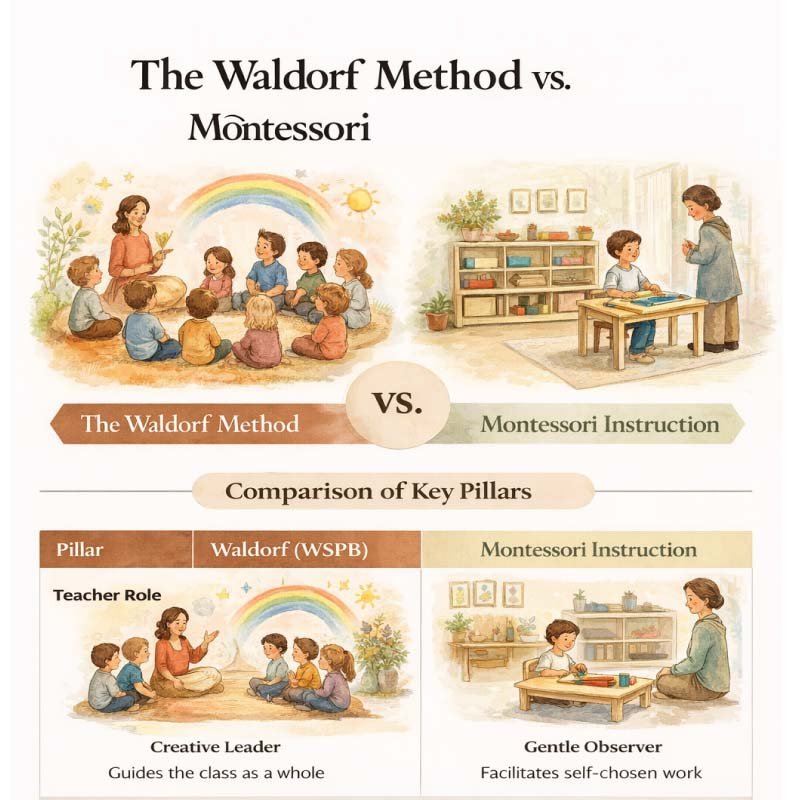
The Waldorf Method vs. Montessori Instruction
The Waldorf Method centers the teacher as the heart of the classroom. Learning unfolds collectively, with the entire class moving through rhythmic daily activities together: morning circle time, storytelling, artistic work, and seasonal celebrations all follow a deliberate, shared rhythm. The teacher leads with intention, guiding the group as a unified community rather than addressing individual learners one by one.
Montessori instruction takes a fundamentally different approach. Here, the classroom is decentralized by design. Children independently select their "work" from carefully prepared shelves and move through activities at their own pace. The teacher steps back, functioning as a quiet observer and gentle guide rather than a lecturer or central authority. Instruction is largely child-driven, with the environment itself doing much of the teaching.
Where Waldorf finds strength in collective rhythm and teacher presence, Montessori places its faith in individual choice and self-directed discovery.
Comparison Table
Use this table to compare the core pillars of Waldorf vs Montessori at a glance.
| Pillar | Waldorf (WSPB) | Montessori |
|---|---|---|
| Teacher Role | Creative Leader who loops with students (Class Teacher Model) | A director who guides self-chosen activities |
| Curriculum | Arts-integrated, narrative-based with Main Lesson Books | Child-led, using structured Montessori materials |
| Social Structure | Same-age cohorts with strong peer bonds | Multi-age classrooms (3-year cycles) |
| Technology | Minimal to none through 8th grade | Varies by school; some integrate early |
| Learning Style | Experiential Learning through Head, Heart, and Hands | Independent discovery in a prepared environment |
| Assessment | Narrative evaluations and portfolio-based | Observation-based with material mastery benchmarks |
| Campus Experience | Two dedicated campuses (Lower + Upper) for age-appropriate environments | Typically a single campus for all ages |
Academic Timing for Waldorf Kids
One of the most striking differences hits right at the start: when formal learning begins.
In Waldorf education, structured academics like reading and math are strictly delayed until age seven, which lines up with Grade 1. The reasoning? Young children need time for sensory exploration, movement, and storytelling before they sit down with letters and numbers. Waldorf educators talk a lot about protecting the "magic of childhood," and they mean it literally. Pushing literacy before a child is developmentally ready, they argue, does more harm than good.
Montessori takes the opposite stance. Preschoolers as young as three start working with academic concepts through tactile, specialized materials. Think sandpaper letters (where kids trace letter shapes with their fingers) or the famous "Pink Tower" for understanding size and dimension. It's hands-on and self-directed, but there's no question: Montessori kids encounter formal concepts years before their Waldorf peers.
The Lower Campus: Nurturing the Youngest Learners (EC – Grade 4)
WSPB’s 5th Ave campus feels more like a warm home than a typical school. Early childhood classrooms follow a consistent Rhythm of the Day: morning circle time, outdoor play, storytelling, and handwork flow in a predictable pattern that gives young children a deep sense of security.
Oral storytelling replaces worksheets. Watercolor painting replaces flashcards. Waldorf kids at the Lower Campus learn letters through movement and rhythm, not rote memorization. This approach may look “slower” on paper, but a landmark study by researchers Larrison, Daly, and VanVooren found that Waldorf students who start at this unhurried pace significantly outperform peers on standardized tests by the 8th grade.
The Class Teacher Model is another defining feature. One teacher stays with the same group of students through several grade levels (a practice called looping). This creates a bond that goes beyond academics. The teacher knows each child’s strengths, struggles, and learning style. Montessori uses multi-age classrooms with a different social structure, where the teacher serves as a “director” of the prepared environment.
Families considering the Lower Campus can explore nursery tuition details or learn about the grades 1–8 curriculum to see how the Rhythm of the Day evolves as children grow.
The Upper Campus: Developing Critical Thinkers (Grades 5 – 11)
The transition to WSPB’s 35th St campus marks a deliberate shift. The wonder-driven experiential learning of the Lower Campus gives way to sophisticated academic inquiry, socratic inquiry, and independent research that intellectually challenge students.
Instead of pre-set Montessori materials, Upper Campus students create Main Lesson Books. These handwritten, illustrated volumes synthesize complex subjects like physics, history, and literature through each student’s own analytical and artistic lens. A main lesson book's entry on the French Revolution, for example, might include original essays, hand-drawn maps, and timeline illustrations. This process builds cognitive rigor and deep retention in ways that standard textbooks rarely achieve.
The Upper Campus emphasizes Socratic inquiry in classroom discussions. Students learn to question assumptions, defend arguments, and engage with ideas at a level that prepares them for college-level work. Research confirms that 94% of Waldorf graduates attend college after high school, and 42% major in science or math, debunking the myth that Waldorf is an “arts-only” path.
The Rhythm of the Day at the Upper Campus also looks different. Morning main lessons run in three to four-week blocks, allowing students to immerse themselves in one subject before moving to the next. This block scheduling supports the kind of experiential learning and deep focus that prepares students for real intellectual challenges. Explore the high school program to see how this developmental journey culminates

Embracing The Waldorf Way of Imaginative Play
Walk into a Waldorf kindergarten, and you'll likely see kids draped in play silks, building castles out of wooden blocks, or staging elaborate puppet shows. The Waldorf Way actively encourages fantasy play and make-believe as core developmental activities. Open-ended toys with no predetermined purpose are the norm. A piece of cloth can become a river, a cape, or a baby blanket depending on the day.
Montessori classrooms? Quite different. The emphasis falls on what Maria Montessori called "functional reality." Children practice practical life skills like slicing apples with real knives (child-sized, obviously), washing dishes, and folding cloth. The goal is competence in the real world. Pretend play isn't banned exactly, but it takes a back seat to activities grounded in everyday tasks.
Approaches to Waldorf Teaching and Teacher Roles
Waldorf teaching has a distinctive structure called looping. One teacher stays with the same class for multiple years, often from 1st through 8th grade. That's eight years with the same adult guiding a group of kids. The bond that develops is deep, and advocates say it creates a kind of extended-family dynamic where the teacher truly understands each child's growth arc.
Montessori frames the teacher differently: as a facilitator. The adult observes individual learning patterns, steps in when a child needs support, and otherwise stays out of the way. Uninterrupted work periods, sometimes lasting three hours, let kids choose activities and move at their own pace. The teacher's job is to prepare the environment and trust the process.
Understanding Waldorf Style Learning Environments
A Waldorf-style classroom feels warm. Walls are typically painted in soft, muted tones like peach or rose. You'll find natural materials everywhere: wooden furniture, wool rugs, silk curtains, and beeswax crayons. There's an intentional "homelike" quality, almost like stepping into a cozy living room rather than an institution.
Montessori environments take a more minimalist route. Everything has a specific place on precisely organized shelves. Learning stations are arranged so children can access materials independently. The whole room is scaled down: child-sized tables, chairs, even brooms and dustpans. It mirrors a "child-sized adult world" where kids function with real autonomy.
The Waldorf Philosophy on Technology and Media
Here's where things get firm. The Waldorf philosophy is strictly low-tech in the early years. Screens, tablets, digital media are all typically banned. The belief is that young children need human-to-human interaction, physical movement, and sensory-rich experiences that screens simply can't provide. Many Waldorf families extend this rule at home, too.
Montessori leans screen-free as well, but with a slightly softer boundary. Technology is treated as a "purposeful tool." In some Montessori settings, older children might use a computer for research projects or creative work. The key word is purposeful. Screens aren't entertainment; they serve a specific learning goal.
Why “The Waldorf Way” Scales with Your Child
One of the most common pain points for parents is the “middle school slump.” Children outgrow their elementary environment but feel lost in a one-size-fits-all middle school. The Waldorf Way addresses this directly.
WSPB’s two-campus model gives older students a dedicated space that feels age-appropriate and intellectually challenging. The Upper Campus respects the developmental shift that happens around age 10–11, when children begin craving more autonomy and cognitive rigor. By moving to a new campus, students experience a tangible rite of passage rather than simply advancing to the next grade in the same hallway.
This continuity matters. Waldorf teaching at WSPB supports families through every developmental milestone. The Rhythm of the Day adapts from gentle morning circles in early childhood to demanding Socratic inquiry sessions in the upper grades. Waldorf-style learning weaves the arts, academics, and practical life skills into a single thread that runs from preschool through high school graduation.
Parents considering a long-term educational commitment can explore the admissions process to see how experiential learning grows alongside their child. Cognitive assessments also show that children who develop through holistic methods build stronger analytical foundations over time.
Finding the Right Rhythm with Waldorf Education vs Montessori
The choice between Montessori and Waldorf depends on your child’s temperament and your family’s values. Montessori works well for children who thrive on structured independence and self-paced discovery. Waldorf is ideal for parents seeking a deep, arts-integrated, and socially connected long-term journey.
What makes Waldorf education vs Montessori education a meaningful comparison is that both reject passive learning. Both demand active engagement from children. The difference lies in the vehicle: Montessori uses carefully designed materials; the Waldorf method uses experiential learning, narrative, and the arts.
If you want to feel the difference firsthand, schedule a campus tour of both the Lower and Upper campuses. Walking through the classrooms, watching the Rhythm of the Day unfold, and speaking with teachers will tell you more than any comparison chart.
Ready to explore what Waldorf-style learning looks like for your child? Visit Waldorf School of Palm Beach to take the next step.
Frequently Asked Questions on Montessori vs Waldorf Education
Which is better, Waldorf or Montessori?
Neither approach claims a universal win, but Waldorf often stands out for families seeking depth over acceleration. Waldorf education emphasizes imagination, emotional intelligence, and integrated thinking, using art, storytelling, music, and movement to build strong cognitive foundations over time. This method favors developmental readiness, allowing creativity and curiosity to mature before formal academics take center stage.
What are the disadvantages of Waldorf Education?
Critiques of Waldorf education usually center on its intentional pacing. Formal academics begin later than in conventional schools, which can make Waldorf students seem behind on early standardized tests. Long-term studies show that these students typically catch up and often surpass peers by middle school as conceptual understanding solidifies.
What is the biggest criticism of Montessori?
The biggest criticism is inconsistency across schools. Because “Montessori” is not a trademarked term, quality varies widely from one program to another. Some schools follow the method closely while others use the name loosely. Parents should verify teacher credentials, classroom materials, and adherence to authentic Montessori principles when evaluating any program.
What’s the difference between Goddard and Montessori?
Goddard schools follow a play-based, STEAM-focused curriculum designed for early learners, typically ages six weeks through six years. Montessori spans a wider age range and uses structured, self-directed materials in a prepared environment. Goddard centers on school readiness and social skills, while Montessori emphasizes independence and intrinsic motivation across multiple developmental stages.