
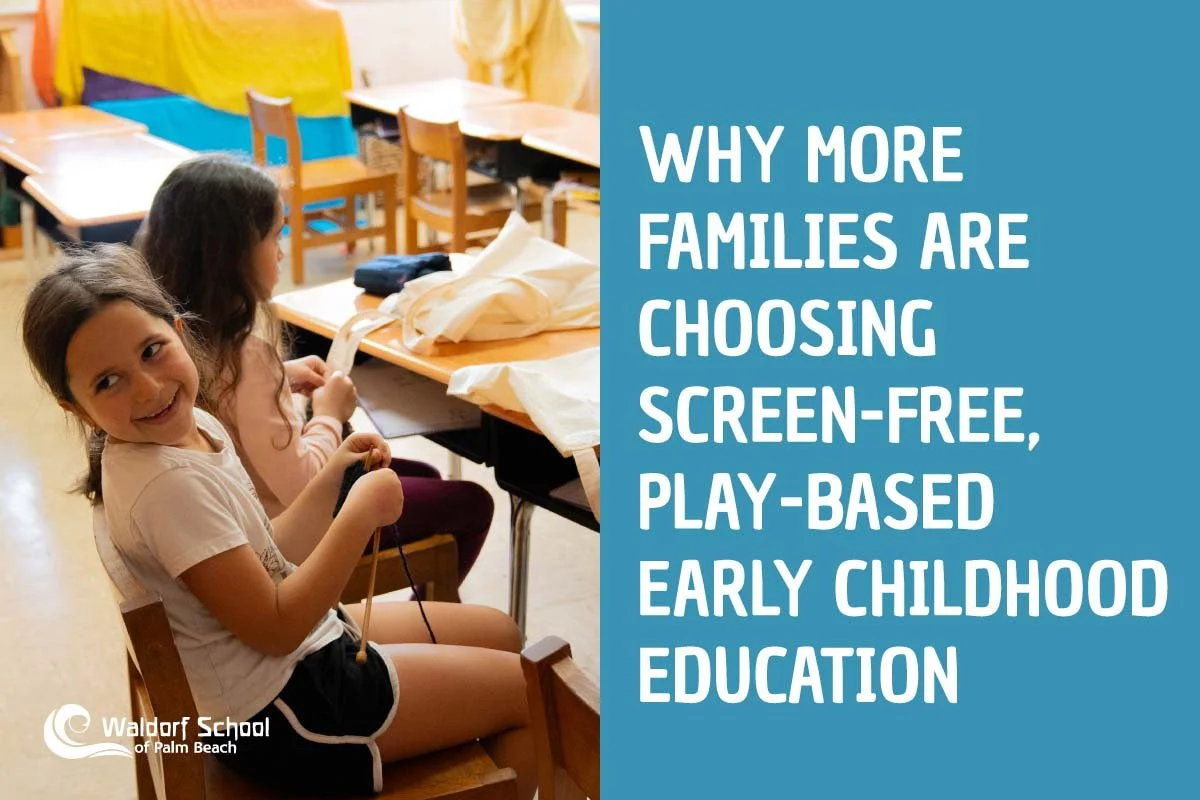
Life in South Florida moves fast. Between activities, careers, and the daily pace of Palm Beach County, most parents default to handing over a screen when they need a quiet moment. It is a reflex born from convenience, and it is quietly reshaping how a generation of children across Palm Beach County is growing up. The effects show up early, in shorter attention spans, reduced creativity, and a growing disconnection from the kind of hands-on play that actually wires a developing brain.
A growing number of local families are now choosing screen-free education as a deliberate strategy to protect their child’s development during the most critical years of brain growth.
Delaying screens helps kids build stronger creativity, deeper focus, and real-world problem-solving skills. Families exploring early childhood education in Palm Beach options are discovering that the Waldorf approach offers exactly this foundation. The data backing this shift is compelling.
Statistics on Screen-Free Education 2026
U.S. schools spent $30 billion on educational technology in 2024. A Daily Camera editorial reports that close to 90% of schools now give students a device, some as early as kindergarten. Close to two-thirds of elementary-age children spend up to four hours daily in front of a laptop. Despite this investment, learning outcomes are declining.
A World Bank report on early childhood found that the WHO recommends no more than one hour of screen time daily for children ages 2 to 5. In Malaysia, 91% of preschoolers exceed that limit. In Brazil, 69%. Even Silicon Valley executives send their children to screen-free, sensory-rich schools because they understand the value of hands-on learning. An OECD report on children and digital life confirms that excessive digital media use raises the risk of depression, anxiety, and academic struggles in young users.
These numbers paint a clear picture: screen dependency in early childhood is no longer a fringe concern. It is a documented developmental risk that families across Palm Beach County and throughout South Florida are increasingly taking seriously. For parents already questioning the role of technology in their child's earliest years, the research offers a compelling case for a different path.
What Science Says About Screens and Developing Brains
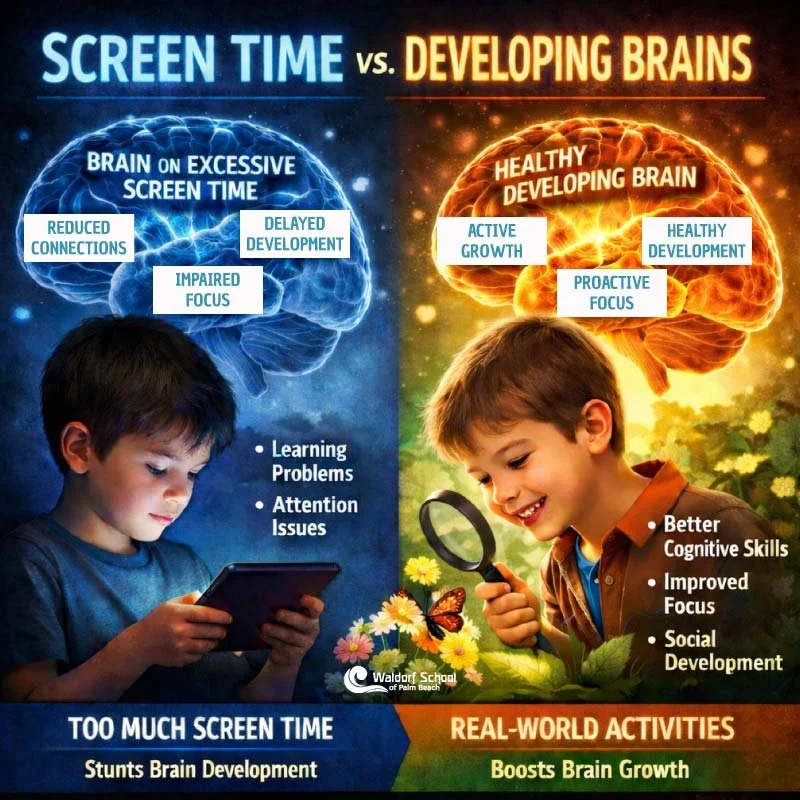
Young brains need movement, real-life sounds, and face-to-face interaction to build healthy neural wiring. During the first five years, the brain forms roughly one million neural connections per second. Those connections grow strongest through direct, sensory-rich experiences.
A meta-analysis of 42 studies with 18,905 children found a clear pattern: more screen time leads to smaller vocabularies. Children exposed to more than two hours daily are 2.3 times more likely to develop attention span problems.
Impact on Language and Focus
Face-to-face conversation builds stronger language skills than any app. When a teacher leads a circle discussion, children practice critical thinking, turn-taking, and emotional interpretation in real time. Blue light from devices suppresses approximately 88% of melatonin in preschoolers, disrupting sleep cycles essential for memory and attention spans.
A New York Times teacher survey found that 56% of educators report off-task device behavior as a major classroom distraction. For young children in the most formative window of their development, every hour spent in front of a screen is an hour not spent building the neural connections that language, focus, and emotional intelligence depend on.
The Need for Physical Movement
Movement and hands-on play support healthy brain development in early childhood. Kneading dough, climbing, and painting build spatial relationships and fine motor coordination. This tactile learning strengthens neural pathways that swiping a screen cannot replicate. Screen time reduces sensory and motor experiences, limiting the social-emotional skills and spatial awareness that families searching for a no-screen preschool in South Florida want for their children.
Why Play-Based Learning Wins the Long Game
Play is how children learn to think for themselves, navigate relationships, and stay curious. Building a fort from wooden blocks teaches engineering concepts, negotiation, and persistence. These moments build executive function more effectively than any app. Children who learn through play develop stronger critical thinking and social-emotional skills.
A study from the Institute for Family Studies highlights that phone-free school environments produce more thoughtful, diligent students who socialize actively with classmates. The evidence is consistent: children who engage actively with their environment during the early years carry those cognitive advantages well into adulthood.

The Waldorf Difference: A Day Without Distraction
A Waldorf classroom feels different the moment you walk in. Natural materials like wood, wool, and beeswax fill the space. Zero digital noise. The environment supports human connection and focused engagement. The Waldorf difference is in how children engage:
Storytelling over screens: Children develop language, imagination, and emotional intelligence through oral tradition and narrative, not passive viewing.
Art as a thinking tool: Watercolor painting, beeswax modeling, and drawing ask children to observe, interpret, and express, building creative and critical thinking faculties simultaneously.
Nature-integrated learning: Outdoor exploration and seasonal activities connect children to the living world in ways no app can replicate.
Rhythm and routine: Every day follows a predictable structure that builds security, focus, and self-regulation naturally.
Active participation: Every activity asks the child to imagine, create, and engage, replacing passive screen consumption with purposeful, hands-on learning that builds critical thinking and digital literacy readiness from the ground up.
Explore our campus to see this approach in action.
What a Typical Day Looks Like at Our Palm Beach Campus
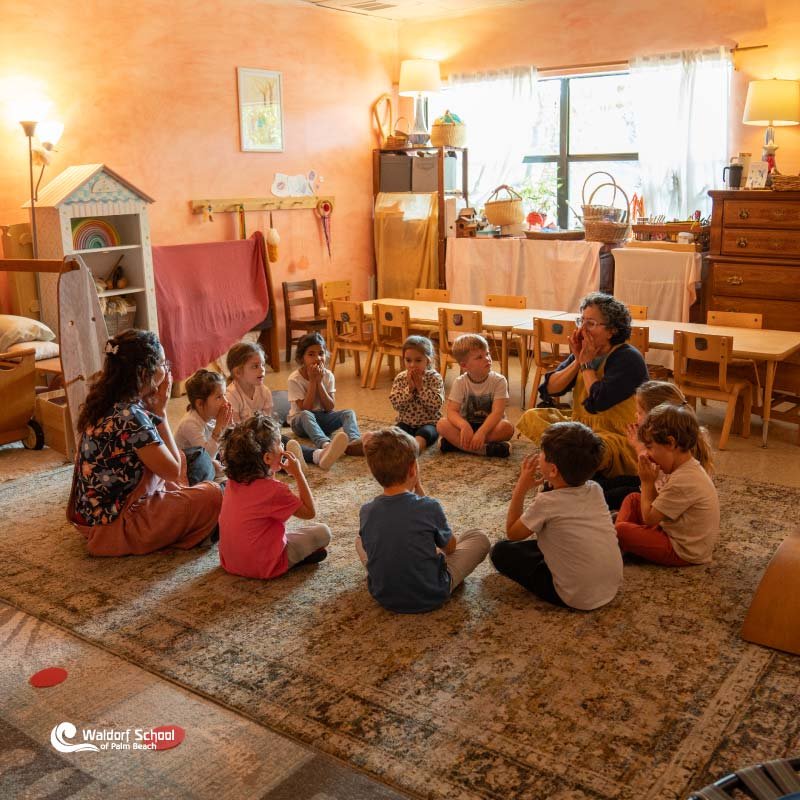
Mornings at Waldorf School of Palm Beach start with baking bread together, measuring flour, kneading dough, and learning patience. Circle time follows with songs, movement, and verses that build language and community. Then comes outdoor play in the Florida sunshine.
Each day follows a predictable rhythm that makes children feel safe and ready to learn. Focused activities like watercolor painting alternate with free play and exploration. This predictable rhythm reduces anxiety and builds the security young children need.
A Challenge Island study confirms that hands-on learning environments foster greater creativity. Learn about nursery tuition and enrollment to get started.
Making the Shift: How Parents Can Ensure a Smooth Transition
Small, consistent changes make the biggest difference. Start with making mealtimes “no-phone zones.” Swap a tablet for crayons, beeswax, and a sketchbook. The World Bank’s research on habit change offers a useful framework: a restless child (cue) triggers the tablet handoff (routine) for peace (reward). Keep the cue and reward, but change the routine. Place books on the table and devices in a drawer.
Even one screen-free meal per week creates momentum. Nature-integrated activities like gardening or a simple walk become powerful alternatives supporting social-emotional skills and human connection. You don’t need perfection. Small steps improve a child’s mood and sleep within weeks.
Is Screen-Free Education the Right Choice for Your Family?
Choosing screen-free education gives your child foundational skills, critical thinking, creativity, empathy, and resilience to lead confidently in a tech-driven future. The best preschool Palm Beach County families can choose protects childhood while building real readiness. Waldorf early childhood programs deliver this balance.
Schedule a campus tour or join an upcoming Open House to experience the Waldorf difference firsthand. Ready to protect your child’s early years? Submit an application today. Families considering the high school program will find the same intentional, screen-conscious philosophy at every level.
Frequently Asked Questions on Screen-Free Education
What is screen-free education, and how does it work?
Screen-free education removes digital devices from the classroom and replaces them with hands-on activities like storytelling, art, music, and outdoor play. Teachers guide children through tactile learning experiences designed to build critical thinking, creativity, and social-emotional skills during the early years when brain development responds most actively to direct, real-world stimulation.
Will my child fall behind in technology at a screen-free school?
Children who develop strong critical thinking and problem-solving skills through play adapt to technology faster when introduced later. Many Waldorf graduates excel in STEM fields because they built foundational cognitive abilities first.
Digital literacy comes naturally to children who already know how to think creatively, collaborate effectively, and approach complex tasks with confidence.
At what age should children start using screens for learning?
The World Health Organization recommends no screen time for children under two and no more than one hour daily for ages two to five. Waldorf schools introduce technology intentionally around middle school, after students have established strong attention spans, motor coordination, and interpersonal abilities that make digital tools genuinely useful rather than distracting.
How does a Waldorf school differ from a traditional preschool?
Waldorf classrooms use natural materials, storytelling, movement, and art instead of worksheets and devices. The curriculum follows a predictable daily rhythm that builds security and focus.
Teachers prioritize human connection and sensory-rich experiences over standardized testing, creating an environment where children develop imagination, self-regulation, and social-emotional skills through active engagement rather than passive consumption.
What are the long-term benefits of screen-free early childhood education?
Children who experience screen-free early education develop stronger executive function, better attention spans, and deeper social-emotional skills. Research links these outcomes to higher academic performance and greater adaptability in adulthood.
Play-based learning builds the cognitive flexibility and creative confidence that employers and universities increasingly value, giving graduates a measurable advantage in competitive environments.