
Experiential learning is the process of learning through direct experience and structured reflection on that experience. It is most often described through David Kolb’s four-stage cycle, in which a learner does something, reflects on what happened, draws conclusions, and applies them to the next situation.
Most people have done experiential learning without ever calling it that. The internship where the job finally made sense. The lab period where a formula stopped being a formula. The class play that taught a historical period better than the chapter on it did. People often ask, “What is experiential learning in simple terms?” The short answer is learning by doing — followed by reflecting on what you did. That second half is the part most explanations skip, and it is the part that does the work.
This guide covers the definition, Kolb’s four-stage cycle explained plainly, real examples across ages, how experiential learning differs from traditional instruction, and the part most guides leave out: what happens when experiential learning is not a single course or a semester abroad but the foundation of an entire education, beginning at age four.
That last point is worth flagging early. Most people meet experiential learning in a college internship, and nearly everything written about it assumes an adult learner. Some schools build their entire pedagogy on it from early childhood onward. Waldorf education is the oldest continuous example, and we will come back to it once the concept itself is clear.
Experiential Learning, Defined
Experiential learning is the process of learning through direct experience and reflection. Learners do something, reflect on what happened, draw conclusions, and apply those insights to the next experience — turning activity into durable understanding.
The phrase attached to this idea almost everywhere is “learning by doing,” and by itself it is incomplete. Activity is not the same as learning. A child can bake fifty muffins and come away knowing one recipe. What converts activity into understanding is reflection — the deliberate step where the learner looks back at what happened and makes meaning of it. Remove that step and you have a pleasant afternoon, not an education. This is the single most common error in how experiential learning gets described, especially in materials written for younger children, where the hands-on activity gets all the attention and the thinking afterward gets none.
Experiential educators name two goals for the process, and both matter. The first is learning the specifics of the subject itself. The second is learning about your own learning — noticing how you approach a problem, where you get stuck, what you would do differently. That second goal is why the method compounds. Each round teaches the content and sharpens the learner’s method for the next round.
To understand how this actually works, educators turn to a four-stage model developed by David Kolb.
What Does “Experiential” Mean?
“Experiential” means relating to or derived from experience. So experiential learning is, literally, learning derived from experience rather than from instruction alone. The word carries the whole definition.
One clarification, because the two get typed interchangeably: experiential learning and experimental learning are different words with different meanings. Experimental means testing a hypothesis under controlled conditions. Experiential means grounded in lived experience. Experimentation shows up inside the experiential cycle, as you are about to see, but the two terms are not substitutes for each other.
Kolb’s Experiential Learning Cycle: The Four Stages
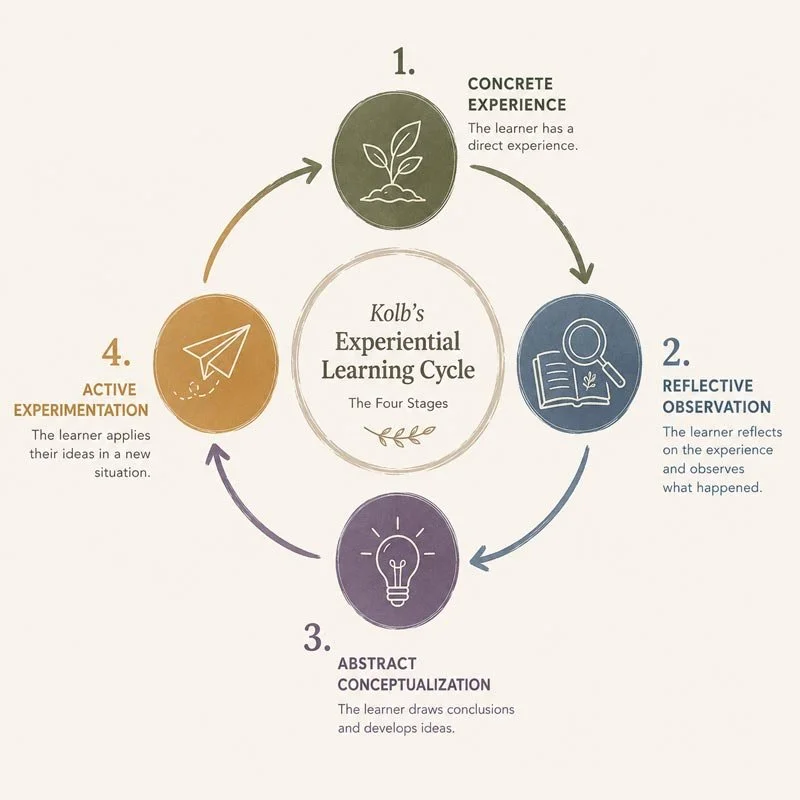
The difference between activity and learning is the cycle. David Kolb described experiential learning as four stages that repeat.
Kolb published his Experiential Learning Cycle in 1984, drawing on John Dewey, Kurt Lewin, and Jean Piaget — thinkers who had argued for decades that experience comes before understanding, not after it. According to David Kolb’s model (1984), learning is not an event but a loop, and David Kolb’s experiential learning cycle remains the standard reference for how that loop runs. The four stages are:
Concrete Experience — the learner does something directly, rather than reading or hearing about it.
Reflective Observation — the learner looks back at what happened and notices what stood out.
Abstract Conceptualization — the learner draws conclusions and forms ideas that explain the experience.
Active Experimentation — the learner tests those ideas in a new situation.
The reason it is drawn as a cycle rather than a line is that the fourth stage produces the first. You test an idea, and testing it is a new concrete experience, which starts the loop again. This is why experiential learning behaves differently over time than a one-off activity does: the understanding accumulates. A single lap teaches a lesson. Forty laps in the same subject build judgment. That distinction becomes important later, when the question is what happens if a school runs the cycle continuously for twelve years instead of one semester.
The Four Stages, Step by Step
The cycle begins with Concrete Experience. Take a single example and carry it all the way around. A class plants a garden bed in the fall. That is the concrete experience — soil, seeds, water, hands.
In spring, half the bed has thrived and half has not. Reflective Observation is the part where the children stand at the bed and say what they see: the beans climbed, the lettuce bolted, the corner nearest the wall never came up at all. Nobody has explained anything yet. They are looking.
Abstract Conceptualization is where the explanations come. The corner by the wall sits in shade for most of the day. The lettuce went to seed once the heat arrived. The children are now working with ideas — light, timing, water, soil — and those ideas came out of something they watched happen, which is why they hold.
Active Experimentation is next season. Move the lettuce earlier. Give the shaded corner something that tolerates shade. Plant, and watch again. The test is a new concrete experience, and the loop restarts one turn wiser.
Kolb also observed that people favor different stages of the cycle. Some learners want to jump straight to experimenting; others would happily stay in reflection. His work on learning styles grew out of that observation. For understanding the model itself, the useful point is that a complete education moves a learner through all four stages regardless of which one they gravitate toward.
Experiential Learning Examples (What It Actually Looks Like)
Here’s what most people don’t realize — they’ve already done experiential learning. Common examples include:
Internships and apprenticeships, where the work itself is the instruction.
Laboratory experiments, where a result has to be produced before it can be explained.
Field trips and site visits, when they carry an assignment rather than a worksheet.
Service learning, where students meet a real need and then examine what they learned from meeting it.
Simulations, mock trials, and role-play, which put a learner inside a situation instead of beside it.
Studio and performance work — rehearsing, showing, revising, showing again.
Hands-on classroom projects, from building a model to running a school store.
That list is where most guides stop, and nearly every item on it is written for someone over eighteen. Experiential learning in higher education typically means internships, co-ops, undergraduate research, and study abroad, and universities have built entire offices around delivering them. The Association for Experiential Education, the field’s professional body, frames it more broadly — as a philosophy in which educators deliberately combine direct experience with focused reflection to build knowledge and skill. Nothing in that framing requires an adult.
The childhood examples are just as real, and they are the ones the internet mostly gets wrong. A class play, where a group of ten-year-olds carries a story for six weeks. A school garden. Building a stool by hand and sitting on it. Cooking a recipe from the period a history block is covering. Form drawing, where children draw flowing geometric line patterns by hand before their handwriting settles. Seasonal festivals that a whole school prepares for and then takes part in. Each of these is a concrete experience with real stakes for the child doing it.
What makes any of them experiential learning, though, is the same thing that makes an internship experiential: the loop closes. The children who put on the play talk afterward about what the character wanted and why the ending lands the way it does. The children who built the stool notice which joint held. Search for children’s experiential learning activities and you will find hundreds of good activities and very little about the reflection that turns them into learning — which is the whole mechanism. Activity without the loop is recreation. Worth doing, but it is not what Kolb described.
Experiential Learning vs. Traditional Learning
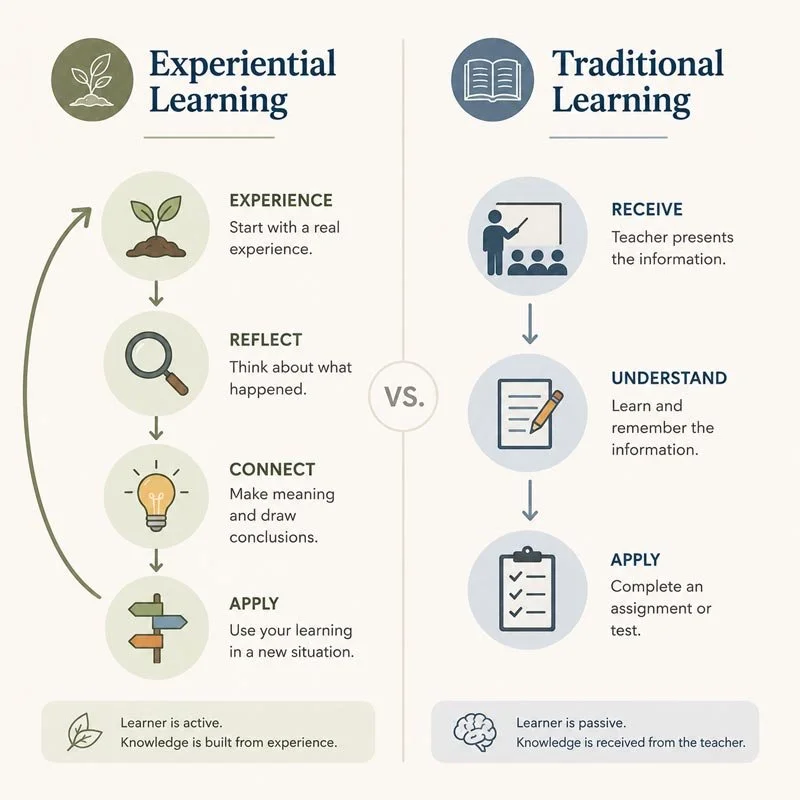
The difference between experiential and traditional learning is where knowledge starts — with the learner’s experience, not the teacher’s lecture.
Traditional instruction is not a failure, and it is worth resisting the caricature. A lecture is an efficient way to transmit a body of organized knowledge to a room full of people, and some subjects genuinely need someone to lay out the structure before a learner can do anything useful with it. The honest contrast is about sequence and role. Traditional instruction delivers the concept first and then asks the student to apply it. Experiential learning starts with the encounter and builds the concept out of it. One tests recall; the other tests application. Most good teaching uses both, and the practical question is which one comes first and which one carries the weight.
Experiential approaches are widely associated in the education literature with deeper understanding, stronger retention, and better transfer of learning to new situations — the ability to use something in a context where nobody prompts you. The reasoning behind those findings is straightforward enough: a learner who constructed an idea has a route back to it, while a learner who received one has only the memory of receiving it.
Which raises the question this article has been building toward. If starting with experience works, what happens when a school does not treat it as an enrichment add-on — a semester, a program, a field trip line item — but as the method itself, beginning in early childhood and continuing until graduation?
Experiential Learning as a Whole Education: The Waldorf Example
At the Waldorf School of Palm Beach, experiential learning isn’t a program bolted onto the curriculum — from early childhood through grade 11, it is the curriculum.
Waldorf education began in 1919, when Rudolf Steiner opened a school in Stuttgart, Germany for the children of factory workers. That is sixty-five years before Kolb published his cycle, and it puts Waldorf in the same progressive-education current that Dewey was writing in during the same decades. Waldorf did not invent experiential learning and does not own Kolb’s model; Steiner never used that vocabulary. What Waldorf did was commit an entire twelve-year curriculum to the premise that understanding follows experience — and then keep practicing it, without interruption, for more than a century. That is the tradition WSPB works in today. For readers who want the underlying ideas, the philosophy behind Waldorf education is a longer subject than this article can hold.
The clearest place to see the cycle running is the main lesson — the two-hour morning block that anchors each day, with a single subject running for three to four weeks at a time. A grade 5 botany block means five weeks of plants: growing them, drawing them, dissecting them, walking outside to find them. That is concrete experience at a scale a single class period cannot reach.
Then look at what each child produces from it. Over the block, students make a main lesson book — a handmade book combining writing, illustration, and their own account of the work, and Waldorf’s alternative to a textbook. Consider what that object actually requires. A child spends weeks inside an experience, then has to go back through it, decide what mattered, organize it, and render it in their own words and images. That is Kolb’s reflective observation and abstract conceptualization, built into a physical thing a nine-year-old holds in their hands. Most schools hope reflection happens. This one hands the child a blank book and makes it the assignment.
The same loop runs through the rest of the day in different materials. Handwork — knitting, sewing, weaving, and woodwork, taught from grade 1 onward — gives immediate, unarguable feedback: the sock either fits or it does not. Gardening runs on the seasons, so the reflection stage takes months. Eurythmy, an expressive movement art that turns speech sounds and music into visible gesture, works ideas through the body rather than the pencil, and at WSPB it sits in the weekly schedule alongside music and handwork rather than as an occasional special. In the upper grades the balance tips toward active experimentation, with independent projects and practical placements where students test what they have learned somewhere real. Across the Waldorf curriculum from early childhood through the upper grades, the sequence stays the same and only the sophistication changes.
Continuity is the part that is hard to reproduce anywhere else. A Waldorf class teacher typically stays with the same group of children for several years, which means the adult guiding the reflection knows exactly which loops that child has already been around. That is the practical shape of the whole-child Waldorf approach — head, heart, and hands, worked on together rather than in sequence. WSPB serves families across Boca Raton, Delray Beach, West Palm Beach, Boynton Beach, and Coral Springs, running this method continuously from early childhood through grade 11. Most experiential programs measure their scope in weeks.
Conclusion: Why Experiential Learning Endures
Experiential learning is learning through direct experience and reflection on that experience, structured by Kolb’s four-stage cycle. It is a loop rather than a one-off: do, reflect, conclude, test, repeat.
Three things are worth carrying away. The cycle, not the activity, is what makes learning experiential. It shows up everywhere — hospital rotations, apprenticeships, kindergarten gardens — and the age of the learner changes the content, not the mechanism. And it differs from traditional instruction mainly in sequence: experience first, concept second.
As of 2026, with schools arguing over screens, artificial intelligence, and students who can produce an answer without having understood the question, a method built on real experience and honest reflection is drawing fresh attention. The schools that have practiced it longest have the most to say about doing it well, including where it is difficult. In summary, experiential learning turns activity into understanding — and when it is the foundation of an entire education, that understanding compounds year after year.
If you are a Palm Beach County family who would rather see this than read about it, schedule a campus tour at the Waldorf School of Palm Beach in Boca Raton. Watching a main lesson unfold, and paging through a child’s main lesson book at the end of a block, explains the cycle better than any diagram of it.
Frequently Asked Questions
Q1. What is experiential learning in simple terms?
Experiential learning is learning by doing, followed by reflecting on what you did. Instead of receiving information passively, the learner has a direct experience, thinks about what happened, draws conclusions, and applies them to the next situation. It turns activity into lasting understanding.
Q2. What are the four stages of Kolb’s experiential learning cycle?
David Kolb’s cycle has four stages: Concrete Experience (doing something), Reflective Observation (reflecting on it), Abstract Conceptualization (drawing conclusions or forming ideas), and Active Experimentation (testing those ideas in a new situation). The cycle repeats, so each round of learning feeds the next. It begins with a concrete experience.
Q3. What is an example of experiential learning?
Common examples include internships, lab experiments, field trips, service projects, apprenticeships, simulations, and hands-on classroom work like tending a garden or staging a play. What makes each one experiential is the reflection step, not just the activity. The learner acts, then makes meaning from what happened.
Q4. What is the difference between experiential and traditional learning?
Traditional learning usually starts with information delivered by a teacher, then tests recall. Experiential learning starts with the learner’s own experience and builds understanding through reflection and application. The two work well together, but experiential learning is active and construction-based rather than passive.
Q5. Who created the theory of experiential learning?
The modern theory is most associated with educational theorist David A. Kolb, who published his four-stage experiential learning cycle in 1984. Kolb built on earlier thinkers including John Dewey, Kurt Lewin, and Jean Piaget. The broader idea of learning through experience, however, is ancient.
Q6. Is Waldorf education a form of experiential learning?
Yes. Waldorf education, founded by Rudolf Steiner in 1919, is built on experience-first, developmental learning — students learn through hands-on main lesson work, handwork, gardening, movement, and projects, then reflect and build on them. At the Waldorf School of Palm Beach in Boca Raton, this method runs continuously from early childhood through grade 11.
Q7. What are the benefits of experiential learning?
Experiential learning is associated with deeper understanding, stronger retention, and better transfer of skills to new situations, because learners actively construct meaning rather than memorize. It also builds problem-solving, collaboration, and self-awareness about how one learns. These benefits grow when the approach is used consistently over time.