If you have been researching schools in Palm Beach County, you have probably hit the same wall most parents hit. Waldorf, Montessori, and Reggio Emilia all sound wonderful, all sound broadly similar, and none of the descriptions tell you how a Tuesday morning actually differs between them. All three are child-centered, play-based, and holistic. All three reject rote memorization and test-first schooling. All three treat children as capable people rather than empty containers. That common ground is real, and it is the reason the three get confused.
Parents often ask, “What’s the difference between Waldorf, Montessori, and Reggio Emilia?” The short answer is that they share a philosophy of respecting the child but differ in structure, in the role of academics, and in how far up the grades they go. Scope gets treated as a footnote in most comparisons, and it deserves better. Reggio Emilia is primarily an early-childhood approach. Montessori spans early childhood into the elementary years, with secondary programs that exist but are far less common. Waldorf runs continuously from early childhood through high school. That is a factual difference in scope, not a claim about quality, and it changes what you are actually deciding.
What follows is a fair profile of each approach, an at-a-glance comparison table, an honest framework for matching an approach to your child and your family, and a concrete look at what Waldorf looks like in practice at the Waldorf School of Palm Beach in Boca Raton. If you finish this and choose Montessori, the article did its job.
What All Three Approaches Share
Before the differences, the common ground: Waldorf, Montessori, and Reggio Emilia are all child-centered, play-based, and built on respect for how children actually develop.
The shared values run deeper than the marketing overlap suggests. All three prefer intrinsic motivation to gold stars and grades. All three assume children learn by handling real things rather than by hearing about them. All three use mixed-age grouping and treat the classroom as a community with obligations, not just a room with desks. All three cast the teacher as a guide rather than a broadcaster. And all three came out of the same broad rejection of one-size-fits-all, standardized instruction.
They also share a vocabulary, which is most of why parents find them hard to tell apart. Each one talks about the whole child. Each one talks about following the child. Two of them describe the environment as a kind of teacher. Read three school websites in an evening and the language blurs into one message.
Because they share so much, the useful question is not which philosophy is best. It is which structure and which scope fit this child and this family. Those two words are where the three part ways.
The Montessori Approach, Fairly Explained
Montessori, founded by Dr. Maria Montessori, centers on the prepared environment and self-directed work with purpose-built materials. Montessori was Italy’s first woman physician, and she developed the method in the early 1900s out of close observation of children — which is why the Montessori method feels more like a designed system than a philosophy statement. It was built from what she watched children do.
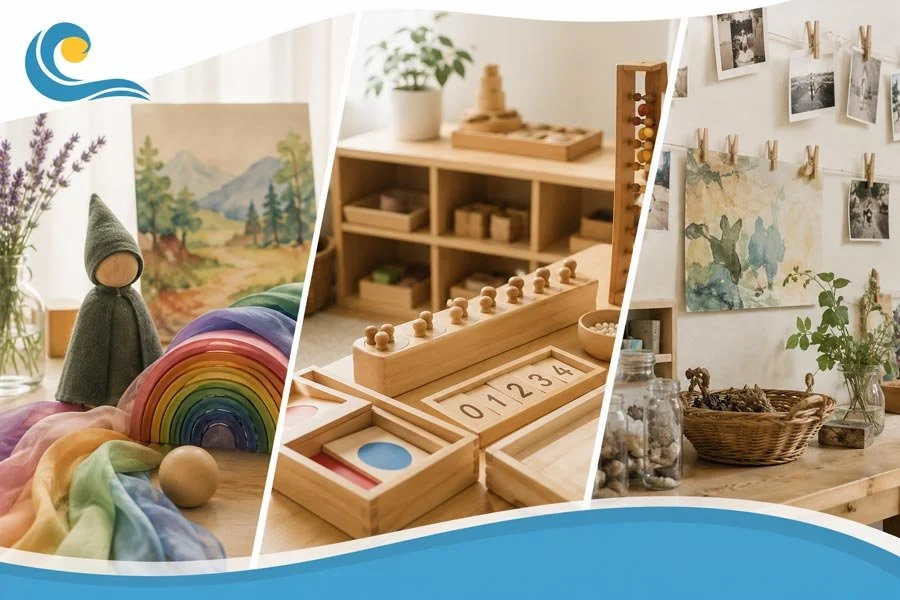
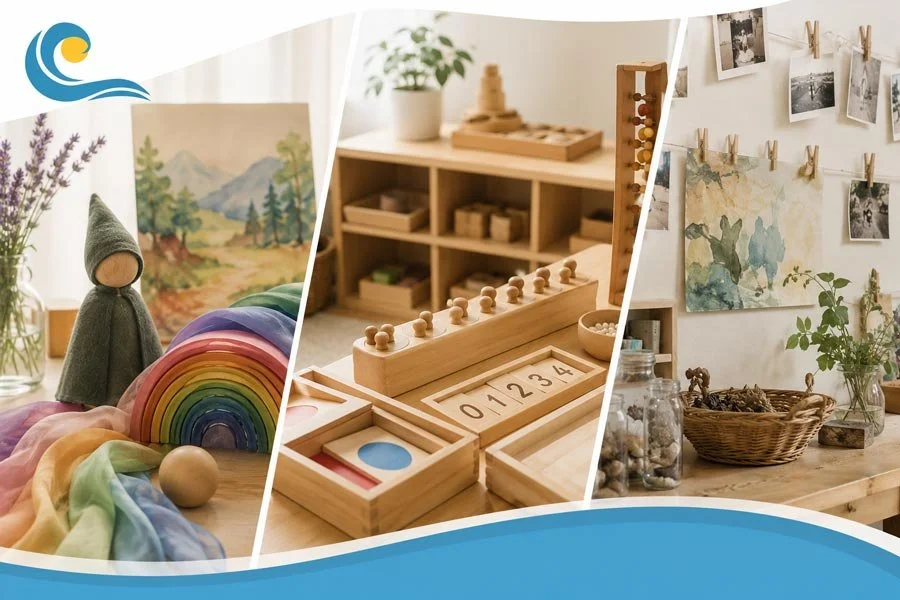
The hallmarks are specific and worth knowing. The prepared environment is a classroom arranged so a child can choose work independently, with everything within reach and in its place. The materials are didactic and largely self-correcting: the pink tower only stacks one way, so the child discovers the error without a teacher marking it. Work periods run long and uninterrupted, up to three hours, on the principle that deep concentration takes time to arrive and should not be broken by a bell. Classrooms typically span three years of age, so children learn from older peers and then teach younger ones. And the child chooses their work, within limits the teacher has set.
These are strengths. A child who wants to master something on their own terms, at their own pace, without being hurried or held back, does well in a Montessori classroom in a way they would not elsewhere.
On scope: Montessori is strongest and most widespread in early childhood and elementary. Secondary Montessori programs exist — some schools do run from infancy through high school — but they are far rarer than Montessori preschools, and in most communities a family choosing Montessori at age three is choosing for the early years. That is context for planning, not a criticism of the method.
The difference in daily feel is worth naming plainly, since this is where waldorf vs montessori comparisons go vague. Montessori centers individual work with materials, and the room is quiet, with children absorbed separately. Waldorf centers the group, with a teacher leading through story, song, and rhythm before the children move into their own work. Neither is better. They feel entirely different to be inside, and children tend to have a preference.
The Reggio Emilia Approach, Fairly Explained
Reggio Emilia, born in postwar Italy under Loris Malaguzzi, treats the child as a capable co-author of learning and the environment as a “third teacher.” The Reggio Emilia approach grew from a parent cooperative in the city of Reggio Emilia after the Second World War and became a municipal system of infant-toddler centers and preschools that now influences early-childhood education worldwide.
The hallmarks: an emergent curriculum, meaning projects grow out of what the children are interested in rather than a scope and sequence set in advance; extensive documentation, where teachers photograph, transcribe, and display the process of learning so children can revisit their own thinking; the atelier, a studio space, and the atelierista, an artist-educator working alongside the classroom teachers; collaboration between children, teachers, and families; and Malaguzzi’s idea of the hundred languages of children — that a child has many ways of thinking and expressing, and a school should honor all of them rather than privileging reading and writing.
The un-prescribed quality is a strength, not a gap. A Reggio project can follow a four-year-old’s question about shadows for two months because nobody decided in advance what week five must cover. For a curious, verbal, socially engaged child, that responsiveness is hard to beat.
Two honest points of clarification. The first answers the question most parents eventually ask about waldorf vs reggio emilia: scope. Reggio is fundamentally an early-childhood philosophy, developed for and centered on ages birth to six — infant-toddler centers and preschools. Reggio-inspired early elementary programs exist, but there is no standardized Reggio secondary program, so families who choose Reggio for the early years will be choosing again later. The second: “Reggio-inspired” is not a certification. There is no accrediting body that licenses a school to use the name, and quality varies widely between programs claiming the label. If you are touring one, ask what specifically makes it Reggio-inspired and listen for documentation and the atelier rather than for the word itself.
The Waldorf Approach: Head, Heart, and Hands
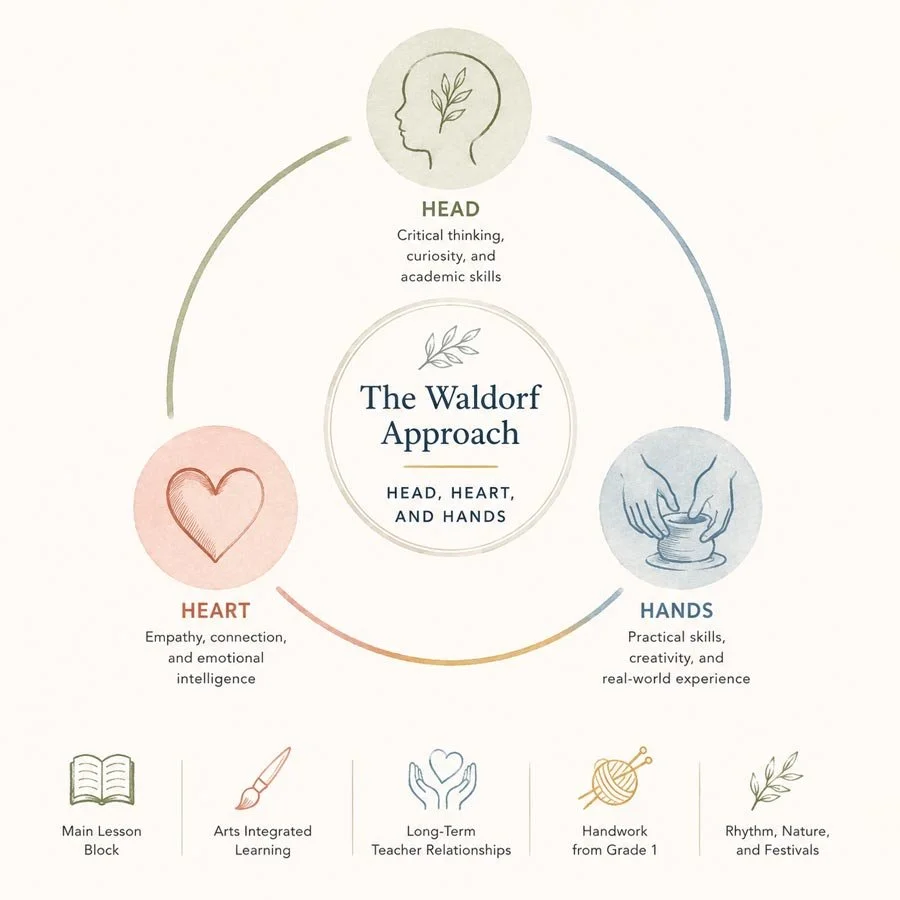
Waldorf education, founded by Rudolf Steiner in 1919, develops the whole child — head, heart, and hands — through a rhythmic, arts-integrated curriculum that unfolds with the child’s development. The first school opened in Stuttgart, Germany for the children of factory workers, and the model spread into what is now one of the largest independent school movements in the world, represented in North America by the Association of Waldorf Schools of North America.
What a parent sees on a tour day is concrete. The main lesson is the two-hour morning block that anchors each day, with one subject — botany, ancient history, geometry — running three to four weeks at a time rather than in forty-minute slices. Instead of a textbook, each child makes a main lesson book: a handmade book combining their writing, illustration, and own account of the work. A class teacher typically stays with the same group of children for several years, so the adult in the room knows each child’s history rather than their file. Arts run through every subject rather than sitting in a separate period. Handwork — knitting, sewing, weaving, and woodwork — begins in grade 1. Eurythmy, an expressive movement art that turns speech sounds and music into visible gesture, is taught alongside music and drama. Seasonal festivals mark the year. The early years are intentionally screen-light.
The point most comparisons get wrong deserves a direct answer, because it is the thing skeptical parents are really asking about, whether they frame it as waldorf vs montessori or montessori vs steiner. Waldorf introduces formal reading and math around ages six to seven. That is a developmental judgment about timing, not an indifference to academics, and the word “delayed” misleads. Reading is prepared for well before then — through story, verse, form drawing, and the fine motor work of handwork — and by the upper grades Waldorf students carry a full academic load: literature, higher mathematics, laboratory sciences, history, and a foreign language, alongside the arts. A family looking closely at the Waldorf curriculum from early childhood through the upper grades will find a sequence that starts slowly on purpose and then asks a great deal.
Scope is where Waldorf differs from the other two as a matter of fact rather than emphasis. Alone among the three, Waldorf runs as a single continuous developmental arc from early childhood through high school — through grade 11 at the Waldorf School of Palm Beach. A family is not choosing a philosophy they will have to leave behind after preschool. For readers who want the reasoning underneath the sequence, the philosophy behind Waldorf education sets out how the stages are meant to fit together.
One more thing parents run into while searching: the Waldorf-Montessori hybrid. Programs blending the two exist, usually pairing Montessori-style practical materials with Waldorf-style arts, rhythm, and imaginative play. It is worth knowing that the two rest on different foundations — Montessori on individual self-directed work with designed materials, Waldorf on a group rhythm led by a teacher through a developmental sequence — so a hybrid has to decide which principle wins when they conflict. Ask a hybrid program how they resolve that. The answer tells you what kind of school it is.

Waldorf vs. Montessori vs. Reggio Emilia: At-a-Glance Comparison
Here’s how Waldorf, Montessori, and Reggio Emilia compare across the factors parents ask about most.
| Waldorf | Montessori | Reggio Emilia | |
|---|---|---|---|
| Founder & origin | Rudolf Steiner, Stuttgart, Germany, 1919 | Dr. Maria Montessori, Rome, Italy, early 1900s | Loris Malaguzzi and local parents, Reggio Emilia, Italy, after 1945 |
| View of the child | A developing whole person, unfolding in stages of head, heart, and hands | A capable individual driven to build independence through purposeful work | A capable co-author of learning with a hundred languages of expression |
| Teacher’s role | Leads the class through story, rhythm, and demonstration; typically stays with a class for years | Prepares the environment and guides from the side; observes closely, intervenes lightly | Co-researcher alongside the children; documents and reflects learning back to them |
| Learning environment | Warm natural materials, seasonal rhythm, group-centered classroom | Ordered prepared environment with sequenced, self-correcting materials | Fluid, aesthetic space shaped by ongoing projects; an atelier for making |
| Academics & timing | Formal reading and math around ages 6–7 by developmental design; full academic load in the upper grades | Literacy and numeracy introduced earlier through hands-on materials, at each child’s pace | Emergent and project-driven; academic skills arise through investigation rather than sequence |
| Role of arts & imagination | Central: arts integrated into every subject, plus music, drama, handwork, and eurythmy | Present, though secondary to the didactic materials and practical life work | Central: expression through many media is the core of the approach |
| Technology in early years | Intentionally screen-light in the early grades | Minimal in early childhood; varies by school | Sometimes used as one more language of expression |
| Age range served | Early childhood through high school (through grade 11 at WSPB) | Early childhood through elementary; secondary programs exist but are less common | Early childhood (birth to about age six); no standardized secondary program |
| Best-fit child | Thrives on rhythm, story, making things by hand, and a long relationship with one teacher | Thrives on independence, order, and mastering concrete materials at their own pace | Thrives on open-ended investigation, conversation, and collaborative projects |
The age-range row is the one to sit with. It is no knock on Reggio or Montessori — both do what they do well within their range — but it quietly determines how many school searches you will run over the next decade.
Which Approach Is Right for Your Child?
The best approach depends less on which philosophy is “better” and more on your child’s temperament, your family’s values, and how many years you want the philosophy to last.
You might prefer Montessori if your child works best alone and resents being hurried, if they light up at mastering something concrete step by step, and if you want independence and self-direction treated as the central skill of childhood. Parents who describe their three-year-old as wanting to do it themselves, right now, without help, are describing a Montessori child.
You might prefer Reggio Emilia if your focus is the early years and you want them spent in open-ended, art-rich investigation, if your child is verbal and social and learns by talking ideas through with other children, and if you like a curriculum that follows their questions rather than a plan. It also suits families who want to be closely involved, since collaboration with parents is built into the approach.
You might prefer Waldorf if you want arts integration and imaginative play protected in the early years rather than squeezed out, if a screen-light childhood matters to you, if your child settles under predictable rhythm and thrives on story, and if you want one continuous path from early childhood through high school. The whole-child Waldorf approach also asks something of families in return — a home life that broadly matches the school’s approach to screens and pace — and it is fairer to say that up front than to let a family discover it in October.
Then there is the consideration nobody puts in a comparison chart: how many times you want to do this. Choose Reggio at three and you will be researching schools again at five or six, learning a new philosophy, and asking your child to change communities in the same year they learn to read. Choose Montessori and, depending on what your area offers, the same question can arrive at eleven or twelve. Waldorf can be one decision that carries through grade 11. Some families would rather re-evaluate at each stage, which is a legitimate preference. But the transition is a real cost, it lands on the child, and it belongs in the decision.
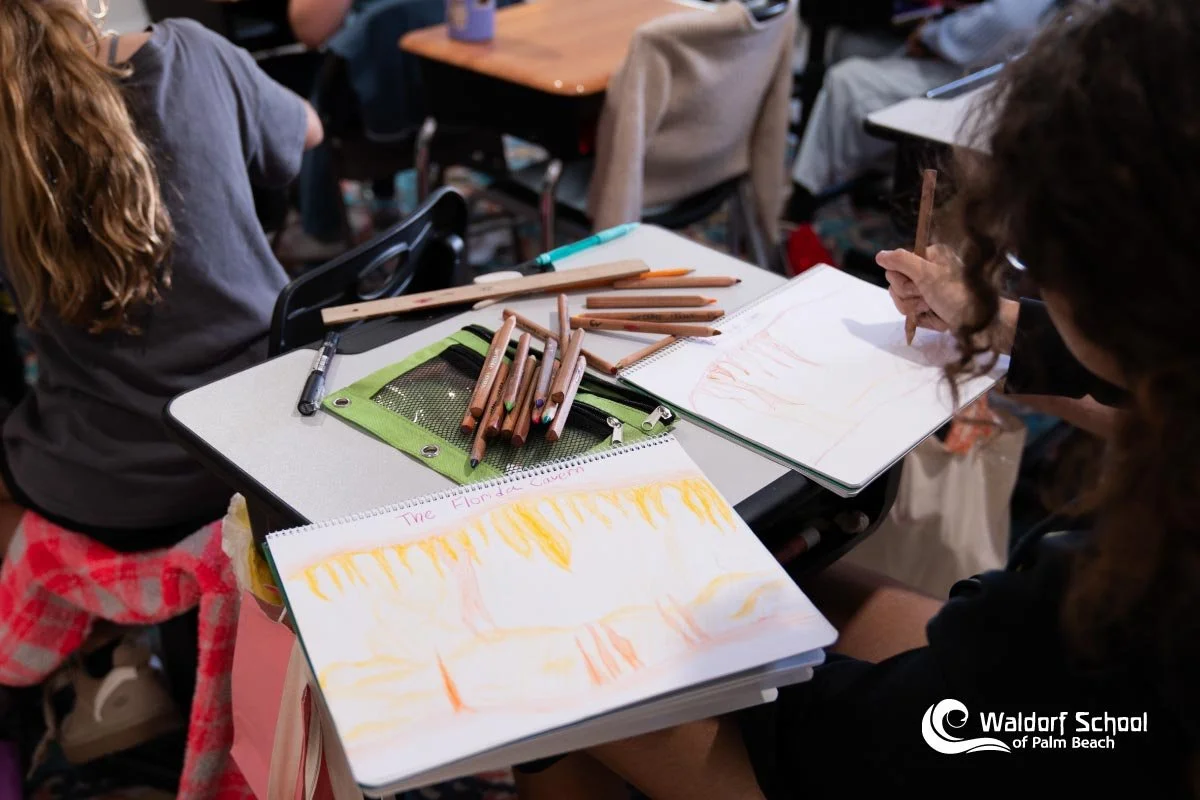
Seeing Waldorf in Practice at the Waldorf School of Palm Beach
The clearest way to understand any of these philosophies is to see one in action — at the Waldorf School of Palm Beach in Boca Raton, families can watch the Waldorf approach unfold from early childhood through grade 11.
WSPB draws families from Boca Raton, Delray Beach, West Palm Beach, Boynton Beach, and Coral Springs, which means most families here made this exact comparison before enrolling. What a tour shows is the continuity argument made concrete: a kindergarten where the day runs on rhythm and imaginative play, a grade 3 classroom in the middle of a building block, and grade 11 students working at a level that surprises parents who had heard Waldorf called academically light. Those rooms sit on one campus, running the same developmental logic at different stages.
Comparison charts take a family only so far. Seeing a main lesson, watching a eurythmy class, or visiting during a seasonal festival settles questions reading cannot. Families weighing these three approaches are welcome to schedule a campus tour and see a Waldorf classroom firsthand. If the approach resonates, this is where to watch it work; if it does not, a tour is a fast and honest way to find that out.
Conclusion: Three Good Approaches, One Continuous Path
Waldorf, Montessori, and Reggio Emilia are three strong child-centered approaches, and the right one depends on your child, your family’s values, and the scope you want. The honest differentiators are these: Montessori offers a prepared environment and independent, materials-based work. Reggio Emilia offers emergent, art-rich projects in the early years. Waldorf offers an arts-integrated, developmentally paced education that runs as one arc from early childhood through high school.
As of 2026, with academic pressure reaching further down into early childhood and screens further into family life, all three offer a humane alternative to the standardized model. In summary, the difference between Waldorf, Montessori, and Reggio Emilia comes down to structure, the role of the arts, and how many years the philosophy carries your child.
The surest way to choose is to see a classroom for yourself. Schedule a campus tour at the Waldorf School of Palm Beach in Boca Raton and watch the Waldorf approach in action from early childhood through grade 11 — then go tour a Montessori and a Reggio program too. An hour in each room will tell you more than another week of reading.
Frequently Asked Questions
Q1. What is the difference between Waldorf, Montessori, and Reggio Emilia?
All three are child-centered, play-based approaches, but they differ in structure and scope. Montessori emphasizes independent work with specialized materials in a prepared environment; Reggio Emilia follows children’s interests through emergent, art-rich projects in early childhood; and Waldorf develops the whole child through an arts-integrated, developmentally paced curriculum that runs from early childhood through high school.
Q2. What is the difference between Waldorf and Reggio Emilia?
Waldorf and Reggio Emilia both value creativity and the whole child, but Reggio is primarily an early-childhood approach built around emergent, child-led projects, while Waldorf is a continuous developmental philosophy spanning early childhood through the high school years. Waldorf also places stronger emphasis on rhythm, storytelling, and a consistent class teacher over multiple years.
Q3. Is Waldorf better than Montessori?
Neither is objectively better — they suit different children and families. Montessori tends to fit children who thrive on independent, self-directed work with structured materials, while Waldorf fits families who want arts integration, imaginative play, screen-light early years, and a single philosophy that continues through high school. The right choice depends on your child’s temperament and how many years you want the approach to last.
Q4. What age does Reggio Emilia go up to?
Reggio Emilia is fundamentally an early-childhood approach, developed for infant-toddler and preschool programs from birth to about age six, and sometimes extended into early elementary. There is no standardized Reggio secondary program, so families choosing Reggio for the early years typically transition to another approach later. Waldorf, by contrast, offers a continuous path through the upper grades.
Q5. What is a Waldorf-Montessori hybrid?
Some programs blend elements of both — for example, Montessori-style practical materials alongside Waldorf-style arts, rhythm, and imaginative play. Hybrids appeal to families drawn to features of each, though practitioners on both sides note that the two philosophies rest on different foundations. A Waldorf school follows the developmental arc Rudolf Steiner designed rather than combining methods.
Q6. Do Waldorf schools teach academics?
Yes. Waldorf schools introduce formal reading and math around ages six to seven by developmental design, then build to a rigorous academic high school. The later start is intentional, not a lack of academics, and by the upper grades Waldorf students carry full college-preparatory course loads alongside the arts.
Q7. Where can I compare these approaches in person in Palm Beach County?
The Waldorf School of Palm Beach in Boca Raton welcomes prospective families to tour campus and observe the Waldorf approach firsthand, from early childhood through grade 11. Seeing a main lesson or a seasonal festival in person is the clearest way to understand how Waldorf differs from Montessori and Reggio Emilia. WSPB serves families across Palm Beach County, including Delray Beach, West Palm Beach, and Boynton Beach, as well as Coral Springs.